What is Training? (Meaning & Definition)
Training is the act of increasing the knowledge and skills of an employee for doing a particular job. It is a planned program designed to improve performance and bring about measurable changes in knowledge, skills, attitude, and social behavior.
Key Definitions:
-
Flippo: “The act of increasing the knowledge and skills of an employee for doing a particular job.“
-
General Definition: A process of learning a sequence of programmed behavior relevant to a specific job.
Characteristics of Training:
-
Increases knowledge and skills for the job.
-
Bridges the gap between job needs and employee skills.
-
Job-oriented and vocational in nature.
-
A short-term activity designed essentially for operatives.
Training Needs Analysis (TNA)
Before training begins, the company must decide who needs training and what kind. This diagnosis is called Training Needs Analysis.
It is done at three levels:
-
Organizational Analysis: Looking at the whole company’s strategy. (e.g., “We are going digital, so everyone needs IT training”).
-
Task Analysis: Looking at the job requirements. (e.g., “What skills are needed to be a Salesman?”).
-
Individual Analysis: Looking at the person. (e.g., “Does Mr. Sharma lack communication skills?”).
Importance of Training
Why do companies spend millions on training?
-
Higher Productivity: Trained workers work faster and make fewer mistakes, increasing output.
-
Reduced Supervision: A trained employee knows their job well and needs less checking by the boss.
-
Better Safety: Proper training on machines reduces accidents in factories.
-
Boosts Morale: Employees feel valued when the company invests in them, leading to higher job satisfaction.
-
Adaptability: Helps employees keep up with changing technology (e.g., moving from paper files to computers).
Training vs. Development vs. Education
It is crucial to understand the difference between these three concepts.
| Basis |
Training |
Development |
Education |
| Focus |
Specific Skills & Job Performance |
General Knowledge & Personality |
Conceptual Learning & Understanding |
| Target Audience |
Non-managerial personnel (Operatives) |
Managerial personnel |
Students/General Public |
| Time Frame |
Short-term process |
Long-term educational process |
Lifelong/Long-term |
| Nature |
Reactive (current needs) |
Proactive (future needs) |
General & Broad |
| Purpose |
Vocational (Job-oriented) |
General Purpose (Person-oriented) |
Theory-based Knowledge |
Types of Training
Organizations use various types of training to meet different needs:
-
Skills Training: The most common type. Focuses on basic skills like reading, writing, computing, and problem-solving.
-
Refresher Training: Used to update employees on the latest developments and technologies (e.g., new software).
-
Cross-functional Training: Training employees to perform operations in areas other than their assigned job (e.g., Job Rotation).
-
Team Training: Focuses on content tasks (goals) and group processes (interaction, cooperation).
-
Creativity Training: Encourages “out of the box” thinking, brainstorming, and breaking away from restrictions.
-
Diversity Training: Creates sensitivity towards race, gender, culture, and backgrounds to foster harmonious relationships.
-
Literacy Training: Improving basic reading, writing, and arithmetic skills to improve productivity.
-
Orientation Training: Introducing new employees to the company culture and “learning the ropes.“
The Training Process (Steps)
Training is not a one-time event; it is a continuous cycle.
Step 1: Identify Training Needs
Using TNA to find the gap between “Actual Performance” and “Standard Performance.”
Step 2: Set Training Objectives
What should the employee be able to do after training? (e.g., “Type 50 words per minute”).
Step 3: Design the Program
Deciding the content, selecting the trainer (internal or external), and choosing the method (Online, Classroom, or On-the-job).
Step 4: Implementation
The actual training takes place. The trainer delivers the content to the trainees.
Step 5: Evaluation
Checking if the training worked.
Methods of Training
Training methods are classified by location:
1. On-the-Job Training Methods
“Learning while doing.” The employee learns at the actual workplace while performing the job.
Pros: Cheap, realistic, immediate feedback.
Cons: Can disrupt regular work, risk of accidents/errors during learning.
-
Job Instruction Training (JIT): A step-by-step method where the trainer shows the task, explains it, lets the trainee try, and gives feedback.
-
Coaching: The supervisor guides and instructs the trainee individually.
-
Mentoring: A senior employee (Mentor) takes a junior (Mentee) under their wing to guide their long-term career.
-
Job Rotation: Moving a trainee from one job to another ( e.g., Marketing to Sales to Finance) to give a holistic view of the company.
-
Apprenticeship: Used in trades (Electrician, Plumber) where a learner works under a master for a long period to acquire a craft.
-
Committee Assignments: Trainees work together to solve actual organizational problems.
2. Off-the-Job Training Methods
“Learning before doing.” The employee is taken away from the work floor to a separate room or hall to learn.
Pros: No distraction, no stress of real production errors.
Cons: Expensive, artificial environment (might not match reality).
- Lectures/Classroom: Traditional method for teaching theory to a large group.
-
Vestibule Training: A dummy model of the workplace is created. (e.g., A pilot training in a Flight Simulator, or a bank clerk training on a dummy computer system). Best for dangerous or expensive jobs.
-
Role Playing: Acting out realistic behaviors in imaginary situations to develop interpersonal skills.
-
Lecture Method: Traditional direct instruction to a large group. Low cost but low transfer of training.
-
Conference/Discussion: A group-centered approach where ideas and procedures are clarified.
-
Programmed Instruction: Self-paced learning through sequential units (expensive to develop).
-
E-learning: Online learning at the trainee’s own pace (requires internet and self-motivation).
-
Behaviorally Experienced Training: Business games, case studies, and sensitivity training to improve behavioral skills.

Benefits of Training
For the Organization
-
Profitability: Trained staff = More Efficiency = More Profit.
-
Standardization: Ensures everyone follows the same correct procedures.
-
Future Leaders: Prepares internal employees to take up higher positions (Succession Planning).
-
Less Wastage: Reduced scrap and damage to machinery.
For the Employee
-
Skill Growth: Increases market value and employability.
-
Promotion: Better performance leads to faster career growth.
-
Confidence: Knowing the job well reduces stress and increases confidence.
-
Higher Earnings: Skilled workers can demand higher salaries.
Approaches & Techniques of Job Design
Job Design is the process of deciding the contents of a job. It involves determining the duties, responsibilities, and the methods of doing the work. Proper job design contributes significantly to employee satisfaction and productivity.
It is the process of deciding:
-
What tasks are to be done?
-
How are the tasks to be done?
-
How much authority is given?
-
Who will do it?
Objective: To integrate the needs of the organization (Productivity) with the needs of the individual (Job Satisfaction/Motivation).
If you have doubt in above topic you can prefer watching this video. (LINK)
Techniques to Improve Job Design
To make jobs interesting and efficient, HR managers use specific techniques. The three most popular ones are Rotation, Enlargement, and Enrichment.
-
Job Rotation:
-
Concept: Systematically moving employees from one job to another. Ex; Job A today, Job B next month, and Job C later.
-
Benefit: Relieves boredom, broadens the employee’s perspective, and increases workforce flexibility.
-
Drawback: Can be expensive and disruptive if done too frequently.
-
Job Enlargement:
-
Job Enrichment:
-
Concept: Giving the employee the power to plan, execute, and evaluate their own work.
-
Benefit: Increases motivation and job satisfaction by giving employees a sense of ownership and achievement.
- Example: A marketing executive is not just told to sell; they are allowed to design their own ad campaign and set their own targets.
-
Work Simplification:
-
What is it? Breaking down jobs into smaller, simpler tasks.
-
Benefit: Increases efficiency for repetitive tasks but can lead to boredom.
What is Job Analysis?
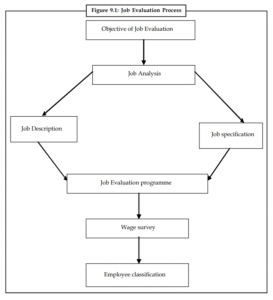
Job Analysis is the systematic process of collecting and studying information about the operations and responsibilities of a specific job.
It is the “Fundamental Tool” of HRM because almost every HR activity (Recruitment, Training, Performance Appraisal) depends on the data gathered during Job Analysis.
Definition:
“Job Analysis is the process of studying and collecting information relating to the operations and responsibilities of a specific job.” — Edwin B. Flippo
The Process Answers:
-
What is the job title?
-
What are the tasks?
-
What machines/tools are used?
-
What qualifications are needed?
-
What are the working conditions (Heat, noise, risk)?
Components of Job Analysis
Job Analysis results in two key documents: Job Description and Job Specification.
1. Job Description (JD) – “The Job”
A written statement that describes the tasks, duties, and responsibilities (TDRs) of a job. It focuses on what needs to be done.
-
Focus: The Job itself.
-
Contents:
-
Job Title & Location.
-
Job Summary.
-
Duties & Responsibilities.
-
Machines/Tools used.
-
Working Conditions (e.g., Night shifts, Hazardous).
-
Reporting relationships (Who is the boss?).
2. Job Specification (JS) – “The Person”
A written statement that describes the minimum qualifications, traits, and skills required to perform the job effectively. It focuses on who should do it.
Difference: Job Description vs. Job Specification
| Basis |
Job Description (JD) |
Job Specification (JS) |
| Meaning |
A statement of the duties and responsibilities of a specific job. |
A statement of the human qualifications required to do the job. |
| Focus |
Focuses on the JOB. |
Focuses on the PERSON. |
| Question |
Answers “What is the job?” |
Answers “Who is fit for the job?” |
| Components |
Tasks, Duties, Conditions, Hierarchy. |
Education, Experience, Skills, Traits. |
| Outcome |
It is an immediate product of Job Analysis. |
It is derived from the Job Description. |
| Example |
“Manage sales team and generate reports.” |
“MBA in Marketing with 5 years experience.” |
Career Planning & Development
Career Planning is the process by which an individual selects career goals and the path to achieve them. It matches personal goals with the opportunities available in the organization.
Need for Career Planning:
-
Employees desire growth and clear career paths.
-
Without it, frustration leads to high turnover and loss of key talent.
-
It aligns employee aspirations with organizational needs.
The Career Planning Process
-
Identify Individual Needs: Help employees understand their aspirations and skills.
-
Analyze Opportunities: The organization outlines career paths and progression possibilities.
-
Align Needs & Opportunities: Match employee potential with organizational charts.
-
Action Plans: Undertake development programs to bridge gaps and review periodically.
Succession Planning
Succession Planning is the process of ensuring a suitable supply of successors for key senior jobs. It protects the organization from a leadership vacuum.
-
Purpose: To identify and develop people to replace current job holders in key positions.
-
Replacement Charts: Visual representations of who will replace whom. They show details of key executives and their potential successors.
-
Difference from Career Planning: Succession planning focuses on key positions (mostly top level), while Career Planning covers all employees and their individual growth.
Steps in Career Development System
Career development is the lifelong process of managing your career. Key steps for individuals include:
-
Performance: Delivering excellent results is the foundation.
-
Exposure: Becoming known by decision-makers.
-
Networking: Building professional contacts inside and outside the firm.
-
Mentors & Sponsors: Finding senior guides who offer advice and create opportunities.
-
Expand Ability: Acquiring new degrees and skills proactively.
To learn how job roles are valued after designing them, please read Job Evaluation: Concept & Methods. Click here to read the full article.