Management is the art of getting things done through people. While managers deal with finance, operations, and information, the Human Resource (HR) is the only “living” resource.
Human Resource Management (HRM) is the process of acquiring, developing, maintaining, and retaining competent workforce to achieve the goals of an organization effectively and efficiently. It brings people and organizations together so that the goals of each are met.
According to Leon C. Megginson, HR is:
“The total knowledge, skill, creative abilities, talents and aptitudes of an organization’s workforce, as well as the values, attitudes and beliefs of the individuals involved.”
Objectives of HRM
The primary goal of HRM is to ensure the organization has a competent and motivated workforce.
Advisory Role: Advising management on HR policies to ensure a highly motivated and high-performing workforce.
Talent Management: Attracting, hiring, rewarding, maintaining, and developing the human resources of the organization.
Crisis Management: Handling difficult human relations situations to ensure organizational stability.
Communication Link: Acting as a bridge between the workforce and management.
Custodian of Values: Maintaining organizational standards and ethics regarding the treatment of employees.
Functions of HRM
HRM functions are broadly divided into Line and Staff roles.
Line Function: Directing the activities of people in their own department. The HR manager exerts line authority within the HR department.
Coordinative Function: Ensuring that line managers (like production or sales managers) are implementing HR policies (e.g., sexual harassment policies).
Staff (Service) Function: Assisting and advising line managers. This is the main function. Examples include:
Recruiting and hiring.
Training and developing employees.
Administering compensation and benefits.
Ensuring compliance with labor laws.
Handling grievances and labor relations.
Evolution of HRM (The 6 Stages)
Though HRM seems modern, its roots go back to 1800 BC (Code of Hammurabi). The evolution can be traced through six key stages:
Stage I: Pre-Industrial Era (1400-1700 AD): No formal HR. End of feudalism led to a free employment relationship. Skilled craftsmen and merchants emerged.
Stage II: Industrial Revolution (1700-1900 AD): The rise of the Factory System. Machines replaced human effort. Workers were treated as a “commodity” to be bought cheaply. Focus was on production, not people.
Stage III: Scientific Management & Welfare Work (1900-1935 AD):
Scientific Management (F.W. Taylor): Focus on efficiency, time studies, and training. Treated workers somewhat mechanically but stressed proper selection.
Welfare Work: Voluntary efforts by employers to improve working conditions (to avoid unions).
Industrial Psychology: Applying psychology to increase efficiency and well-being.
Stage IV: Golden Age of Industrial Relations (1935-1970): After the Great Depression and WWII, unions grew powerful. The focus shifted to Collective Bargaining and industrial relations. Governments passed labor laws to protect workers.
Stage V: Control of Labour Tradition (1970-1990): Trade unions began to decline due to political fragmentation and the government taking over welfare functions. The workforce composition changed to younger, educated employees who viewed unions as service agencies rather than a movement.
Stage VI: Professional Tradition (1990 – Present): HRM became a professional discipline requiring specialized education (MBA/HR). The focus shifted from “personnel management” to Strategic HRM—aligning HR with business goals.
Difference Between Personnel Management & HRM
The shift from Personnel Management (PM) to Human Resource Management (HRM) represents a change in philosophy.
Feature
Personnel Management (PM)
Human Resource Management (HRM)
Focus
Employee maintenance and administration.
Employee development and asset management.
Nature
Routine, administrative function.
Strategic, continuous function.
Philosophy
Managing people as a tool/cost.
Managing people as a valuable resource/asset.
Function
Independent function.
Integrated with corporate strategy.
Orientation
Rules and regulations oriented.
Performance and culture oriented.
Policies, Principles & Strategy
Personnel Policies: These are guides to thinking and action. They provide a roadmap for managers (e.g., “We promote from within first”). Policies ensure uniformity, better control, and confidence among employees.
HR Principles: These are fundamental truths or laws (e.g., principle of fair remuneration). They are universally applicable and guide the formulation of policies.
Strategic HRM: This is the modern approach. It links HRM with strategic goals to improve business performance. It views employees as a source of competitive advantage.
Traditional HR: Reacts to problems.
Strategic HR: Proactively designs policies to help the company win.
How HRM Contributes to Success
HRM is the “life-giving element” of an organization. Without it, resources like money and machinery are useless.
Growth Instrument: It ensures competence and effective management, crucial for survival.
Liaison: It balances the needs of employees with the goals of the employer.
Professional Field: It moves focus from simple management to development, handling skill-building and capacity utilization to meet modern challenges.
Sales Promotion refers to short-term incentives designed to encourage the purchase or sale of a product or service. It includes all marketing activities—other than personal selling, advertising, and publicity—that stimulate consumer purchasing and dealer effectiveness.
While advertising offers a reason to buy, sales promotion offers an incentive to buy now.
Key Definitions:
Philip Kotler: “Sales Promotion encompasses all the tools in the marketing mix whose major role is persuasive communication.”
American Marketing Association: “Those marketing activities, other than personal selling, advertising and publicity that stimulate consumer purchasing and dealer effectiveness, such as displays, shows and exhibitions, demonstrations and various non-recurrent selling efforts not in the ordinary routine.”
Objectives of Sales Promotion
Sales promotion is used to achieve five major objectives:
Building Product Awareness: It exposes customers to products for the first time (e.g., free samples) and helps capture customer information for future marketing.
Creating Interest: An appealing promotion can significantly increase customer traffic to retail outlets or websites. Allowing customers to experience a product for free creates interest.
Providing Information: Offering free trials or online services helps move the customer to action by providing necessary product information.
Stimulating Demand: Lowering the cost of ownership (e.g., discounts) stimulates sales by convincing customers to make a purchase.
Reinforcing the Brand: Rewards for “preferred” customers (like loyalty points) encourage additional purchases and strengthen the brand relationship.
What are Main Tools of Sales Promotion?
Sales promotion methods are broadly divided into two categories:
1. Consumer Promotion Methods
These are designed to encourage the final consumer to buy the product.
Free Samples: Distributing small amounts of the product for free to induce trial.
Discount Coupons: Certificates that give buyers a saving when they purchase a specific product.
Free Gifts: Offering a free item with the purchase of a product (e.g., “Buy a TV, get a pendrive free”).
Price Reduction: Selling products at a reduced price for a limited time (e.g., “50% Off”).
Contests & Competitions: Giving consumers a chance to win something (cash, trips) by luck or extra effort.
Demonstrations: Showing how a product works at retail stores or door-to-door to prove its value.
Money Back Guarantee: Promising to return the customer’s money if the product doesn’t meet standards, building trust.
After-Sale Service: Offering free maintenance or repairs for a certain period.
2. Dealer (Trade) Promotion Methods
These are designed to encourage dealers and distributors to stock and sell more of the manufacturer’s product.
Advertisement Allowance: Money or materials (posters, signboards) given to dealers to help them advertise the product.
Quantity Discount: Offering price breaks to dealers who buy in large quantities.
Incentives to Salesmen: Prizes or bonuses for dealer sales staff who meet specific targets.
Credit Policy: Allowing dealers to buy goods on credit for a certain period.
Meetings & Seminars: Organizing events to discuss problems and solutions with dealers.
Training: Teaching the dealer’s sales force how to sell the product effectively.
What are Importance of Sales Promotion?
For Manufacturers:
Creates demand for new products.
Increases sales volume, leading to large-scale production and lower costs.
Helps face competition successfully.
For Middlemen (Dealers):
Increases their sales and profits.
Increases their goodwill.
Supplements the work of their own salesmen.
For Consumers:
Provides knowledge of new products.
Offers goods at reduced prices.
Improves standard of living through trials of new items.
What is Advertising?
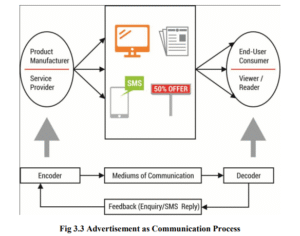
Advertising is any paid form of non-personal presentation and promotion of ideas, goods, or services by an identified sponsor. It is a powerful communication tool intended to inform, persuade, and remind the target audience.
Key Definitions:
American Marketing Association: “Any paid form of non-personal presentation and promotion of ideas, goods or services by business firms identified in the advertising message intended to lead to a sale immediately or eventually.”
William J. Stanton: “Advertising consists of all the activities involved in presenting to a group a non-personal oral or visual, openly sponsored message regarding a product, service or idea.”
What are Objectives of Advertising?
To Inform: Telling the market about a new product, explaining how it works, suggesting new uses, or informing about price changes.
To Persuade: Building brand preference, encouraging customers to switch to your brand, and persuading them to purchase now.
To Remind: Keeping the product in the customer’s mind during off-seasons and reminding them where to buy it.
Media of Advertising
The “medium” is the vehicle used to carry the message to the audience.
Press Advertising:
Newspapers: Wide circulation, flexible, and timely. Can be local, state, or national.
Magazines: Better quality reproduction, longer life, and targeted audiences.
Outdoor (Mural) Advertising: Posters, hoardings, and electric signs. Used to remind consumers of the product while they are out of their homes.
Direct Mail Advertising: Sending a personal message in writing through the post directly to selected persons.
Other Media:
Radio & TV: Popular for mass appeal. TV combines audio and visual effects for high impact.
Cinema: Slides or films played in theaters.
Digital/Internet: Social media, websites, and apps (fastest growing medium).
Fairs & Exhibitions: Displaying goods to a large number of visitors.
How to Create an Advertisement?
Creating a winning ad requires thinking like an “advertising guru.” Key factors include:
Title & Tagline: A unique product name and an eye-catching slogan (e.g., “Just Do It”) that grabs attention.
Remarkable Design: Layout, pictures, and special effects must be appealing.
USP (Unique Selling Point): Highlight the specific features that make your product a “killer competitor.”
Emotional Connection: Understand consumer psychology—sell “dreams,” comfort, and safety, not just a product.
Target Audience (KYC): Know who you are talking to. Use language and cultural references (Cross-Cultural Intelligence) that resonate with them.
Brand Ambassador: Using celebrities (like film stars or athletes) can increase appeal.
Comparative Advertisement
This involves comparing your product directly or indirectly with a competitor.
Pros: Helpful for customer decision-making, offers variety, and effective for new ventures challenging established brands.
Cons: Must be legal, accurate, and objective. Vague comparisons can damage your brand. “Sell your products, don’t just sell yourself.”
The Advertising Agency
An Advertising Agency is a service business dedicated to creating, planning, and handling advertising for its clients.
Key Tasks of an Agency:
Account Management: Liaising with the client to understand their goals and budget.
Creative Production: Designing the ad (layout, copy, special effects).
Media Planning: Deciding where to run the ad (TV, Print, Digital) to reach the target customer most effectively.
Research: Studying the market and customer to ensure the ad hits the mark.
Agencies can be Full-Service (doing everything), Creative Boutiques (focusing only on design), or Media Buying Agencies (focusing on purchasing ad space).
Marketing Research is the formal process of generating information to help marketing managers make better decisions.
Unlike a Marketing Information System (MIS), which manages the flow of data, Marketing Research is conducted to address a specific problem or opportunity. It is used to identify consumer needs, define market segments, measure the effectiveness of promotions, and develop new products.
According to the American Marketing Association (AMA):
“Marketing Research is the function which links the consumer, customer, and public to the marketer through information.”
The 3 Rs of Marketing Research
David G. Bakken suggests that research helps in three key areas:
Recruiting new customers.
Retaining current customers.
Regaining lost customers.
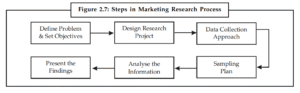
🔄 The 6-Step Marketing Research Process
Conducting research is a systematic journey. While every project is different, most follow this 6-step framework.
Getty Images
Step 1: Define the Problem & Set Objectives
This is the most critical step. A problem well-defined is half solved.
Problem Definition: Uncovering the nature and boundaries of the situation (e.g., “Why has our market share in men’s jeans slipped by 10%?”).
Research Objectives: Defining exactly what information is needed to solve the problem (e.g., “Who are our customers?”, “How are we perceived compared to competitors?”).
Step 2: Design the Research Project
This involves specifying the methods for gathering and analyzing data. To ensure accuracy, the research must be Valid (measures what it’s supposed to measure) and Reliable (gives similar results if repeated).
There are three main categories of research design:
Exploratory Research: Used when the problem is vague. It aims to discover the general nature of the problem. (Sources: Secondary data, expert interviews).
Descriptive Research: Used when the problem is clearly defined. It describes market characteristics or functions (e.g., “How many people visit McDonald’s weekly?”).
Causal (Experimental) Research: Used to prove a cause-and-effect relationship (e.g., “Will changing the package color increase sales?”). It involves experiments in a lab or the field.
Step 3: Data Collection Approach
Researchers must decide where to get the data.
Secondary Data: Information that already exists (e.g., company records, published reports, internet). It is cheaper and faster but may be outdated.
Primary Data: New information collected specifically for the current project.
Methods for Collecting Primary Data:
Observation: Watching how people behave (e.g., in a store).
Survey: Asking people questions (most common method).
Experiment: Testing variables to see the effect.
Step 4: Sampling Plan
You cannot survey everyone. You must select a Sample (a limited number of units) to represent the whole Population (Universe).
Key Decisions:
Sampling Unit: Who is to be surveyed?
Sample Size: How many people? (Larger samples are more reliable but expensive).
Sampling Procedure: How do we choose them?
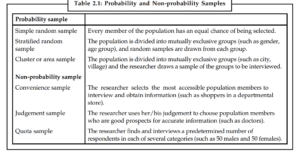
Types of Sampling:
Probability Sampling (Random): Every member has a known and equal chance of being selected. (e.g., Simple Random Sample, Stratified Sample). This is the most accurate.
Non-Probability Sampling: Based on the researcher’s judgment or convenience. (e.g., Convenience Sample, Quota Sample). It is easier and cheaper but less reliable.
Step 5: Analyze the Information
Raw data is useless on its own. The researcher must tabulate and analyze it to find meaningful insights.
Tools: Frequency counts, percentages, averages (mean/median/mode), standard deviation, and advanced statistical tools (regression analysis).
Goal: To interpret the data and accept or reject the hypothesis.
Step 6: Present the Findings
The final step is to present the results to the decision-makers in a formal report.
Executive Summary: A brief overview for senior managers who may not read the full report.
Clear Language: Avoid complex statistical jargon. Explain the findings simply so managers can use them to make decisions.
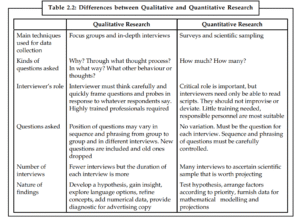
Qualitative vs. Quantitative Research
Feature
Qualitative Research
Quantitative Research
Main Techniques
Focus groups, In-depth interviews
Surveys, Scientific sampling
Questions Asked
“Why?”, “In what way?” (Open-ended)
“How much?”, “How many?” (Closed-ended)
Sample Size
Fewer interviews, longer duration
Many interviews, shorter duration
Goal
To gain insight, develop a hypothesis
To test a hypothesis, get numerical data
Nature of Findings
Explore language, refine concepts
Numerical data, projections
Summary: Why is Marketing Research Important?
It reduces uncertainty in decision-making.
It helps identify new market opportunities.
It allows companies to monitor their performance and customer satisfaction.
It provides the data needed for financial planning and economic forecasting.
We’re constantly updating this page with the latest notes for every Student. Bookmark this page so you can easily find lu notes again, all in one place!
Found a mistake or have a suggestion? We work hard to ensure all notes are 100% accurate. If you spot an error, find a missing subject, or have a request, please [click here to let us know]!
In the modern market, competition is rarely about the product itself; it is about the “augmented” product. As Prof. Theodore Levitt noted nearly 45 years ago, the new competition is about what companies add to their factory output in the form of packaging, services, advertising, and things people value.
A Brand is defined as a name, term, sign, symbol, or design (or a combination of them) intended to identify the goods and services of one seller and differentiate them from the competition.
However, a brand is much more than a tag. It is a contract with the consumer regarding performance. It builds a bond of faith and trust, eliminating search costs and risks for the buyer.
1. Brand Identity vs. Brand Image
It is crucial for students to distinguish between how a brand is seen internally versus externally.
A. Brand Identity (The Insider’s Concept)
Brand identity refers to the brand strategist’s vision. It is a unique set of brand associations that the company aspires to create or maintain. It represents what the brand stands for and implies a promise to customers.
Jean-Noel Kapferer identified six dimensions of Brand Identity (The Brand Identity Prism):
Physique: The tangible, physical aspects (features, logo, packaging). Example: IBM’s physique includes desktops and servers.
Personality: The brand character (using adjectives like “rugged,” “youthful,” or “sophisticated”). Example: Boost is energetic; Bajaj Pulsar is “Definitely Male.”
Culture: The values and principles the brand reflects. Example: Apple symbolizes simplicity and innovation; Mercedes symbolizes German engineering efficiency.
Relationship: The transaction and exchange between the brand and customer. Example: Nike’s “Just Do It” encourages the user to win; Apple conveys friendliness.
Reflection: The image of the target consumer that the brand projects. Example: Pepsi reflects young, carefree, fun-loving people.
Self-Image: How the customer perceives themselves when using the brand. Example: A Nike user sees their inner athlete.
B. Brand Image (The Outsider’s Concept)
Brand Image is the sum total of impressions created by the brand in the consumer’s mind. It encompasses physical characteristics, functional benefits, and symbolic meanings.
Types of Brand Associations:
Hard Associations: Perceptions of tangible attributes like speed, fuel economy, or sturdiness.
Soft Associations: Emotional perceptions. Example: Indian Airlines may be associated with dullness or inefficiency, while Bajaj Pulsar is associated with excitement.
The Three Elements of Brand Image (Alexander L. Biel):
Image of Provider: The reputation of the manufacturer. An inappropriate corporate image can hurt a good product. Example: Apple is seen as creative/cool; DCM is seen as old/dull.
Image of Product: The functional characteristics and technology. Example: Laundry detergents are driven by rationality, while perfumes are driven by emotion.
Image of User: Who uses the product? Example: The image of Raymond Suitings is “The Complete Man.”
2. Brand Equity (The Value of the Brand)
Brand Equity is the value a brand adds to a product. It explains why a product with a brand name can command a higher price and loyalty than an identical unbranded product.
Definitions:
David Aaker: “Brands have equity because they have high awareness, many loyal consumers, a high reputation for perceived quality, and proprietary assets.”
Kevin Lane Keller: “Brand equity is the marketing effects uniquely attributed to the brand. It is when certain outcomes result because of the brand name that would not occur otherwise.”
The 5 Dimensions of Customer-Based Brand Equity: (By Lasser, Mittal, and Sharma)
Performance: Is the product fault-free and durable?
Social Image: Does the brand hold esteem within the customer’s social group?
Value: The ratio between the cost and the perceived delivered value.
Trustworthiness: Does the customer have faith in the brand’s quality and the people behind it?
Identification: Does the customer feel emotionally attached to the brand? (Does it match their self-concept?)
3. Types of Brands
Marketers have several options when deciding the ownership of a brand.
Manufacturer Brands (National Brands):
Initiated by producers.
The initiator controls distribution, pricing, and promotion.
Focus: Building brand loyalty and corporate image.
Private Brands (Store/House Brands):
Initiated by resellers (wholesalers or retailers).
The manufacturer is not identified on the product.
Example: Shoppers’ Stop brands.
Trend: Gaining popularity in India as large retail chains grow (e.g., Reliance Retail).
Licensed Brands:
A company allows approved manufacturers to use its trademark for a royalty fee (2% – 10% of revenue).
Example: P&G licensed the ‘Camay’ soap brand to Godrej in India for a period.
Risk: The licensor loses control over manufacturing, which may hurt the brand reputation.
Generic Brands:
Products that indicate only the product category (e.g., “Aluminium Foil” or “Paracetamol”).
They are usually sold at lower prices than branded versions.
4. Branding Strategies (Detailed)
Companies grow by adding products. They must decide how to name them. Here are the six generic strategies:
1. Product Branding Strategy (One Product, One Brand)
The company assigns a unique name to every product. The brand reflects its own personality and does not take on company associations.
Philosophy: “Singularity.” Create the perception that there is no product quite like this one.
Example:P&G (Tide, Ariel, Pantene, Vicks, Old Spice) and HUL (Lux, Dove, Liril, Lifebuoy). Even though Ariel and Tide are both detergents by P&G, they have separate identities.
Advantage: You can cover different market segments without confusion. If one brand fails, it doesn’t hurt the company’s reputation.
Disadvantage: Extremely expensive to build a new brand from scratch ($5 million – $50 million).
2. Line Branding Strategy
Products share a common concept. The brand starts with one product and extends to complementary products that “surround” the core need.
Example:Lakmé (Core concept: Beauty). The brand extends to lipsticks, winter lotions, and face wash because they all complement the core concept of beauty. Park Avenue (Core concept: The upwardly mobile man).
Advantage: Stronger brand identity; promotion of the main brand helps all items in the line.
3. Range Branding Strategy (Brand Extension)
Different product categories share the same brand name because they fall under the company’s “Area of Expertise.”
Difference from Line Branding: In Line Branding, products complement each other (lipstick + makeup remover). In Range Branding, products might not complement each other, but they share a domain.
Example:Maggi (Noodles, Sauces, Soups, Dosa mixes). The area of expertise is “Fast Food.” Himalaya (Ayurvedic concepts).
Advantage: One brand banner covers many products, lowering promotional costs.
Risk: Overstretching may confuse consumers.
4. Umbrella Branding Strategy (Mega Branding)
The company name is the brand name for all products across diverse, unrelated categories. This is common in Eastern companies (Japan, Korea).
Example:Samsung, Sony, Tata, Amul, Philips, GE.
Advantage: Very economical. Transfers the goodwill of the company to new products instantly.
Disadvantage: Not market-focused. A failure in one category (e.g., a faulty toaster) can tarnish the image of another category (e.g., medical equipment).
5. Double Branding Strategy
Combining the company name AND a product brand name. Both are given equal status.
Why? The product gains trust from the company name (Bajaj) and excitement/differentiation from the product name (Pulsar – “Definitely Male”).
Limitation: Works best when the product is consistent with the company’s expertise.
6. Endorsement Branding Strategy
A variation of double branding where the Product Brand dominates, and the Company Name takes a back seat, acting only as a seal of quality (endorsement).
Example:Kit-Kat (endorsed by Nestlé), Cinthol (endorsed by Godrej).
Advantage: The brand gets freedom to have its own distinct image (fun, youthful) while assuring the customer of the manufacturer’s quality.
5. Packaging and Trade Marks
Packaging
Packaging includes all activities focused on the development of a container and a graphic design for a product. It is often called the “Silent Salesman.”
Functions: It protects the product, identifies the brand, offers convenience to the user, and acts as a promotional tool on the shelf.
Trade Marks
A trademark is a brand, brand name, brand mark, or trade character that has been given legal protection. It protects the seller’s exclusive rights to use that brand name or mark, preventing competitors from copying it.
In the world of marketing, the “Product” is the engine that pulls the rest of the marketing program. It is the most critical element of the marketing mix because if the product fails to deliver value, no amount of clever pricing or promotion can save it.
This comprehensive article covers the entire journey of a product: from its policy and planning to its development and eventual life cycle in the market.
What is a Product? (Concepts & Levels)
A Product is anything that can be offered to a market to satisfy a want or a need. It is not just a tangible object; it includes services, events, persons, places, organizations, and even ideas.
According to Philip Kotler:
“A product is anything, tangible or intangible, which can be offered to a market for attention, acquisition, use, or consumption that might satisfy a need or want.”
The 5 Levels of a Product (Customer Value Hierarchy)
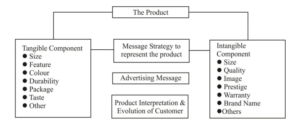
To understand what a customer truly buys, marketers analyze a product on five levels:
Core Benefit: The fundamental service or benefit that the customer is really buying. (e.g., For an Air Conditioner, the core benefit is “Cooling and Comfort”).
Generic Product: The basic version of the product that performs the function. (e.g., The AC machine itself with basic components).
Expected Product: The set of attributes and conditions buyers normally expect when they purchase this product. (e.g., Remote control, warranty, quiet operation, cooling speeds).
Augmented Product: Additional features, benefits, or services that exceed customer expectations and set the product apart from competitors. (e.g., Free installation, 24/7 customer support, smart-home connectivity). Competition mostly happens at this level.
Potential Product: All the possible augmentations and transformations the product might undergo in the future. (e.g., An AC that runs on solar power, purifies air like a tree, and is completely silent).
What is Product Policy Decisions? (Nature & Scope)
Before a single product is made, top management must set the ground rules. This is called Product Policy.
Product Policy refers to the broad guidelines and rules set by top management that determine the nature, volume, and timing of the products a company offers. It acts as a compass for all product-related decisions, ensuring they align with the company’s long-term goals.
Nature of Product Policy:
Strategic Guide: It is a long-term strategic plan, not a short-term tactic.
Top Management Function: Critical decisions (like entering a new market or dropping a product line) are taken by the Board of Directors.
Focus: It balances maximizing customer satisfaction with ensuring profitability and growth.
Objectives of Product Policy:
Survival: To keep the company viable in a competitive market.
Growth: To increase sales volume and market share over the long run.
Flexibility: To remain adaptable to changing customer needs and technology.
Resource Utilization: To optimize the use of production capacity, finance, and marketing networks.
Scope of Product Policy (What it covers):
Product Mix Decisions: Broadening or narrowing the product mix.
Product Line Decisions: Stretching or filling the product line.
Product Differentiation: How to distinguish the product (branding, packaging).
Product Innovation: Policies regarding R&D for new products.
Product Mix (Product Assortment)
Most companies do not sell just a single product. They sell a variety of goods to satisfy different market needs. The total set of all products and items that a particular seller offers for sale is called the Product Mix, also known as Product Assortment.
To understand this concept, let’s look at two real-world examples: Patanjali and Nestlé.
Real-World Examples
1. Patanjali Ayurved: Patanjali does not just sell toothpaste. Its “Product Mix” is massive.
It sells Personal Care (Dant Kanti, Soaps, Shampoos).
It sells Food Products (Atta, Ghee, Biscuits, Noodles).
It sells Home Care (Dishwash bar, Detergents).
It sells Medicines (Ayurvedic supplements).
2. Nestlé India: Nestlé is a classic example of a deep and wide product mix.
A product mix is defined by four dimensions: Width, Length, Depth, and Consistency.
1. Product Mix Width (Breadth)
This refers to the number of different product lines the company carries.
Example: Patanjali has a wide mix because it deals in Medicine, Cosmetics, Grocery, and Garments (Paridhan).
Strategy: Companies increase width to diversify risk and capitalize on their brand reputation.
2. Product Mix Length
This refers to the total number of items in the mix. It is the sum of all the products within all the lines.
Example: If Nestlé has 5 milk products, 5 beverages, and 10 chocolates, the “Length” of its mix is 20.
3. Product Mix Depth
This refers to the number of versions offered of each product in the line. It includes different sizes, flavors, and formulations.
Example:Maggi Noodles comes in Masala, Chicken, Atta, Oats, and varied pack sizes (single pack, family pack). This variety represents the depth of the Maggi line.
4. Product Mix Consistency
This refers to how closely related the various product lines are in end-use, production requirements, or distribution channels.
Example:Amul has high consistency because almost all its products (Milk, Butter, Cheese, Ice Cream) are dairy-based and use a cold-chain distribution network.
Example:Samsung has lower consistency because it sells everything from Smartphones (Consumer Electronics) to Heavy Ships and Insurance.
Product Line Decisions
A Product Line is a group of products that are closely related because they function in a similar manner, are sold to the same customer groups, or fall within given price ranges. Product managers must constantly decide whether to expand or cut their product lines.
1. Line Stretching
This occurs when a company lengthens its product line beyond its current range. This can be done in three ways:
Downward Stretch: A company located at the upper end of the market introduces a lower-priced line.
Reason: To plug a market hole that would otherwise attract a new competitor or to respond to an attack on the high end.
Example:Mercedes-Benz introducing the A-Class (a smaller, cheaper car) to compete in the lower-luxury segment.
Risk: It might cheapen the brand image.
Upward Stretch: Companies at the lower end of the market may enter the higher end.
Reason: Higher margins and faster growth rates at the top.
Example:Maruti Suzuki, known for budget cars (Alto, WagonR), launched the Nexa channel to sell premium cars like the Ciaz and Grand Vitara.
Risk: Customers may not believe the “budget” brand can produce “premium” quality.
Both-Way Stretch: Companies in the middle range may decide to stretch their line in both directions.
Example:Titan Watches sells Sonata for the budget segment and Nebula (gold watches) for the luxury segment, while keeping Titan in the middle.
2. Line Filling
This involves adding more items within the existing range of the product line.
Reason: To reach for incremental profits, satisfy dealers who complain about missing items, utilize excess capacity, or keep out competitors.
Risk: If overdone, it results in “cannibalization” (new products eating the sales of old ones) and customer confusion.
3. Line Pruning
The opposite of stretching. This involves cutting down the number of items in the product line.
Reason: When products are dead weight (unprofitable) or when production capacity is short.
Example:P&G significantly pruned its “Head & Shoulders” shampoo line from 31 items down to 15 to reduce complexity and focus on best-sellers.
New Product Development (NPD) Process
Innovation is key to survival. However, new products have a high failure rate. To minimize risk, companies follow a systematic New Product Development (NPD) process.
The 7 Stages of NPD:
Idea Generation: The systematic search for new product ideas. Sources include internal employees, customers, competitors, and distributors.
Idea Screening: Filtering the ideas to spot good ones and drop poor ones as soon as possible. (e.g., Is it feasible? Is there a market?).
Concept Development & Testing: A “product idea” is a possible product; a “product concept” is a detailed version of the idea stated in meaningful consumer terms. This concept is then tested with a group of target consumers to gauge their reaction.
Business Analysis: A review of the sales, costs, and profit projections for a new product to find out whether they satisfy the company’s objectives.
Product Development: Turning the product concept into a physical product (prototype) to ensure the idea is workable and safe. This involves R&D and engineering.
Test Marketing: Introducing the product and marketing program into realistic market settings (a few select cities) to test consumer response before a full-blown launch.
Commercialization: The full-scale launch of the product into the market. This involves high costs for advertising and distribution.
The Product Life Cycle (PLC)
The Product Life Cycle (PLC) is a concept that describes the stages a product goes through from when it was first thought of until it finally is removed from the market.
According to Philip Kotler:
“The PLC is an attempt to recognize distinct stages in the sales history of the product… corresponding to these stages are distinct opportunities and problems with respect to marketing strategy and profit potential.”
!
Shutterstock
Explore
The PLC typically has four stages: Introduction, Growth, Maturity, and Decline.
Stage 1: Introduction Stage
This starts when the new product is first launched.
Sales: Low and slow. It takes time for the product to roll out to markets and for dealers to stock it.
Profits: Negative or low. Distribution and promotion expenses are at their highest.
Competition: Low. Few or no competitors.
Marketing Objective: Create product awareness and trial.
Strategic Decisions in Introduction:
Rapid Skimming Strategy: Launching at a High Price with High Promotion. (Example: Apple iPhone launches).
Slow Skimming Strategy: Launching at a High Price with Low Promotion. Used when the market size is limited and competition is not expected soon.
Rapid Penetration Strategy: Launching at a Low Price with High Promotion. Used to capture a large market share quickly in a price-sensitive market. (Example: Reliance Jio launch).
Slow Penetration Strategy: Launching at a Low Price with Low Promotion. Used when the market is price sensitive but not promotion sensitive.
Stage 2: Growth Stage
If the new product satisfies the market, it enters the growth stage.
Sales: Climb rapidly. Early adopters continue buying, and more consumers follow.
Profits: Increase rapidly as promotion costs are spread over a larger volume and unit manufacturing costs fall.
Competition: New competitors enter, attracted by the opportunities for profit. They introduce new product features.
Strategies for Growth:
Product Improvement: Improve quality and add new product features or styling.
New Models: Add new models and flanker products (different sizes, flavors) to protect the main product.
New Segments: Enter new market segments.
New Channels: Enter new distribution channels (e.g., moving from online-only to retail stores).
Shift in Advertising: Shift from building product awareness to building product conviction and purchase.
Price Cuts: Lower prices slightly to attract the next layer of price-sensitive buyers.
Stage 3: Maturity Stage
This is the longest stage for most products. Sales growth slows down or plateaus.
Sales: Peak sales. The market is saturated (most people who want the product already have it).
Profits: Begin to decline. Competition is fierce, leading to price wars and increased advertising spending to defend market share.
Competition: Intense. Weak competitors drop out.
Strategies for Maturity:
Market Modification: Try to increase consumption by finding new users or new segments (e.g., Johnson & Johnson marketing baby oil to adults).
Product Modification: Change characteristics such as quality, features, or style to attract new users (e.g., Car manufacturers launching “facelift” versions of existing models).
Marketing Mix Modification:
Price: Cut prices to match competitors.
Distribution: Seek more outlets.
Promotion: Use aggressive sales promotion (contests, discounts).
Stage 4: Decline Stage
The sales of most product forms and brands eventually dip. This can happen slowly (oatmeal) or rapidly (VHS tapes).
Sales: Declining.
Profits: Eroding.
Reason for Decline: Technological advances (CDs replacing Cassettes), shifts in consumer tastes, or increased competition.
Strategies for Decline:
Maintain: Continue hoping that competitors will leave the industry. (Example: P&G remained in the liquid soap business while others withdrew, eventually making good profits).
Harvest: Reduce various costs (R&D, advertising, sales force) and hope that sales hold up. This is also called “milking the brand.”
Divest: Drop the product from the line. Sell it to another firm or liquidate it.
Example Case Study:
Introduction: 3G Mobile Phones (High price, low awareness initially).
Growth: 4G Smartphones (Rapid adoption, many competitors like Samsung, Apple, Xiaomi).
Maturity: Laptops (Everyone has one, competition is on price and minor features).
Decline: Landline Telephones / Typewriters (Replaced by newer tech.
Product Improvement & Diversification
Companies cannot rely on one product forever. They must improve existing products and find new markets.
Product Improvement
This is the process of making meaningful changes to an existing product to satisfy customers better or combat competition. Unlike NPD, this focuses on upgrading what you already have.
Why Improve Products?
To extend the Product Life Cycle (especially during the Maturity stage).
To create a “new” talking point for advertising (e.g., “New and Improved Formula”).
To fix customer complaints or defects.
3 Main Strategies for Product Improvement:
Quality Improvement: Increasing the durability, reliability, or speed. (e.g., A smartphone using stronger glass).
Feature Improvement: Adding new functions that make the product more versatile or safe. (e.g., WhatsApp adding “Delete for Everyone”).
Style/Aesthetic Improvement: Changing the look, feel, or color without changing functional performance. (e.g., A car facelift with new headlights).
Product Diversification
Diversification is a growth strategy where a company enters a new market with a new product. It is high-risk but high-reward.
Types of Diversification:
Concentric Diversification: Adding new products that are related to existing products (technology/marketing). Example: A shoe company starting a line of socks.
Horizontal Diversification: Adding new products that are unrelated to current products but appeal to the same customer group. Example: A gym selling protein shakes.
Conglomerate Diversification: Adding new products that are totally unrelated to current products and markets. Example: Tata Group moving from Steel to Salt to Software.
We’re constantly updating this page with the latest notes for every Student. Bookmark this page so you can easily find lu notes again, all in one place!
Found a mistake or have a suggestion? We work hard to ensure all notes are 100% accurate. If you spot an error, find a missing subject, or have a request, please [click here to let us know]! (You can link this text to your contact page or WhatsApp).
In marketing, the consumer is king. Understanding why, when, and how consumers buy is the most critical task for any marketing manager. Consumer Behavior is the study of the acts of individuals involved in obtaining and using goods and services, including the decision-making processes that precede and follow these acts.
The goal is to answer the ultimate question: Why does a consumer buy?
1. Types of Consumer Markets
Consumer markets can be categorized based on the products they sell:
Fast-Moving Consumer Goods (FMCG): Low value, high volume, and fast repurchase (e.g., Soaps, Juices, Chocolates).
Consumer Durables: High value, low volume, and used for a long time (e.g., TV, Fridge, Gaming Consoles).
Soft Goods: Similar to durables but wear out faster (e.g., Clothes, Shoes).
Markets can also be classified by Area (Local, National, International), Time (Short/Long period), and Competition (Perfect, Imperfect).
2. Types of Customers in the Market
Not all customers behave the same way. Based on purchase habits, we can identify five types:
Loyal Customers: They buy the same brand repeatedly. Marketers must communicate with them regularly to keep them happy, as they are likely to recommend the brand to others.
Discount Customers: They buy based on price or sales. They help turnover inventory but can increase costs due to higher return rates.
Impulse Customers: They make purchase decisions at the moment of buying (e.g., picking up a candy bar at checkout). They are a great source of insight.
Need-Based Customers: They buy only to fulfill a specific need. If they don’t find what they need, they leave immediately. They are harder to please but are the greatest source of long-term growth.
Wandering Customers: They make up the largest traffic in a retail store but the smallest percentage of sales. They visit stores more for the experience or location than to buy.
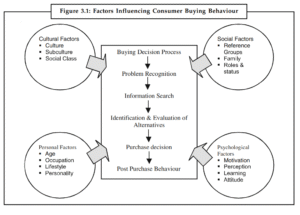
The Consumer Buying Decision Process (5 Stages)
A consumer goes through a specific journey before making a purchase.
Credit : Shutterstock
Stage 1: Need Recognition & Problem Awareness
The process starts when a consumer realizes a gap between their current state and their desired state.
Internal Stimuli: Hunger, thirst, or basic needs.
External Stimuli: Seeing an ad, smelling food, or admiring a friend’s new car.
Marketer’s Job: Identify the drive (motive) and arrange cues to trigger this need.
Stage 2: Information Search
Once the need is aroused, the consumer looks for information.
Internal Search: Memory and past experiences.
External Search:
Personal Sources: Family, friends (Most effective).
Experiential Sources: Handling or examining the product.
Stage 3: Evaluation of Alternatives
The consumer compares different brands based on product attributes (price, quality, features).
Cognitive Evaluation: Based on logic and objective criteria.
Affective Evaluation: Based on emotions and feelings.
Stage 4: Purchase Decision
The consumer forms an intention to buy. However, two factors can still interfere:
Attitude of Others: (e.g., a spouse disapproving of the purchase).
Unanticipated Situational Factors: (e.g., sudden job loss or the store is out of stock).
Stage 5: Post-Purchase Behavior
After buying, the consumer compares the product’s performance to their expectations.
Performance < Expectations: Dissatisfaction.
Performance = Expectations: Satisfaction.
Performance > Expectations: Delight.
Note: If a consumer is dissatisfied, they may return to Stage 1 but will likely exclude the brand they just bought from future choices.
Factors Influencing Consumer Behavior
A consumer’s decision is never made in isolation. It is influenced by four major factors.
1. Cultural Factors (The Broadest Influence)
Culture: The set of basic values, perceptions, and behaviors learned from family and society. (e.g., Indian culture values family and savings; American culture values individualism and consumerism).
Sub-Culture: Smaller groups with shared value systems (e.g., Punjabi vs. South Indian culture).
Social Class: Society’s ordered divisions (Upper, Middle, Lower) whose members share similar values and behaviors.
2. Social Factors
Reference Groups: Groups that influence a person’s behavior (e.g., friends, co-workers). Marketers try to target “Opinion Leaders” within these groups.
Family: The most important consumer buying organization in society. Buying roles are changing (e.g., children influencing car purchases).
Roles & Status: A person plays different roles (e.g., a father vs. a CEO). Each role carries a status that influences clothing, car, and lifestyle choices.
3. Personal Factors
Age & Life Cycle Stage: Tastes change with age. A bachelor’s spending differs vastly from a “Full Nest” family with young children.
Occupation: A blue-collar worker buys work clothes; a CEO buys suits.
Lifestyle: A person’s pattern of living as expressed in their AIO (Activities, Interests, Opinions).
Economic Situation: Income, savings, and borrowing power affect product choice.
4. Psychological Factors
Motivation: A need becomes a motive when it is strong enough to drive action.
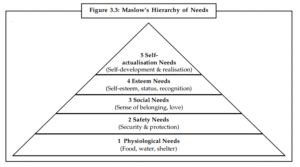
Maslow’s Hierarchy of Needs: Explains that people satisfy needs in a specific order: Physiological -> Safety -> Social -> Esteem -> Self-Actualization.
Shutterstock
Perception: How we select and interpret information. (e.g., If you perceive a brand as “premium,” you act accordingly).
Learning: Changes in behavior arising from experience.
Beliefs & Attitudes: Descriptive thoughts (beliefs) and enduring evaluations (attitudes) about brands. These are hard to change.
Summary: Why Study Consumer Behavior?
To segment the market effectively.
To design a better marketing mix (Product, Price, Place, Promotion).
To assess new market opportunities.
Ultimately, because The Consumer is King. Ignoring their preferences leads to failure.