Top 5 CV Writing Skills for Perfect Resumes & Cover Letters
For Every Corporate professional or student the transition from campus to corporate begins with one crucial document: the Job Application. This is your offer of service. It is not just a piece of paper; it is a tool to persuade an employer that you are the perfect fit for the job.
Here is a complete Article on how to craft a Job Ready Resume and Cover Letter, based on professional communication standards.
1. The Basics of Resume Writing
A Resume (or Curriculum Vitae/CV) is a written statement of your personal history. It includes your biographical details, education, work experience, and achievements.
The 10-Second Rule: Did you know that due to the high volume of applicants, recruiters often spend only about 10 seconds reviewing a resume? This means your resume must be “dynamite”—it needs to grab attention immediately.
Key Principles:
-
Self-Introduction: It is a tool to promote yourself.
-
Credibility: It supports the claims you make in your cover letter.
-
Employer-Focused: Don’t just list what you have done; focus on what you can do for the employer.
-
Specialized: Never send the exact same resume for every job. Modify it to highlight the specific skills the job requires it increases your chances if getting shortlisted.
2. How to write a Perfect Resume
To ensure your resume is readable, professional and best organize it under these headings:
A. Heading (Important contact details)
Include your full name, address, telephone number, and email id. (be specific short nothing irrelevant)
B. Objective
State a clear, practical objective. (Short mainly why you want to join the company and you are going to benefit the company)
-
Avoid vague or ambiguous phrases like: “i am thinking to join that particular position…..”
-
Instead, be specific: Mention the position that suits your education and experience and tell them with confidence that you want to join the company.
C. Education (Most important section for a fresher)
List your qualifications in reverse chronological order (most recent degree first).
-
Include degrees (MBA/BBA/ or any filed its better to have a relevant degree but if you don’t have its okay but you should out perform other when it comes to skills).
-
Include special certificate programs (From good companies) or academic achievements.
-
List specializations and Grade Point Averages (CGPA) Percentage or find whats your Countries Norms.
D. Work Experience (For people who have already worked in a company )
Most important, try to be relevant to the field which you are applying to, List your experience in reverse chronological order (latest job which you done first).
-
Format: Job Title, Company Name, Place, Duration.
-
Action Words: Describe your role using forceful words like Achieved, Coordinated, Supervised, Developed or you can also use STAR Method.
-
Performance or what outcome you got from it: Don’t just list duties mention how well you performed them (STAR Method will help you in that).
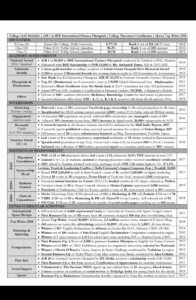
I have below attached a sample CV format followed in the IIMs which are top colleges for business studies in India. also you can look at the discussions around it Click here.
E. Awards & Achievements
-
Freshers: List scholarships, school awards, and prizes to show merit it academic awards.
-
Experienced: Mention successful projects handled, targets achieved, or new techniques developed or Mainly how you used the pre-extential skills which you have to make the organization achieve its goal.
F. Activities and Skills
Mention hobbies or activities that helped you acquire specific skills (e.g., ‘Captain of school kabaddi team or head boy for school’ shows leadership). Mention computer skills and languages known here.
Mistake to avoid:
Make sure it should be most relevant one don’t mention school achievements until and unless its so big and try to fully avoid it if you already have many don’t fill it just for the sake your resume look dense.
G. References
List 2-3 people who know you professionally and can verify your facts.
(its better to have people who gives you recommendations cause it increases your chances of getting your resume shortlisted but if you don’t have references, try to get those or learn how to get referrals from here or just use learn to use LinkedIn.
3. What are some dos and don’t for Covering Letter?
A resume is almost always accompanied by a Covering Letter. This letter must create a strong desire in the employer to meet you.
Formatting “Dos”:
-
Use good quality paper.
-
Use a formal salutation (e.g., ” Mr. Singh”).
-
Include a complimentary close (e.g., “Sincerely”).
-
Mention that the resume is enclosed.
-
Do not use a letterhead.
Writing Techniques for getting shortlisted?
-
Be Positive: Show confidence, but do not appear arrogant.
-
Show Knowledge: Demonstrate that you know about the company and the specific job requirements.
-
Be Specific: Prove that your capabilities match their requirements how you are going to surf that particular role.
-
The Opening: Use the first paragraph to capture attention and to hook.
-
The Closing: Use the ending to request an interview and follow ups.
4. How to Avoid Typos, Boast, and Bravado?
A major part of CV writing is knowing what NOT to do. Your document must be professional and honest.
-
Avoid Typos (Errors): Employers overlook applications with errors. Proofread carefully. Check for spelling and grammar. Ask a friend to read it before you send it you can also tell him to read yours and you read his resume.
-
Avoid Boast and Bravado:
-
Do not use unnecessary flattery regarding the company no (cause who knows that HR loved his company or not or soon going to leave as soon as he gets a good offer).
-
Avoid negative remarks about yourself or previous employers (Gives a very bad image for you).
-
Be Honest: The key to a successful letter is basic honesty. Do not paint your life events as “rosier” than they truly are (Cause you could be fresher its okay now to know everything and hiring manager them selves understand that its better to be honest).
-
Tone: Keep the tone polite, respectful, and straightforward. Do not be demanding or quarrel with the imployer that you were correct .
-
5. How to Follow-Up?
If you have sent your resume but haven’t heard back within two weeks, it is time to follow up. This shows eagerness and interest, not desperation. (if they don’t reply you who cares they already didn’t when you applied for job.)
Methods for follow ups:
-
by Email: Keep it short. Re-state your interest and key qualifications. Check for spelling errors make it short and crisp.
-
by Phone:
-
Make a short script of what you want to say and what you want to know or what were which you were lacking in cv or in skills.
-
Keep your resume in front of you for reference.
-
Call from a quiet place now on random road with car honks be professional.
-
Be prepared for a short “screening interview” on the spot.
-
Always thank the manager for their time and the feedback which they have you.
-
Conclusion: Whether it is the CV, the cover letter, or the follow-up, the goal is to present yourself as a valuable asset. Time and care put into these documents now will pay off in your future career and Remember for a corporate professional a single piece of paper can decide your future .
Enjoyed reading the article make sure to read 5 Proven Job Interview Strategies for Cracking your Dream Job
By Lunotes.in – crafted with love. ❤️