STP: Segmentation, Targeting & Positioning Strategies
Introduction to the STP Model
In the early days of business, companies practiced Mass Marketing—selling the same product to everyone (e.g., Henry Ford selling only black Model T cars). But today, customers are different. You cannot sell a Ferrari to a college student, and you cannot sell a skateboard to a senior citizen.
To succeed, modern marketers use the STP Model. It is a three-step process to identify your best customers and sell to them effectively.
Segmentation: “Divide the market.” (Slice the cake).
Targeting: “Choose the best group.” (Pick the biggest/tastiest slice).
Positioning: “Create a unique image.” (Put a cherry on top so they want your slice).
1. Market Segmentation
Concept and Meaning
Market Segmentation is the process of dividing a large, heterogeneous (mixed) market into smaller, homogeneous (similar) groups of customers who have similar needs, characteristics, or behaviors.
Why Segment?
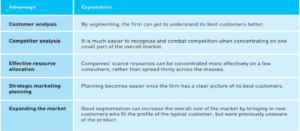
Resource Optimization: Companies have limited money. Segmentation helps spend it on people most likely to buy.
Better Product Design: You can design a phone specifically for gamers (Asus ROG) or specifically for business (Blackberry), rather than making a mediocre phone for everyone.
Competitive Advantage: Avoiding head-on competition by finding a unique spot (Niche) in the market.
Bases for Segmentation (How to Divide the Market)
Marketers generally use four major variables to segment consumer markets. Most successful companies use a combination of these.
A. Geographic Segmentation
Dividing the market based on physical location. People in different places have different needs.
Region: North India prefers wheat (Roti), while South India prefers rice (Idli/Dosa). McDonald’s changes its menu accordingly.
Climate: Selling air conditioners in Mumbai (hot/humid) vs. heaters in Shimla (cold).
Density: Urban (Cities), Suburban (Towns), Rural (Villages). Rural marketing requires smaller packs (sachets) and lower prices.
B. Demographic Segmentation
This is the most popular method because demographic data is easy to measure and highly relevant.
Age:
Kids: Cartoon Network, Kinder Joy.
Youth: Smartphones, Fast Fashion (Zara, H&M).
Elderly: Retirement plans, health supplements.
Gender: Cosmetics for women, Razors for men (though gender-neutral products are rising).
Income:
High Income: Luxury cars (Audi, BMW), 5-star hotels.
Middle Income: Value-for-money cars (Maruti Swift), Budget hotels.
Family Life Cycle: Newlyweds need furniture; parents with babies need diapers; empty nesters (retired parents) need travel packages.
C. Psychographic Segmentation
This divides buyers based on psychology—their social class, lifestyle, or personality. It answers “What are they like?”
Lifestyle:
Adventurous: GoPro cameras, Mountain bikes.
Health Conscious: Green tea, Gym memberships, Fitbits.
Personality:
Aggressive/Macho: Thums Up (“Taste the Thunder”), SUVs.
Sophisticated/Classy: Dove, Raymond (“The Complete Man”).
Social Class: Upper class buys art and luxury; Working class buys utility items.
D. Behavioural Segmentation
Dividing buyers based on their knowledge, attitude, uses, or responses to a product. Many marketers believe this is the best starting point.
Occasions:
Regular: Toothpaste, Bread.
Special: Cadbury Celebrations for Raksha Bandhan; Hallmark cards for Valentine’s Day.
Benefits Sought: Why do you buy the product?
Shampoo: Some buy for “Dandruff control” (Head & Shoulders), some for “Beauty/Shine” (L’Oreal), some for “Herbal” (Patanjali).
Usage Rate:
Light Users: Buy once a year.
Heavy Users: Buy every week. (Marketers focus on keeping heavy users happy).
Loyalty Status:
Hard-core Loyals: Buy only Apple products.
Switchers: Buy whatever is on discount (Pepsi today, Coke tomorrow).
Criteria for Effective Segmentation
Not every segment is useful. For a segment to be viable, it must meet the MASDA criteria:
Measurable: Can you measure its size and purchasing power?
Accessible: Can you reach them via media (TV, Internet) and distribution (Stores)?
Substantial: Is the group large and profitable enough to support a business? (e.g., A car for people under 4 feet tall is a segment, but not substantial enough to build a factory).
Differentiable: Does the segment respond differently to marketing? (If married and unmarried women buy the same perfume for the same reason, they are not different segments).
Actionable: Do you have the resources to serve them?
2. Market Targeting
Once the market is sliced (Segmented), the company must evaluate the segments and decide which ones to serve. This decision is called Targeting.
Target Market: A set of buyers sharing common needs or characteristics that the company decides to serve.
Targeting Strategies
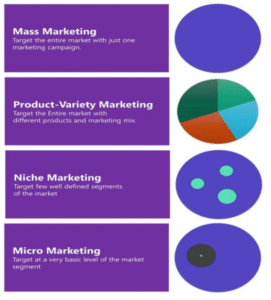
A. Undifferentiated Marketing (Mass Marketing)
The company ignores segment differences and targets the whole market with one offer.
Philosophy: “One size fits all.”
Focus: What is common in the needs of consumers, not what is different.
Examples: Salt, Sugar, Steel.
Pros: Low cost (economies of scale in production and advertising).
Cons: Very difficult to satisfy everyone; vulnerable to competitors who focus on specific groups.
B. Differentiated Marketing (Segmented Marketing)
The company targets several market segments and designs separate offers for each.
Philosophy: “Different strokes for different folks.”
Example: Maruti Suzuki.
Alto: For first-time budget buyers.
Swift: For young, sporty drivers.
Ciaz: For corporate executives desiring status.
Pros: Higher total sales; strong position in each segment.
Cons: Increased costs (separate ads, production lines, and research for each product).
C. Concentrated Marketing (Niche Marketing)
The company goes after a large share of one or a few smaller segments (niches).
Philosophy: “Big fish in a small pond.”
Example: Rolex (Targets only the super-rich), Royal Enfield (Targets only cruiser bike lovers), Bansal Classes (Targets only IIT-JEE aspirants).
Pros: Strong market position due to expert knowledge; high profit margins.
Cons: High risk. If that one segment fails or a large competitor enters, the company can die.
D. Micromarketing
Tailoring products to the needs of specific individuals or local customer groups.
Local Marketing: Tailoring brands to local cities or stores (e.g., Groupon offers deals specific to your city).
Individual Marketing (Mass Customization): Customizing products for individual customers.
Example: Dell lets you configure your own laptop. Tailors make suits to your exact measurement.
3. Positioning
Positioning is not what you do to the product; it is what you do to the mind of the consumer.
Definition: Arranging for a product to occupy a clear, distinctive, and desirable place relative to competing products in the minds of target consumers.
The Goal: When a customer thinks of a category (e.g., Safety), they should immediately think of your brand (e.g., Volvo).
Perceptual Mapping (Positioning Map)
Marketers often use a graph called a Positioning Map to see where their brand stands versus competitors.
X-Axis: Price (Low to High).
Y-Axis: Quality (Low to High).
Goal: To find an empty spot on the map (a gap in the market) where no competitor exists.
Positioning Strategies
How can a brand position itself?
Attribute Positioning: Positioning based on a feature. (e.g., Redmi phones position on “Battery Life” or “Camera MP”).
Benefit Positioning: Positioning based on the result/benefit. (e.g., Colgate = No Cavities; Sensodyne = Sensitivity Relief).
Use/Application Positioning: Positioning based on when it is used. (e.g., Kellogg’s Cornflakes positioned specifically as a “Breakfast” meal).
User Positioning: Positioning for a specific type of person. (e.g., Johnson’s Baby Shampoo is for babies; Pepsi is for the “Young Generation”).
Competitor Positioning: Positioning directly against a rival. (e.g., 7-Up calling itself the “Un-Cola” to distinguish from Coke/Pepsi).
Quality/Price Positioning:
More for More: High price, high quality (Mercedes).
Less for Much Less: Low price, low quality (Ryanair/Budget Airlines).
More for Less: The winning value proposition (Big Bazaar – “Isse Sasta Aur Accha Kahin Nahi”).
Differentiation: The Key to Positioning
To position effectively, you must be different. If you are the same as the competitor, the customer will just buy the cheaper one.
Product Differentiation: Features, performance, style, durability (e.g., Apple’s build quality).
Service Differentiation: Speed, delivery, installation, repair (e.g., Amazon’s fast delivery).
Channel Differentiation: Coverage, expertise (e.g., Eureka Forbes selling directly at home).
People Differentiation: Hiring and training better staff (e.g., Singapore Airlines flight attendants are famous for hospitality).
Image Differentiation: Symbols, atmosphere, logos (e.g., The Nike Swoosh represents victory and speed).
Repositioning
Sometimes, a brand’s original position becomes outdated or sales drop. The company must then change its image. This is called Repositioning.
Example: Dettol. Originally positioned only for cuts and wounds (First Aid). Repositioned as a daily hygiene soap, handwash, and floor cleaner to increase daily usage.
Example: Cadbury Dairy Milk. Originally for kids. Repositioned for adults with the “Kuch Meetha Ho Jaye” campaign (replacing traditional Indian sweets)
Advantages of segmentation