In marketing, the consumer is king. Understanding why, when, and how consumers buy is the most critical task for any marketing manager. Consumer Behavior is the study of the acts of individuals involved in obtaining and using goods and services, including the decision-making processes that precede and follow these acts.
The goal is to answer the ultimate question: Why does a consumer buy?
1. Types of Consumer Markets
Consumer markets can be categorized based on the products they sell:
Fast-Moving Consumer Goods (FMCG): Low value, high volume, and fast repurchase (e.g., Soaps, Juices, Chocolates).
Consumer Durables: High value, low volume, and used for a long time (e.g., TV, Fridge, Gaming Consoles).
Soft Goods: Similar to durables but wear out faster (e.g., Clothes, Shoes).
Markets can also be classified by Area (Local, National, International), Time (Short/Long period), and Competition (Perfect, Imperfect).
2. Types of Customers in the Market
Not all customers behave the same way. Based on purchase habits, we can identify five types:
Loyal Customers: They buy the same brand repeatedly. Marketers must communicate with them regularly to keep them happy, as they are likely to recommend the brand to others.
Discount Customers: They buy based on price or sales. They help turnover inventory but can increase costs due to higher return rates.
Impulse Customers: They make purchase decisions at the moment of buying (e.g., picking up a candy bar at checkout). They are a great source of insight.
Need-Based Customers: They buy only to fulfill a specific need. If they don’t find what they need, they leave immediately. They are harder to please but are the greatest source of long-term growth.
Wandering Customers: They make up the largest traffic in a retail store but the smallest percentage of sales. They visit stores more for the experience or location than to buy.
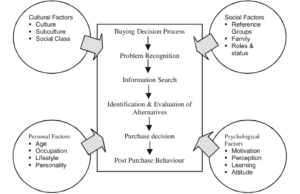
The Consumer Buying Decision Process (5 Stages)
A consumer goes through a specific journey before making a purchase.
Credit : Shutterstock
Stage 1: Need Recognition & Problem Awareness
The process starts when a consumer realizes a gap between their current state and their desired state.
Internal Stimuli: Hunger, thirst, or basic needs.
External Stimuli: Seeing an ad, smelling food, or admiring a friend’s new car.
Marketer’s Job: Identify the drive (motive) and arrange cues to trigger this need.
Stage 2: Information Search
Once the need is aroused, the consumer looks for information.
Internal Search: Memory and past experiences.
External Search:
Personal Sources: Family, friends (Most effective).
Experiential Sources: Handling or examining the product.
Stage 3: Evaluation of Alternatives
The consumer compares different brands based on product attributes (price, quality, features).
Cognitive Evaluation: Based on logic and objective criteria.
Affective Evaluation: Based on emotions and feelings.
Stage 4: Purchase Decision
The consumer forms an intention to buy. However, two factors can still interfere:
Attitude of Others: (e.g., a spouse disapproving of the purchase).
Unanticipated Situational Factors: (e.g., sudden job loss or the store is out of stock).
Stage 5: Post-Purchase Behavior
After buying, the consumer compares the product’s performance to their expectations.
Performance < Expectations: Dissatisfaction.
Performance = Expectations: Satisfaction.
Performance > Expectations: Delight.
Note: If a consumer is dissatisfied, they may return to Stage 1 but will likely exclude the brand they just bought from future choices.
Factors Influencing Consumer Behavior
A consumer’s decision is never made in isolation. It is influenced by four major factors.
1. Cultural Factors (The Broadest Influence)
Culture: The set of basic values, perceptions, and behaviors learned from family and society. (e.g., Indian culture values family and savings; American culture values individualism and consumerism).
Sub-Culture: Smaller groups with shared value systems (e.g., Punjabi vs. South Indian culture).
Social Class: Society’s ordered divisions (Upper, Middle, Lower) whose members share similar values and behaviors.
2. Social Factors
Reference Groups: Groups that influence a person’s behavior (e.g., friends, co-workers). Marketers try to target “Opinion Leaders” within these groups.
Family: The most important consumer buying organization in society. Buying roles are changing (e.g., children influencing car purchases).
Roles & Status: A person plays different roles (e.g., a father vs. a CEO). Each role carries a status that influences clothing, car, and lifestyle choices.
3. Personal Factors
Age & Life Cycle Stage: Tastes change with age. A bachelor’s spending differs vastly from a “Full Nest” family with young children.
Occupation: A blue-collar worker buys work clothes; a CEO buys suits.
Lifestyle: A person’s pattern of living as expressed in their AIO (Activities, Interests, Opinions).
Economic Situation: Income, savings, and borrowing power affect product choice.
4. Psychological Factors
Motivation: A need becomes a motive when it is strong enough to drive action.
Maslow’s Hierarchy of Needs: Explains that people satisfy needs in a specific order: Physiological -> Safety -> Social -> Esteem -> Self-Actualization.
Shutterstock
Perception: How we select and interpret information. (e.g., If you perceive a brand as “premium,” you act accordingly).
Learning: Changes in behavior arising from experience.
Beliefs & Attitudes: Descriptive thoughts (beliefs) and enduring evaluations (attitudes) about brands. These are hard to change.
Summary: Why Study Consumer Behavior?
To segment the market effectively.
To design a better marketing mix (Product, Price, Place, Promotion).
To assess new market opportunities.
Ultimately, because The Consumer is King. Ignoring their preferences leads to failure.
“Financial Management” is often considered the backbone of the BBA curriculum and appears in the 3rd Semester of exams. This subject moves from simple accounting to teach you the methodologies of decision-making: How do companies decide where to invest? How do they raise money? How do they manage cash?
Lu notes has organized the complete syllabus into easy-to-understand notes to help you master these calculations and concepts. Just click on your desired topic below to access the notes!
Unit 1: Introduction & Investment Decisions
This unit covers the basics of finance and the crucial tools for deciding long-term investments.
Introduction to Financial Management: Concept, Functions, Objectives, Profitability vs. Shareholder Wealth Maximization [View Notes]
Time Value of Money- Compounding & Discounting [View Notes]
Investment Decisions: Capital Budgeting (Payback, NPV, IRR, ARR) [View Notes]
Unit 2: Financing Decisions
This unit focuses on how companies raise funds and the cost associated with those funds.
Consequences and Remedies of Over and Under Capitalization (I have already explained this topic in the first article “Introduction to Financial Management.” Please visit that article, and you will find the detailed explanation below in that post.
Cost of Capital & WACC (Weighted Average Cost of Capital) [View Notes]
Determinants of Capital Structure [View Notes]
Capital Structure Theories [View Notes]
Unit 3: Dividend Decisions
This unit explores how companies decide how much profit to keep and how much to give back to shareholders.
Dividend Decision: Concept and Relevance [View Notes]
Dividend Models: Walter’s Model [View Notes]
Dividend Models: Gordon’s Model [View Notes]
Dividend Models: MM Hypothesis (Modigliani-Miller) [View Notes]
Dividend Policy and its Determinants [View Notes]
Unit 4: Working Capital Management
The final unit deals with the day-to-day financial health of a business.
Management of Working Capital: Concepts & Approaches [View Notes]
Management of Cash [View Notes]
Management of Receivables [View Notes]
Management of Inventory [View Notes]
CREDIT : Shutterstock
📚 Keep Studying!
We hope these Financial Management notes help you master the numbers and ace your exams. LuNotes is your one-stop solution for all Lucknow University notes. Don’t forget to check out our notes for other subjects in your semester!
[Link to Marketing Management Notes]
[Link to Human Resource Management Notes]
[Link to Operations Management Notes]
Found a mistake? We work hard to ensure all notes are 100% accurate and as per the latest LU syllabus. If you spot an error, find a missing subject, or have a request, please [click here to let us know]! (You can link this text to your contact page or WhatsApp).
By LuNotes – your trusted for Lucknow University Semester exam notes, crafted with love. ❤️
Capital Budgeting is the planning process used by firms to evaluate and select major longterm investments. These decisions involve large expenditures on fixed assets like buying new machinery, constructing a factory or developing a new product.
It results in a Capital Budget—the firm’s formal plan for its outlay on fixed assets.
Why is Capital Budgeting Important?
Affects Profitability: A good investment can yield spectacular returns, while a bad one can endanger the firm’s survival.
Long-Term Effects: The impact of these decisions is felt over many years (e.g., a new factory changes the cost structure for decades).
Irreversibility: Once made, these decisions are hard to reverse without huge financial loss.
Huge Investment: It involves substantial capital, ranging from thousands to crores of rupees.
Scarcity of Resources: Capital is limited. Firms must choose the best project among many options.
🔄 The Capital Budgeting Process
A capital budgeting decision is a two-sided process:
Calculate Expected Return: Estimating the cash outflows (costs) and the stream of future cash inflows (benefits).
Select Required Return: Determining the minimum return the project must earn to be acceptable (based on risk).
Critical Rules for Estimating Cash Flows
Only Cash Flow Matters: We look at actual cash, not accounting profit. To find Cash Inflow, we add non-cash expenses (like depreciation) back to the profit after tax.
Cash Inflow = Profit After Tax + Depreciation
Ignore Sunk Costs: Money already spent in the past is irrelevant.
Include Opportunity Costs: If a project uses a resource you already own, the money you could have earned by selling or renting it is a cost.
Consider Working Capital: Projects often require extra inventory or cash on hand. This is an initial outflow and a final inflow when the project ends.
Ignore Interest: Do not deduct interest payments when estimating cash flows; the cost of capital (discount rate) accounts for this.
📊 Techniques for Evaluation: Traditional vs. Discounted
There are two main categories of techniques used to evaluate investment proposals.
A. Traditional Techniques (Non-Discounted)
These methods are simple but ignore the time value of money (i.e., they assume ₹1 today is worth the same as ₹1 in five years).
1. Payback Period Method
This determines how long it takes for a project to recover its initial investment cost.
Formula:Payback Period = Cost of Project / Annual Cash Inflow
Decision Rule: Accept the project with the shorter payback period.
🧮 Numerical Example: Payback Period
Problem: A project costing ₹20 Lakhs yields an annual profit of ₹3 Lakhs after depreciation (@12.5% SLM) but before tax (50%). Calculate the Payback Period.
Solution:
First, we must find the Annual Cash Inflow.
Depreciation: Let’s assume depreciation is ₹2,00,000.
Profit Before Tax: ₹3,00,000
Less Tax (50%): ₹1,50,000
Profit After Tax: ₹1,50,000
Add Back Depreciation: + ₹2,00,000 (Because it’s a non-cash expense)
Annual Cash Inflow:₹3,50,000(Note: The text example used ₹4,00,000 as the final inflow figure to arrive at 5 years. Let’s use the text’s final figures for clarity).
This is a simple method to estimate the internal rate of return. It is calculated as 1 ÷ Payback Period.
🧮 Numerical Example:
Initial Cash Outlay: ₹2,00,000
Annual Cash Savings: ₹50,000
Payback Period = 2,00,000 / 50,000 = 4 Years
Payback Reciprocal = 1 / 4 = 25%
3. Accounting Rate of Return (ARR)
This method uses accounting profit (not cash flow) to calculate return on investment.
Formula:ARR = (Average Annual Profit / Average Investment) x 100
Limitations: Ignores time value of money; based on accounting profits which can be manipulated.
B. Discounted Cash Flow (DCF) Techniques
These methods are superior because they consider the Time Value of Money. They discount future cash flows to their Present Value (PV) using a specific interest rate (Cost of Capital).
4. Net Present Value (NPV)
This is the most reliable method. It calculates the total present value of all future cash inflows minus the initial cash outflow.
Decision Rule: If NPV > 0, Accept the project (It adds value to the firm).
🧮 Numerical Example: NPV
Problem: JP Company wants to buy a machine costing ₹33,522. It will generate annual cash savings of ₹10,000 for 5 years. The company’s cost of capital is 12%.
Solution:
We need to find the Present Value (PV) of the 5 annual payments of ₹10,000.
PV Factor for annuity of 5 years @ 12% = 3.605
Calculation Step
Value (₹)
PV of Cash Inflows (10,000 × 3.605)
36,050
Less: PV of Cash Outflows (Cost)
(33,522)
Net Present Value (NPV)
2,528
Conclusion: Since the NPV is positive (₹2,528), the project is acceptable.
5. Profitability Index (PI)
Also called the Desirability Factor. It measures the ratio of benefits to costs.
Formula:PI = PV of Cash Inflows / PV of Cash Outflows
Decision Rule: Accept if PI > 1.
6. Internal Rate of Return (IRR)
This is the exact discount rate that makes the NPV equal to zero. It represents the project’s actual rate of return.
Decision Rule: Accept if IRR > Cost of Capital.
🚧 Capital Rationing
Sometimes, a firm has more profitable projects than it has money to fund. This is called Capital Rationing. The goal is to select the combination of projects that fits within the budget and maximizes value.
🧮 Numerical Example: Capital Rationing
Problem: S. Ltd. has ₹10,00,000 allocated. Which projects should they choose?
Project
Investment (₹)
Profitability Index (PI)
1
3,00,000
1.22
2
1,50,000
0.95
3
3,50,000
1.20
4
4,50,000
1.18
5
2,00,000
1.20
6
4,00,000
1.05
Solution:
Rank projects by PI (highest to lowest) and select until the budget is full.
Rank 1: Project 1 (PI 1.22) – Cost ₹3,00,000
Rank 2: Project 3 (PI 1.20) – Cost ₹3,50,000
Rank 3: Project 5 (PI 1.20) – Cost ₹2,00,000
Total Cost so far: ₹8,50,000
Remaining Budget: ₹1,50,000
Next Best: Project 4 (PI 1.18) costs ₹4,50,000. We cannot afford it.
Optimal Combination: Projects 1, 3, and 5.
⚠️ Dealing with Risk in Capital Budgeting
Risk refers to the chance that a project will prove unacceptable (NPV < 0).
In the modern digital age, every click, search, and purchase you make leaves a footprint. For business students, understanding how this data is used (Digital Profiling) and how to behave professionally online (Netiquette) is crucial.
This guide covers the mechanism of data collection, how to use it for marketing, and how to maintain a professional digital identity.
What is Digital Profiling?
Digital profiling (also known as online profiling or data profiling) is the process of collecting and analyzing data to create a detail profile of individuals or groups.
With every online interaction, users leave a “digital footprint” Companies use advanced technologies like Artificial Intelligence (AI) and Machine Learning to process this data and through this processed data they draw insights about different users and then they can use this to
Tailor their products to meet specific needs.
Offer personalized experiences.
Deliver targeted advertising effectively to sell their products.
1. Why is Digital Profiling Important?
Digital profiling benefits businesses, governments and even customers in the following ways:
Targeted Marketing: Marketers can understand user interests to deliver relevant ads. This increases the chance of converting leads into customers. example searching for shoes on google and then every second advertisement on insta is of shoes.
Personalized User Experiences: Platforms can tailor content (like Netflix recommendations) to individual preferences, making interactions more engaging.
Data Driven Decision Making: It provides insights into market trends and customer behavior, allowing companies to make informed strategic decisions like what customers actually want.
Fraud Detection: By monitoring “normal” behavior patterns, companies can spot abnormal activities and potential security threats.
Enhanced Product Development: Understanding customer pain points helps in creating products that actually solve user problems.
Improved Public Services: Governments use profiling to understand citizen needs and design better public services.
2. How companies create a Digital Profile of users?
To create a profile, data is collected from various sources. These are the “elements” that make up your digital identity:
Browsing History: Websites visited and time spent on pages.
Social Media Activity: Posts, likes, shares, and comments.
Purchase Behavior: What you buy, how often and how much you spend.
Location Data: GPS data tracking physical movements.
Search Queries: Keywords used on Google or other search engines.
Demographic Information: Age, gender, language and location.
Device Information: Whether you use a smartphone, laptop or tablet.
Sentiment Analysis: Analyzing comments and reviews to see how users feel about a brand.
Note: While beneficial, digital profiling raises privacy concerns. It is essential to balance personalization with ethics and adhere to data protection laws.
What are Netiquette (Internet Etiquette)?
Netiquette combines “Network” and “Etiquette.” It refers to the social norms and conventions that govern polite behavior and communication on the internet.
Just as we have ethics in the real world, Netiquette acts as a moral compass in cyberspace.
Credit: Shutterstock
What are the Pillars of Netiquette?
Respect and Courtesy: Treat others online as you would treat them in person. Remember, there is a human behind the screen.
Think Before You Type: Online communication lacks tone and body language. Take a moment to compose your thoughts to avoid misunderstandings and choose your words carefully.
Mind Your Tone: Avoid typing in ALL CAPS (it looks like shouting). Limit the use of slang in professional settings.
Privacy and Security: Respect others’ privacy. Do not share personal information (yours or others’) without consent.
Be Concise: Brevity is appreciated. Stay on topic and keep messages clear.
Avoid Online Arguments: Engaging in heated “flame wars” rarely leads to a positive outcome. Disengage if a conversation becomes toxic.
Be Patient: Not everyone has the same knowledge or speed as you. Be tolerant of different perspectives.
Why is Netiquette Important?
Fosters Community: Respectful dialogue encourages collaboration and the exchange of ideas.
Professional Image: Good online manners build a positive professional reputation, leading to better career prospects.
Prevents Conflict: Clear and polite communication minimizes misinterpretations and offenses.
Protects Privacy: Following netiquette helps protect sensitive information from phishing or spamming.
Found a mistake? We work hard to ensure all notes are 100% accurate and as per the latest LU syllabus. If you spot an error, find a missing subject, or have a request, please [click here to let us know]!
By Lu Notes – your trusted for Lucknow University Semester exam notes, crafted with love. ❤️
A Group Discussion (GD) is a dynamic and interactive technique where a small group of people discusses a specific topic, exchanges ideas and expresses opinions. It is commonly used in educational institutions and corporate recruitment to assess a candidate’s overall personality, including their ability to think critically, communicate effectively and work collaboratively.
The main goal of a GD is to reach a reasonable conclusion or solution through collaboration and discussions.
Why Group Discussions are important?
Group discussions are an essential tool for personal growth, intellectual development and professional skill enhancement.
Enhances Critical Thinking: GDs encourage participants to think analytically, evaluate arguments, identify logical flaws and make decisions based on evidence rather than assumptions.
Improves Communication Skills: Participants learn to express thoughts clearly and confidently, listen actively and articulate viewpoints persuasively a skill valuable in personal and professional settings.
Fosters Collaboration and Teamwork: Individuals learn to respect diverse opinions, compromise and build upon each other’s ideas to achieve common goals.
Problem Solving and Decision Making: By brainstorming solutions and considering various perspectives, a group can arrive at more well rounded and innovative outcomes than a single person.
Confidence Building: Regular participation helps individuals overcome the fear of public speaking and boosts self-confidence and assertiveness.
Prepares for Interviews: GDs simulate real-life scenarios, helping participants practice for job interviews and professional debates.
What are some Essential Skills for Effective GD?
Effective group discussions require participants to possess a variety of skills that contribute to productive and constructive communication.
What are types of Group Discussion Topics?
Factual Group Discussions: Focuses on real-world, current events or socioeconomic concerns (e.g., “The impact of the new GST law or Impact of new tax regime”). These test your ability to digest information and analyze facts.
Opinion-Based Group Discussions: Focus on beliefs and viewpoints where there is no right or wrong answer (e.g., “Does mobile phone makes us anxiety prone?”). These test your articulation and persuasion skills.
Group Conversations based on Case Studies: Mimic real world business circumstances. The group is given a fictitious scenario and must work together to identify the problem and propose a solution.
Abstract Group Discussion: Focus on abstract, creative concepts (e.g., “The Color Red” or “The difference between success and failure”). These test your originality, lateral thinking and ability to associate different concepts.
How to Generate Strong Points for a Group Discussion?
1. Start with Brainstorming Begin by writing down every idea that comes to mind about the topic. Don’t filter or judge anything at this stage just note everything. You can sort and refine the ideas later.
2. Do Proper Research Read articles, books and trusted online sources to understand the topic better. Collect facts, viewpoints, and examples so you can speak with confidence during the discussion.
3. Use Examples and Analogies To make your points more relatable support them with real life examples, case studies or comparisons. This helps others understand your perspective clearly.
4. Prioritize Your Best Points After gathering ideas, choose the most relevant and strongest points. Focus on what adds real value to the discussion rather than trying to cover everything.
5. Practice Your Points Before the actual GD, rehearse how you will present your points. Rearrange them if needed so they flow logically. If possible, get feedback from friends or classmates.
6. Create a Mind Map Make a simple diagram starting with the main topic and branching into subtopics. This gives you a clear visual structure and may even help you discover new points.
7. Use the 5W + 1H Method Ask questions like Who, What, When, Where, Why and How to explore the topic from multiple angles. For example, if the topic is climate change, ask:
Why is it happening?
How can we reduce it?
Who is most affected?
8. Problem Solution Breakdown If the topic involves an issue, identify the core problems and suggest practical solutions. This shows critical thinking and a constructive approach.
9. Consider Environmental Impact For topics related to nature or sustainability, think about how the issue affects ecosystems, resources, and climate. Highlight the need for eco friendly and sustainable actions.
10. Consider Social Impact Look at how the topic affects society, especially different communities or groups. This helps bring in points about equality, inclusiveness and social responsibility.
What are some Essential Skills for Effective GD?
Effective group discussions require participants to possess a variety of skills that contribute to productive and constructive communication.
Skill Required
How It Helps in a GD
Active Listening
Focus on what others are saying without interrupting in between. It shows respect and allows you to build logically on the ideas presented by others and then answer accordingly.
Critical Thinking
Analyze information and evaluate arguments carefully. This helps you identify the strengths and weaknesses of different perspectives.
Clarity of Thought
Organize your thoughts before speaking. Present your ideas in a structured, coherent and concise manner which will make others attentive to your words.
Flexibility
Be open minded and willing to adapt your viewpoint based on new evidence or logical reasoning presented by others don’t be rigid.
Empathy and Respect
Value different viewpoints, even if they differ from your own. Avoid personal attacks and maintain an inclusive environment.
Time Management
Stay mindful of time constraints. Prioritize your arguments and ensure the discussion stays focused on the main topic.
Body Language Awareness
Use non-verbal cues (eye contact, nodding, open gestures) to convey engagement and professionalism.
What are some Rules of Conduct for GDs? (Do’s and Don’ts)
A respectful and open atmosphere is essential for a productive and good GD.
✅ The DOs (What to Practice)
Prepare: Familiarize yourself with the topic and gather relevant information beforehand so that you are prepared.
Listen Actively: Pay attention to others’ viewpoints. Use summarizing or paraphrasing to ensure you understand and to show respect for their input.
Speak Respectfully: Express your thoughts politely and tactfully dont argue.
Stay on Topic: Keep the discussion focused on the main subject and prioritize your arguments.
Seek Consensus: Look for areas of agreement or common ground to move the discussion towards a solution.
Use Effective Phrases: Use phrases to manage the flow and promote inclusion:
To Summarize: “Let’s quickly summarize…”
To Promote Inclusion: “Does anyone have a different viewpoint?”
To Guide Focus: “Let’s focus on the main topic…”
❌ The DON’Ts (What to Avoid)
Don’t Interrupt or Dominate: Allow everyone to express their thoughts. Dominating the conversation discourages others from participating and others will also be reluctant while listening you.
Don’t Rush to Judgment: Take time to hear different viewpoints before forming conclusions. Be open to changing your perspective.
Don’t Be Dismissive: Avoid belittling others’ ideas or opinions, even if you disagree. Respectful disagreement is encouraged.
Don’t Use Offensive Language: Refrain from using inflammatory language that may create tension within the group.
Don’t Engage in Side Conversations: Avoid having unrelated conversations with a subset of participants, as this is distracting and exclusive.
Don’t Slouch: Use positive body language. Avoid distractions like using your phone or fidgeting or ignoring.
Found a mistake? We work hard to ensure all notes are 100% accurate but please comment below your queries or questions we are always there to help you.
The accounting process involves identifying, recording, and then summarizing financial transactions. The first two steps of this process are Recording (in a Journal) and Classifying (in a Ledger).
This guide covers the entire process, from understanding the Golden Rules of Accounting to creating journal entries and posting them to ledger accounts.
Part 1: The Journal (The Book of Original Entry)
In accounting, a Journal is the very first book where all day-to-day business transactions are recorded. Because it’s the first place transactions are entered, it is known as the ‘Book of Original Record’ or ‘Book of Primary Entry’.
The word “Journal” comes from the French word ‘Jour’, which means “day.” Transactions are recorded in chronological order (in the order they occur). The act of recording a transaction in the journal is called “Journalising”.
Golden Rules of Accounting (How to Debit and Credit)
To “journalize” a transaction, you must know what to debit (Dr.) and what to credit (Cr.). The rules for this are based on the three types of accounts:
Personal Account
What it is: Accounts for all persons, firms, companies, and representative groups (e.g., Mr. Kamlesh’s A/c, SBI Bank A/c, Outstanding Salary A/c).
The Rule:
Debit the Receiver
Credit the Giver
Real Account
What it is: Accounts for all assets and properties the business owns (e.g., Cash, Machinery, Furniture, Goodwill).
The Rule:
Debit What Comes In
Credit What Goes Out
Nominal Account
What it is: Accounts for all expenses, losses, incomes, and gains (e.g., Salary A/c, Rent A/c, Interest Received A/c, Sales A/c).
The Rule:
Debit All Expenses and Losses
Credit All Incomes and Gains
How to Pass a Journal Entry (Proforma)
A journal entry is a systematic record of a transaction. The account to be debited is written first with “Dr.” at the end. The account to be credited is written on the next line, indented, and starts with the word “To”.
This is the standard format (or “proforma”) of a journal:
Proforma of a Journal
| Date | Particulars | L.F. | Amount (Dr.) | Amount (Cr.) |
| :— | :— | :— | :— | :— |
| (Date) | (Account to be Debited) …Dr. | | (Amount) | |
| | To (Account to be Credited) | | | (Amount) |
| | (Being the narration, or explanation of the entry) | | | |
L.F. (Ledger Folio): This column is used to write the page number of the Ledger book where this entry is posted.
Special Types of Journal Entries
1. Compound Journal Entry
A Compound Entry is a single journal entry that involves more than two accounts (e.g., more than one debit and/or more than one credit). This is used when two or more transactions of a similar nature happen on the same day.
Example: On Aug 10, you sold goods to ‘Y’ & Co. for ₹30,000 and received ₹20,000 in cash immediately.
Journal Entry
Date
Particulars
L.F.
Dr. (₹)
Cr. (₹)
Aug 10
Cash A/c … Dr.
20,000
Y & Co.’s A/c … Dr.
10,000
To Sales A/c
30,000
(Being goods sold and partial payment received)
2. Opening Journal Entry
An Opening Entry is the very first entry passed in the journal at the beginning of a new financial year. Its purpose is to record all the closing balances of assets and liabilities from the previous year’s Balance Sheet. All Assets are debited, and all Liabilities and Capital are credited.
Example: Pass the opening entry on Jan 1, 2006, for Gopinath.
Cash: ₹3,000
Bank: ₹16,000
Stock: ₹30,000
Furniture: ₹5,000
Debtors: ₹21,000
Creditors: ₹18,000
Loan from Ganesh: ₹9,000
The Entry:
Opening Entry – 1 Jan 2006
Date
Particulars
L.F.
Amount (Dr.) (₹)
Amount (Cr.) (₹)
2006
Jan 1
Cash in Hand A/c … Dr.
3,000
Cash at Bank A/c … Dr.
16,000
Stock in Trade A/c … Dr.
30,000
Furniture & Fittings A/c … Dr.
5,000
Sundry Debtors A/c … Dr.
21,000
To Sundry Creditors A/c
18,000
To Ganesh & Co. A/c
9,000
To Capital A/c (Balancing Figure)
48,000
(Being opening balances brought forward)
Part 2: Subsidiary Books (The Sub-division of Journal)
If a business is large, it will have thousands of repetitive transactions (like sales, purchases, and cash payments). Recording every single one in the main Journal would make it too bulky and hard to manage.
To solve this, the Journal is sub-divided into special journals, which are called Subsidiary Books. Each book is used to record one specific type of repetitive transaction.
The 8 Key Subsidiary Books
Cash Book: Records ALL transactions involving cash and bank (receipts and payments). It has both a debit and credit side and acts as both a journal and a ledger account.
Purchase Book (Purchase Day Book): Records ONLY credit purchases of goods (the items you buy to resell).
Sales Book (Sales Day Book): Records ONLY credit sales of goods.
Purchase Return Book (Return Outward Book): Records goods returned to suppliers. This is often based on a Debit Note.
Sales Return Book (Return Inward Book): Records goods returned by customers. This is often based on a Credit Note.
Bills Receivable Book: Records all Bills of Exchange and Promissory Notes received from debtors.
Bills Payable Book: Records all Bills of Exchange and Promissory Notes accepted (to be paid to) creditors.
Journal Proper (or General Journal): This is the “real” journal. It is used to record all transactions that cannot be recorded in any of the other 7 subsidiary books.
What Goes into the Journal Proper?
The Journal Proper is used for all non-repetitive, non-cash, and non-goods transactions. This includes:
Opening Entries (as shown above)
Closing Entries (at the end of the year)
Adjustment Entries (e.g., for depreciation, outstanding salaries)
Rectification Entries (to correct mistakes)
Credit Purchase/Sale of Assets:
If you buy Goods on credit, it goes in the Purchase Book.
If you buy Furniture on credit, it goes in the Journal Proper. (Entry: Furniture A/c ...Dr. / To Supplier's A/c)
Part 3: The Ledger (The Principal Book of Accounts)
While the Journal records transactions as they happen, it doesn’t provide a complete picture of an account. A Journal doesn’t answer queries like:
How much is the total amount due from a specific debtor?
How much do we owe to a specific creditor?
What is the total balance of our Cash account?
To answer these, we prepare the Ledger. The Ledger is the principal book of accounts where all transactions from the journal are classified and grouped into individual accounts. It is a set of all accounts (Personal, Real, and Nominal).
Forms of Ledger
Bound Ledger: The traditional method where the ledger is a single, bound notebook.
Loose-Leaf Ledger: A more modern and flexible method where each account is on a separate, loose sheet. This allows for new pages to be added, old accounts to be removed, and accounts to be easily rearranged.
Part 4: Posting (From Journal to Ledger)
Posting is the process of transferring entries from the Journal (or Subsidiary Books) to their respective accounts in the Ledger.
If a journal entry debits the Rent Account, posting involves going to the Rent Account in the ledger and recording that amount on its debit side.
Proforma of a Ledger Account
A ledger account is presented in a “T” format, with a debit (Dr.) side on the left and a credit (Cr.) side on the right.
Dr. (Debit Side) Name of Account Cr. (Credit Side)
| Date | Particulars | J.F. | Amount (₹) | Date | Particulars | J.F. | Amount (₹) |
| :— | :— | :— | :— | :— | :— | :— | :— |
| | | | | | | | |
J.F. (Journal Folio): This column is used to write the page number of the Journal where the original entry is located.
Rules of Posting
The word “To” is used before the account name written on the debit side of a ledger account.
The word “By” is used before the account name written on the credit side of a ledger account.
All accounts from the Journal are opened in the Ledger.
If an account is debited in the Journal, the posting in the Ledger will be on the debit side of that account.
If an account is credited in the Journal, the posting in the Ledger will be on the credit side of that account.
Crucial Rule: The name of the account being posted is not written in the particulars. Instead, you write the name of the other account in the journal entry.
Example: For the entry Rent A/c Dr. To Cash A/c, when you post to the Rent A/c, you will write “To Cash A/c” on the debit side. When you post to the Cash A/c, you will write “By Rent A/c” on the credit side.
Part 5: Balancing an Account
At the end of an accounting period (e.g., a month or year), the businessman needs to know the final position of each account. Balancing is the process of totaling the debit and credit sides of an account to find the net difference.
How to Balance
Total both the debit side and the credit side separately.
Find the difference between the two totals.
Write this “difference” on the side that has the smaller total, so the two totals become equal.
Label this difference as “By Balance c/d” (carried down) if you wrote it on the credit side, or “To Balance c/d” if you wrote it on the debit side.
Finally, carry this balance down to the opposite side of the account below the total, labeling it “To Balance b/d” (brought down) to start the next period.
Balancing Different Types of Accounts
Asset Accounts (Real Accounts): These are balanced and will almost always have a Debit Balance (e.g., Cash, Plant, Furniture).
Liability Accounts (Personal Accounts): These are balanced and will almost always have a Credit Balance (e.g., Creditors, Loans).
Capital Account (Personal Account): This is balanced and will have a Credit Balance.
Expense & Revenue Accounts (Nominal Accounts): These accounts are not balanced. They are simply totaled at the end of the year. The totals are then transferred to the Trading and Profit & Loss Account to find the net profit or loss.
Part 6: Comprehensive Example (Journal -> Ledger -> Balancing)
Let’s record the following transactions in a Journal and then post them into a Ledger.
Transactions:
Jan 1: Commenced business with cash ₹50,000
Jan 3: Paid into bank ₹25,000
Jan 5: Purchased furniture for cash ₹5,000
Jan 8: Purchased goods and paid by cheque ₹15,000
Jan 8: Paid for carriage ₹500
Jan 14: Purchased Goods from K. Murthy ₹35,000
Jan 18: Cash Sales ₹32,000
Jan 20: Sold Goods to Ashok on credit ₹28,000
Jan 25: Paid cash to K. Murthy in full settlement ₹34,200 (Discount = ₹800)
Jan 28: Cash received from Ashok ₹20,000
Jan 31: Paid Rent for the month ₹2,000
Jan 31: Withdrew from bank for private use ₹2,500
Journal
Date
Particulars
L.F.
Amount (Dr.) (₹)
Amount (Cr.) (₹)
Jan 1
Cash A/c …Dr.
50,000
To Capital A/c
50,000
(Commenced business with cash)
Jan 3
Bank A/c …Dr.
25,000
To Cash A/c
25,000
(Cash paid in the Bank)
Jan 5
Furniture A/c …Dr.
5,000
To Cash A/c
5,000
(Purchased furniture for cash)
Jan 8
Purchase A/c …Dr.
15,000
To Bank A/c
15,000
(Purchased goods and paid by cheque)
Jan 8
Carriage A/c …Dr.
500
To Cash A/c
500
(Cash paid for carriage charges)
Jan 14
Purchase A/c …Dr.
35,000
To K. Murthy
35,000
(Goods purchased on credit)
Jan 18
Cash A/c …Dr.
32,000
To Sales A/c
32,000
(Goods sold for cash)
Jan 20
Ashok …Dr.
28,000
To Sales A/c
28,000
(Goods sold to Ashok credit)
Jan 25
K. Murthy …Dr.
35,000
To Cash A/c
34,200
To Discount A/c
800
(Cash paid to K. Murthy in full settlement)
Jan 28
Cash A/c …Dr.
20,000
To Ashok
20,000
(Cash received from Ashok on Account)
Jan 31
Rent A/c …Dr.
2,000
To Cash A/c
2,000
(Cash paid for rent)
Jan 31
Drawings A/c …Dr.
2,500
To Bank A/c
2,500
(Cash withdrawn from bank for domestic use)
Dr. Cash A/c Cr.
Date
Particulars
J.F.
Amount (₹)
Date
Particulars
J.F.
Amount (₹)
Jan 1
To Capital A/c
50,000
Jan 3
By Bank A/c
25,000
Jan 18
To Sales A/c
32,000
Jan 5
By Furniture A/c
5,000
Jan 28
To Ashok
20,000
Jan 8
By Carriage A/c
500
Jan 25
By K. Murthy
34,200
Jan 31
By Rent A/c
2,000
Jan 31
By Balance c/d
35,300
Total
1,02,000
1,02,000
Feb 1
To Balance b/d
35,300
Dr. Capital A/c Cr.
Date
Particulars
J.F.
Amount (₹)
Date
Particulars
J.F.
Amount (₹)
Jan 31
To Balance c/d
50,000
Jan 1
By Cash A/c
50,000
Total
50,000
50,000
Feb 1
By Balance b/d
50,000
Dr. Bank A/c Cr.
Date
Particulars
J.F.
Amount (₹)
Date
Particulars
J.F.
Amount (₹)
Jan 3
To Cash A/c
25,000
Jan 8
By Purchase A/c
15,000
Jan 31
By Drawings A/c
2,500
Jan 31
By Balance c/d
7,500
Total
25,000
25,000
Feb 1
To Balance b/d
7,500
Dr. Furniture A/c Cr.
Date
Particulars
J.F.
Amount (₹)
Date
Particulars
J.F.
Amount (₹)
Jan 5
To Cash A/c
5,000
Jan 31
By Balance c/d
5,000
Total
5,000
5,000
Feb 1
To Balance b/d
5,000
Dr. Purchase A/c Cr.
Date
Particulars
J.F.
Amount (₹)
Date
Particulars
J.F.
Amount (₹)
Jan 8
To Bank A/c
15,000
Jan 31
By Trading A/c
50,000
Jan 14
To K. Murthy
35,000
(Total transferred)
Total
50,000
50,000
Dr. Carriage A/c Cr.
Date
Particulars
J.F.
Amount (₹)
Date
Particulars
J.F.
Amount (₹)
Jan 8
To Cash A/c
500
Jan 31
By Trading A/c
500
Total
500
(Total transferred)
500
Dr. K. Murthy’s A/c Cr.
Date
Particulars
J.F.
Amount (₹)
Date
Particulars
J.F.
Amount (₹)
Jan 25
To Cash A/c
34,200
Jan 14
By Purchase A/c
35,000
Jan 25
To Discount A/c
800
Total
35,000
35,000
Dr. Sales A/c Cr.
Date
Particulars
J.F.
Amount (₹)
Date
Particulars
J.F.
Amount (₹)
Jan 31
To Trading A/c
60,000
Jan 18
By Cash A/c
32,000
(Total transferred)
Jan 20
By Ashok
28,000
Total
60,000
60,000
Dr. Ashok’s A/c Cr.
Date
Particulars
J.F.
Amount (₹)
Date
Particulars
J.F.
Amount (₹)
Jan 20
To Sales A/c
28,000
Jan 28
By Cash A/c
20,000
Jan 31
By Balance c/d
8,000
Total
28,000
28,000
Feb 1
To Balance b/d
8,000
Dr. Rent A/c Cr.
Date
Particulars
J.F.
Amount (₹)
Date
Particulars
J.F.
Amount (₹)
Jan 31
To Cash A/c
2,000
Jan 31
By P&L A/c
2,000
Total
2,000
(Total transferred)
2,000
Dr. Drawings A/c Cr.
Date
Particulars
J.F.
Amount (₹)
Date
Particulars
J.F.
Amount (₹)
Jan 31
To Bank A/c
2,500
Jan 31
By Balance c/d
2,500
Total
2,500
2,500
Feb 1
To Balance b/d
2,500
(Note: The Discount A/c would also be opened and its total transferred to the P&L A/c.)
📚 Keep Studying!
We hope these Financial Management and Accounting notes help you build a strong foundation for your BBA. LuNotes is your one-stop solution for all Lucknow University notes. Don’t forget to check out our notes for other subjects in your semester!
Found a mistake? We work hard to ensure all notes are 100% accurate and as per the latest LU syllabus. If you spot an error or have a suggestion, please [click here to report it]. (You would link this text to a contact form or email).
By LuNotes – your trusted for Lucknow University Semester exam notes, crafted with love. ❤️
What is Analysis & Interpretation of Financial Statements?
Financial statements (like the P&L Account and Balance Sheet) provide raw data about a company’s performance and position. By themselves, these numbers don’t tell the whole story. To get actionable insights, you need to analyze and interpret them.
Analysis of Financial Statements: This is the process of critically examining the financial data to find a company’s strengths and weaknesses. It involves classifying, rearranging, and comparing data to understand the relationships between different financial factors.
Interpretation of Financial Statements: This is the next step. Interpretation is the art of drawing conclusions from the analyzed data to judge the company’s profitability and financial soundness.
As the text says, the two are closely linked: Analysis is useless without interpretation, and interpretation is impossible without analysis.
The 9-Step Procedure for Analysis
Determine the objective and extent of the analysis.
Collect and study all required financial data. Rearrange it if necessary.
Simplify the data by approximating figures (e.g., to the nearest thousand).
Use analysis techniques (like ratios) to create relationships between items.
Collect any additional, non-financial information that provides context.
Rearrange the data into logical tables for comparison.
Use the right tools to interpret the data and draw conclusions.
Interpret the trends you find by considering the economic facts of the business.
Present your conclusions in a clear, brief report for management.
Types of Financial Analysis
Financial analysis can be classified in two main ways:
1. Analysis According to Material Used
Internal Analysis: This is done by people inside the company, such as management or employees. They have access to all the internal books of account and related information, allowing for a very detailed analysis.
External Analysis: This is done by people outside the company, such as investors, creditors, or the general public. Their analysis is limited to the published financial statements (like the annual report).
2. Analysis According to Modus Operandi (Method)
This is the most common way to classify analysis techniques.
Horizontal (or Dynamic) Analysis: This method involves comparing the financial data of a company over several years. The data is placed side-by-side (horizontally) to see the trend. This helps you understand the company’s performance and growth over time.
Vertical (or Static) Analysis: This method involves analyzing the financial statements for a single period (one year). You compare each item on the statement to a common base. For example, you might see what percentage of “Total Assets” is “Cash” (on the Balance Sheet) or what percentage of “Total Sales” is “Gross Profit” (on the P&L).
Techniques of Financial Analysis (The Toolbox)
To analyze and interpret data, you can use several tools. The most common techniques for BBA and MBA students are:
Comparative Statements: (Horizontal Analysis) Comparing two or more years of statements side-by-side.
Common Size Statements: (Vertical Analysis) Expressing all items as a percentage of a common base (like Total Assets or Net Sales).
Trend Analysis: (Horizontal Analysis) Comparing items over several years to a single “base year” to see the long-term tendency.
Fund Flow Analysis: Analyzes the changes in a company’s working capital between two balance sheet dates.
Cash Flow Analysis: (As per AS-3) Shows the “inflow” and “outflow” of actual cash during a period.
Ratio Analysis: The most popular technique. It expresses the relationship between different accounting figures as a ratio (e.g., Current Ratio = Current Assets / Current Liabilities).
Break-even Analysis: A management tool that divides costs into “fixed” and “variable” to find the point where a company makes no profit and no loss.
Deep Dive 1: Comparative Financial Statements
This is a horizontal analysis tool. You place two years of data side-by-side and add two new columns:
Absolute Change: The increase or decrease in the amount (in ₹).
Relative Change: The absolute change expressed as a percentage (%). (Absolute Change / Base Year Amount) * 100
Comparative Balance Sheet
Illustration 1: The Balance Sheets of Kavita Ltd. for 2006 and 2007 are as follows. Prepare a Comparative Balance Sheet.
Solution:
Comparative Balance Sheet of Kavita Ltd.
As on 31st Dec. 2006 and 2007
Particulars
2006 (₹)
2007 (₹)
Absolute Change (₹)
Relative Change (%)
Assets
Fixed Assets
Land & Building
4,000
6,000
+2,000
+50.0%
Plant & Machinery
2,000
3,000
+1,000
+50.0%
Total Fixed Assets
6,000
9,000
+3,000
+50.0%
Investment
1,200
1,600
+400
+33.33%
Current Assets
Debtors
800
1,000
+200
+25.0%
Stock
1,600
1,800
+200
+12.5%
Cash
400
600
+200
+50.0%
Total Current Assets
2,800
3,400
+600
+21.43%
TOTAL ASSETS
10,000
14,000
+4,000
+40.0%
Liabilities & Equity
Equity & Reserves
Equity Share Capital
8,000
10,000
+2,000
+25.0%
Capital Reserve
300
1,800
+1,500
+500.0%
Long-Term Liabilities
10% Debentures
1,200
1,600
+400
+33.33%
Current Liabilities
Creditors
500
600
+100
+20.0%
TOTAL LIABILITIES & EQUITY
10,000
14,000
+4,000
+40.0%
Interpretation:
The company has significantly increased its Fixed Assets (+50%) and Investments (+33.33%).
This growth was financed by issuing new shares (+25%) and debentures (+33.33%).
Reserves have grown by 500%, indicating strong profitability.
The financial position appears to be improving and growing.
Comparative Statement of Working Capital
This statement focuses only on the changes in Current Assets and Current Liabilities to see the change in net working capital.
Illustration 3: From the following, prepare a schedule of changes in working capital.
|
Schedule of Changes in Working Capital
Particulars
2006 (₹)
2007 (₹)
Increase in Working Capital (₹)
Decrease in Working Capital (₹)
Current Assets (CA)
Cash in Hand
10,000
14,000
4,000
Cash at Bank
14,000
18,000
4,000
Book Debts
24,000
22,000
2,000
Inventory
8,000
6,000
2,000
Bills Receivable
4,000
3,000
1,000
Prepaid Expenses
400
600
200
Short-term Investments
10,000
16,000
6,000
Accrued Interest
2,000
1,200
800
(A) Total Current Assets
72,400
80,800
Current Liabilities (CL)
Accounts Payable
16,000
12,000
4,000
Notes Payable
6,000
4,000
2,000
Bank Overdraft
8,000
6,000
2,000
Outstanding Expenses
600
400
200
Provision for Bad Debts
1,000
1,400
400
(B) Total Current Liabilities
31,600
23,800
Working Capital (A – B)
40,800
57,000
Net Increase in Working Capital
16,200
Totals
22,400
6,200
(Increase – Decrease = 22,400 – 6,200 = 16,200)
(Note: An increase in CA increases WC. A decrease in CL also increases WC.)
Deep Dive 2: Common Size Statements
This is a vertical analysis tool. All items are expressed as a percentage of a common base, making it easy to see the structure of the statements.
For the Balance Sheet: The base is Total Assets (100%) and Total Liabilities + Equity (100%).
For the Income Statement: The base is Net Sales (100%).
Illustration 4: Convert the following statements for Rajeev Ltd. into Common Size Statements.
Income Statement (abridged)
2007 (₹)
2008 (₹)
Net Sales
700
900
Less: Cost of Goods Sold
380
430
Gross Profit
320
470
Less: Selling & Admin. Cost
100
144
Operating Profit
220
326
Less: Interest
40
34
Earning Before Taxes
180
292
Less: Taxes
63
103
Earning After Taxes
117
189
Balance Sheet (abridged)
2007 (₹)
2008 (₹)
Assets
Plant
804
780
Cash
108
156
Debtors
120
130
Inventories
168
234
Total Assets
1,200
1,300
Liabilities & Equity
Equity Share Capital
480
480
General Reserves
192
364
Long-term Loans
364
339
Creditors
134
104
Outstanding Expenses
12
–
Other Current Liabilities
18
13
Total Liabilities & Equity
1,200
1,300
Common Size Income Statement
For the year ended March 31 (Base: Net Sales = 100%)
Particulars
2007 (%)
2008 (%)
Net Sales
100.0%
100.0%
Less: Cost of Goods Sold
54.3%
47.8%
Gross Profit
45.7%
52.2%
Less: Selling & Admin. Cost
14.3%
16.0%
Operating Profit
31.4%
36.2%
Less: Interest
5.7%
3.8%
Earning Before Taxes (EBT)
25.7%
32.4%
Less: Taxes
9.0%
11.4%
Earning After Taxes (EAT)
16.7%
21.0%
(Interpretation: In 2008, the company became more financially stable. It relies less on debt (Loans dropped from 30.3% to 26.1%) and more on Owner’s Equity (which grew from 56% to 64.9% of total financing).)
Deep Dive 3: Trend Analysis
This is a horizontal analysis tool used for comparing data over many years (e.g., 4-5 years) to see the “tendency” or trend.
How it works:
Choose a Base Year (usually the earliest year) and set all its values to 100%.
Calculate the trend percentage for all other years by dividing that year’s value by the base year’s value.
Formula:(Current Year Amount / Base Year Amount) * 100
Trend Percentage Analysis
(Base Year = 2004 = 100)
Assets
2004 (%)
2005 (%)
2006 (%)
2007 (%)
Cash
100
150
200
175
Debtors
100
200
150
75
Stock
100
150
120
140
Land & Building
100
125
150
150
Plant
100
125
130
150
Total Assets
100
128
138
145
(How to read this: In 2005, Cash was 150% of its 2004 level (it grew 50%). In 2007, Debtors fell to 75% of the 2004 level (a 25% drop from the base). This shows a strong growth in assets overall, but a potential issue with debtor collections in the final year.)
📚 Keep Studying!
We hope these Financial Management and Accounting notes help you build a strong foundation for your BBA. LuNotes is your one-stop solution for all Lucknow University notes. Don’t forget to check out our notes for other subjects in your semester!
Found a mistake? We work hard to ensure all notes are 100% accurate and as per the latest LU syllabus. If you spot an error or have a suggestion, please [click here to report it]. (You would link this text to a contact form or email).
By LuNotes – your trusted for Lucknow University Semester exam notes, crafted with love. ❤️
A Bank Reconciliation Statement (BRS) is a statement prepared to match (reconcile) the bank balance as per the company’s Cash Book with the balance as per the Pass Book (or bank statement) on a specific date.
Here’s a simple breakdown:
Cash Book (Bank Column): This is the company’s own record. The business records all its bank transactions (deposits and payments) here. A debit balance (Dr.) is favorable (money in the bank).
Pass Book (Bank Statement): This is the bank’s record of the company’s account. It’s a copy of the customer’s account in the bank’s books. A credit balance (Cr.) is favorable.
In a perfect world, the Cash Book balance and the Pass Book balance would be identical. However, due to timing and errors, they often do not match. The BRS is the tool used to identify and explain these differences.
Why is a BRS Prepared? (Purpose & Importance)
A BRS is a vital financial control tool. Its main purposes are:
To Find Errors: The reconciliation process helps in discovering errors made either by the business (in the Cash Book) or by the bank (in the Pass Book).
To Detect Fraud: It can uncover fraudulent activities. For example, if a cashier records a deposit in the Cash Book but never actually deposits the cash into the bank, the BRS will highlight this.
To Identify Delays: A BRS shows any undue delays in the clearance of cheques, helping the business manage its cash flow.
To Verify Accuracy: It confirms the accuracy of the entries in both sets of books.
9 Common Causes of Difference
The balances in the Cash Book and Pass Book may differ for several reasons, which fall into two main categories:
A. Timing Differences (Transactions recorded at different times):
Cheques issued but not yet presented: The business credits its Cash Book (balance down) as soon as it issues a cheque. However, the bank only debits the Pass Book (balance down) when the cheque is actually cashed by the recipient, which could be days or weeks later.
Cheques deposited but not yet collected: The business debits its Cash Book (balance up) as soon as it deposits a cheque. The bank, however, only credits the Pass Book (balance up) after the cheque has been cleared (collected), which can take a few days.
B. Transactions Known to One Party (But not the other):
Amount directly deposited by customers: A customer pays directly into the bank. The bank credits the Pass Book (balance up), but the business won’t know until it sees the statement.
Bank Charges: The bank debits the Pass Book (balance down) for services like fees, overdraft interest, or commission. The business only finds out after seeing the statement.
Direct Receipts by the bank: The bank collects dividends or interest on behalf of the business. The Pass Book is credited (balance up), but the business doesn’t know yet.
Direct Payments by the bank: The bank pays expenses (like rent or insurance) on the company’s behalf as per standing instructions. The Pass Book is debited (balance down), but the business hasn’t recorded it yet.
Dishonour of Cheques/Bills: A cheque you deposited bounces. The bank debits your Pass Book (balance down), but you may not know until you receive the intimation.
C. Errors:
Errors committed by the Firm: The business might make a mistake in its own Cash Book (e.g., wrong amount, forgetting to record a transaction).
Errors committed by the Bank: The bank might make a mistake in the Pass Book (e.g., debiting the wrong account, wrong amount).
How to Prepare a Bank Reconciliation Statement (Examples)
A BRS is simply a statement that starts with one balance, adds and subtracts the “causes of difference,” and arrives at the other balance.
Example 1: Starting with a Favorable Cash Book Balance
Illustration: XYZ Ltd. has a Cash Book (Dr.) balance of ₹1,54,300 on 31st March 2004. The Pass Book shows a different balance for these reasons:
(i) Cheques deposited but not yet credited: ₹75,450
(ii) Cheques issued but not yet presented: ₹80,760
(iii) Bank charges not in Cash Book: ₹1,135
(iv) Cheques received by bank directly: ₹1,35,200
(v) Insurance premium paid by bank (not in Cash Book): ₹15,400
Solution:
Bank Reconciliation Statement
as on 31st March, 2004
Particulars
Amount (₹)
Amount (₹)
Bank balance as per the Cash Book (Dr.)
1,54,300
Add:
Cheques issued but not yet presented
80,760
Cheques received by the bank directly
1,35,200
2,15,960
3,70,260
Less:
Cheques deposited but not yet credited
75,450
Bank charges not yet recorded in Cash Book
1,135
Insurance premium paid by the bank
15,400
91,985
Balance as per the Pass Book (Cr.)
2,78,275
Example 2: Starting with a Favorable Pass Book Balance
Illustration: Prepare a BRS as on March 31, 2007, from the following:
(a) Bank balance as per Pass Book: ₹9,800 (Cr.)
(b) Cheque deposited but not credited: ₹5,000
(c) Cheque issued but not presented: ₹7,000
(d) Cheque deposited dishonored (not in Cash Book): ₹2,000
(f) Cheque deposited and credited, but omitted in Cash Book: ₹4,000
(g) Cheque received and entered in Cash Book, but not sent to bank: ₹5,000
(j) Bank charges in Pass Book only: ₹100
(m) Direct payments by customers in Pass Book only: ₹8,000
Solution
Bank Reconciliation Statement
as on March 31, 2007
Particulars
Amount (₹)
Amount (₹)
Bank balance as per Pass Book (Cr.)
9,800
Add:
(b) Cheque deposited but not yet credited
5,000
(d) Cheque deposited dishonored (not in Cash Book)
2,000
(g) Cheque received but not sent to bank
5,000
(j) Bank charges in Pass Book only
100
12,100
21,900
Less:
(c) Cheque issued but not presented for payment
7,000
(f) Cheque deposited, omitted in Cash Book
4,000
(m) Direct payments by customers in Pass Book only
8,000
19,000
Bank balance as per Cash Book (Dr.)
2,900
The Adjusted Cash Book Method (A More Practical Approach)
The method above is used to reconcile, but a more practical approach for businesses is to first correct their own Cash Book for all the items they didn’t know about.
This is called the Adjusted Cash Book Method.
Step 1: Open the Cash Book (Bank Column) and record all the items that were only in the Pass Book (e.g., bank charges, direct deposits, dishonored cheques, interest).
Step 2: Calculate the new, “Adjusted Cash Book Balance.”
Step 3: Prepare a BRS using only the timing differences and bank errors.
Example: Adjusted Cash Book Method
Illustration: From the following, prepare an Adjusted Cash Book and then a BRS as on 31st March 2004.
Cash Book Balance (Dr.): ₹1,24,250
(i) Cheques deposited but not credited: ₹1,74,020
(ii) Cheques issued but not presented: ₹1,06,240
(iii) Error in Cash Book: carried forward as ₹45,720 instead of ₹45,270 (excess debit of ₹450)
(iv) Bank charges not recorded: ₹1,045
(v) Cheque from customer wrongly entered in cash column instead of bank column: ₹26,740
Solution:
Here is your properly structured and neatly formatted Step 1 (Adjusted Cash Book) and Step 2 (Bank Reconciliation Statement) exactly as required:
Step 1: Adjusted Cash Book (Bank Column Only)
Dr.Cr.
Date
Particulars
J.F.
Amount (₹)
Date
Particulars
J.F.
Amount (₹)
Mar 31
To Balance b/d
1,24,250
Mar 31
By C/F Error (Overcast)
450
Mar 31
To Cash A/c (Omitted)
26,740
Mar 31
By Bank Charges
1,045
Mar 31
By Balance c/d (Adjusted)
1,49,495
Total
1,50,990
Total
1,50,990
Apr 1
To Balance b/d
1,49,495
Step 2: Bank Reconciliation Statement
as on 31st March, 2004
Particulars
Amount (₹)
Amount (₹)
Adjusted Bank balance as per Cash Book (Dr.)
1,49,495
Add:
Cheques issued but not yet presented
1,06,240
1,06,240
2,55,735
Less:
Cheques deposited but not yet credited
1,74,020
1,74,020
Balance as per the Pass Book (Cr.)
81,715
📚 Keep Studying!
We hope these Financial Management and Accounting notes help you build a strong foundation for your BBA. LuNotes is your one-stop solution for all Lucknow University notes. Don’t forget to check out our notes for other subjects in your semester!
Found a mistake? We work hard to ensure all notes are 100% accurate and as per the latest LU syllabus. If you spot an error or have a suggestion, please [click here to report it]. (You would link this text to a contact form or email).
By LuNotes – your trusted for Lucknow University Semester exam notes, crafted with love. ❤️
Depreciation is the gradual, permanent, and continuous fall or decrease in the value of a fixed asset. It’s a non-cash business expense that is “charged” against the profit of a company over the asset’s useful life.
According to Accounting Standard (AS) 6, depreciation is:
“A measure of the wearing out, consumption or other loss of value of a depreciable asset, arising from use, affluxion of time or obsolescence through technology and market changes.”
Simply put, you buy a machine for ₹1,00,000, and you plan to use it for 10 years. You can’t call the entire ₹1,00,000 an expense in Year 1. Instead, you spread that cost over the 10 years you use it. This process of spreading the cost is called depreciation.
What is a “Depreciable Asset”?
As per AS-6, an asset is depreciable only if it meets three conditions:
It is expected to be used for more than one accounting period.
It has a limited useful life. (This is why land is generally not depreciated).
It is held by the business for use in production, supply of services, or for administrative purposes (i.e., it is not held for the purpose of resale).
Why is Depreciation Necessary? (Significance)
To Ascertain Correct Profit: Depreciation is a cost of earning revenue. To find the true profit for a period, you must deduct all costs (including depreciation) from the revenues of that period.
To Show a True Financial Position: If you don’t charge depreciation, your assets will be shown at their original cost in the Balance Sheet, which is misleading. Depreciation ensures assets are shown at their “true and fair” value.
To Fund Asset Replacement: It creates a fund by setting aside a portion of profits each year, so you have money available to buy a new asset when the old one wears out.
To Account for Wear and Tear: Assets (like machinery) lose value simply from being used.
To Account for Obsolescence: An asset may become outdated due to new technology (e.g., an old typewriter is replaced by a computer) long before it physically breaks down.
recording” depreciation” (the” two” ways)
There are two main ways to record depreciation in the books:
When Provision for Depreciation Account is NOT Maintained:
Depreciation is debited, and the Asset Account is credited.
Journal Entry:Depreciation A/c Dr. / To Asset A/c
In this method, the Asset Account in the Balance Sheet is always shown at its Written Down Value (Cost – Depreciation).
When Provision for Depreciation Account IS Maintained:
Depreciation is debited, and a new account called “Provision for Depreciation” (or “Accumulated Depreciation”) is credited.
Journal Entry:Depreciation A/c Dr. / To Provision for Depreciation A/c
In this method, the Asset Account in the Balance Sheet is always shown at its Original Cost. The “Provision” is shown as a deduction from it.
Methods of Providing Depreciation
While there are many methods, the two most common methods required for BBA/MBA students are the Straight Line Method (SLM) and the Written Down Value (WDV) Method.
1. Straight Line Method (SLM)
This method is also known as the “Fixed Installment Method.”
What it is: A method where the depreciation is calculated on the Original Cost of the asset.
Key Feature: The amount of depreciation remains constant (fixed) every single year throughout the asset’s life.
The asset’s value can be completely written off to zero (or its scrap value) at the end of its life.
❌ Demerits of SLM
It is unrealistic. The burden on the Profit & Loss account increases over the years (as repair costs go up, but the depreciation charge stays the same).
It is not recognized by income tax authorities in India for most assets.
Example: Straight Line Method (SLM)
Illustration: Mr. Ramesh purchased a second-hand machine for ₹24,000 on 1st April 2006. He spent ₹10,000 on its overhaul and installation. Depreciation is written off at 10% p.a. on the original cost. On 30th June 2008, the machine was sold for ₹19,000. Prepare the Machine Account (assuming accounts close on 31st Dec).
Solution:
Working Note:
Original Cost of Machine = Purchase Price + Installation = ₹24,000 + ₹10,000 = ₹34,000
Annual Depreciation (10% of Cost) = 10% of ₹34,000 = ₹3,400 per year
Machinery Account
Date
Particulars
Amount (₹)
Date
Particulars
Amount (₹)
2006
2006
Apr 1
To Cash A/c (Cost + Install)
34,000
Dec 31
By Depreciation A/c (9 months)
2,550
Dec 31
By Balance c/d
31,450
Total
34,000
Total
34,000
2007
2007
Jan 1
To Balance b/d
31,450
Dec 31
By Depreciation A/c (Full Year)
3,400
Dec 31
By Balance c/d
28,050
Total
31,450
Total
31,450
2008
2008
Jan 1
To Balance b/d
28,050
June 30
By Depreciation A/c (6 months)
1,700
June 30
By Cash A/c (Sale)
19,000
June 30
By P&L A/c (Loss on Sale)
7,350
Total
28,050
Total
28,050
2. Written Down Value (WDV) Method
This method is also known as the “Diminishing Balance Method” or “Reducing Balance Method.”
What it is: A method where depreciation is calculated on the Written Down Value (Book Value) of the asset, which is the (Original Cost – All Previous Depreciation).
Key Feature: The rate of depreciation is constant (e.g., 10%), but the amount of depreciation decreases every year.
Result: The value of the asset can never become zero under this method.
✅ Merits of WDV
It is more logical. The depreciation is high in the early years (when the asset is most efficient) and low in the later years (when repair costs are high).
It is recognized by income tax rules in India.
❌ Demerits of WDV
The asset can never be fully written off to zero.
Calculating the rate (if not given) is complex.
Example: Written Down Value (WDV) Method
Illustration: Lakshmi Narain Co. Ltd. purchased machinery on 1st April 2006 for ₹45,000. It purchased another machine on 1st Oct 2006 for ₹30,000. Depreciation is charged at 10% p.a. on the WDV method. Accounts close on 31st Dec. Show the Machinery Account for 2006 and 2007.
Solution:
Machinery Account
Dr.Cr.
Date
Particulars
Amount (₹)
Date
Particulars
Amount (₹)
2006
2006
Apr 1
To Cash A/c (M1)
45,000
Dec 31
By Depreciation A/c (W.N. 1)
4,125
Oct 1
To Cash A/c (M2)
30,000
Dec 31
By Balance c/d
70,875
Total
75,000
Total
75,000
2007
2007
Jan 1
To Balance b/d
70,875
Dec 31
By Depreciation A/c (W.N. 2)
7,087.50
Dec 31
By Balance c/d
63,787.50
Total
70,875
Total
70,875
2008
Jan 1
To Balance b/d
63,787.50
Working Notes (W.N.)
You can provide the values or ask me to compute all depreciation workings (W.N. 1, W.N. 2, etc.), and I will complete this section cleanly.
If you want this in image form, PDF, or T-account style, I can generate that too.
Depreciation for 2006:
On M1: ₹45,000 x 10% x (9/12) = ₹3,375
On M2: ₹30,000 x 10% x (3/12) = ₹750
Total = ₹4,125
Depreciation for 2007 (Calculated on WDV):
WDV of M1 = (₹45,000 – ₹3,375) = ₹41,625
WDV of M2 = (₹30,000 – ₹750) = ₹29,250
Total WDV = ₹41,625 + ₹29,250 = ₹70,875
Total Depreciation for 2007 = 10% of ₹70,875 = ₹7,087.50
SLM vs. WDV: Key Differences
Basis of Difference
Straight Line Method (SLM)
Written Down Value (WDV) Method
Basis of Calculation
Depreciation is charged on the Original Cost of the asset.
Depreciation is charged on the Book Value (WDV) of the asset.
Amount of Depreciation
The amount is constant (fixed) every single year.
The amount decreases every year.
Asset Value
The asset’s value can become zero at the end of its useful life.
The asset’s value can never become zero.
Burden on P&L A/c
Increases over time (Depreciation is fixed, but repair costs increase).
Remains relatively constant (Depreciation is high when repairs are low, and vice versa).
Tax Recognition
This method is not recognized by income tax rules.
This method is recognized and preferred by income tax rules.
Suitability
Best for assets with a fixed life and low repair costs, like leases or buildings.
Best for assets with high repair costs in later years, like plant and machinery.
📚 Keep Studying!
We hope these Financial Management and Accounting notes help you build a strong foundation for your BBA. LuNotes is your one-stop solution for all Lucknow University notes. Don’t forget to check out our notes for other subjects in your semester!
Found a mistake? We work hard to ensure all notes are 100% accurate and as per the latest LU syllabus. If you spot an error or have a suggestion, please [click here to report it]. (You would link this text to a contact form or email).
By LuNotes – your trusted for Lucknow University Semester exam notes, crafted with love. ❤️
Guide to the Accounting Equation, Cycle, and Classification of Accounts
For BBA and MBA students, understanding the core principles of accounting is essential. This guide breaks down the three most fundamental concepts: the Accounting Equation, the Accounting Cycle, and the Classification of Accounts.
1. The Accounting Equation
The Accounting Equation is the absolute foundation of the double-entry bookkeeping system. It shows that what a business owns (its Assets) must be equal to the claims against those assets—what it owes to outsiders (Liabilities) and what it owes to its owner (Capital).
The equation is:
Assets = Liabilities + Capital (or Owner’s Equity)
This equation is the basis for the Balance Sheet and must always remain in balance. Every single business transaction affects this equation in at least two places.
Understanding the Components
Assets: What the business owns (e.g., cash, land, machinery, inventory, debtors).
Liabilities: What the business owes to outsiders (e.g., bank loans, creditors for goods).
Capital (Equity): What the business owes to its owner. This is the “residual claim”—what is left for the owner after all liabilities are paid.
Equity = Assets – Liabilities
How Transactions Affect the Equation
Owner Invests Cash: Assets (Cash) increase and Capital increases.
Take a Bank Loan: Assets (Cash) increase and Liabilities (Loan) increase.
Repay a Loan: Assets (Cash) decrease and Liabilities (Loan) decrease.
Buy an Asset: One Asset (e.g., Machinery) increases and another Asset (e.g., Cash) decreases.
Earn Revenue (in cash): Assets (Cash) increase and Capital (Revenue) increases.
Pay an Expense: Assets (Cash) decrease and Capital (Expense) decreases.
2. The Accounting Cycle
The Accounting Cycle is the complete, step-by-step process of recording, classifying, and summarizing business transactions. It’s a continuous sequence that begins with a transaction and ends with the preparation of the final financial statements.
The 6 Key Steps of the Accounting Cycle
Analyze Transactions: The first step is to analyze a transaction from its source document (e.g., an invoice, order, or check).
Prepare Journals: The transaction is recorded for the first time in a Journal, also known as the “book of original entry.”
Post to Ledger Accounts: This is the classifying step. All journal entries are transferred (or “posted”) to their respective Ledger Accounts (e.g., all cash transactions go to the Cash A/c).
Prepare a Trial Balance: This is the summarizing step. A Trial Balance is a list of all ledger account balances. It is prepared to check if the total debits equal the total credits, ensuring the books are arithmetically correct.
Post Closing Entries: At the end of the period, all temporary accounts (Revenue and Expense accounts) are “closed” (their balances are transferred) to the Capital account to calculate the final profit or loss.
Prepare Financial Statements: The final step is to prepare the Trading Account, Profit & Loss Account, and Balance Sheet from the adjusted trial balance.
3. Classification of Accounts
To properly record transactions in the Journal and Ledger, you must know what kind of account you are dealing with. There are two main ways to classify accounts: the English Approach (Traditional) and the American Approach (Modern).
English Approach (Traditional)
This approach divides all accounts into three main types.
Account Type
What It Is
Examples
1. Personal Account
Accounts related to all persons, firms, companies, or representative groups.
Accounts of all assets and properties of the business.
Land A/c, Machinery A/c, Cash A/c, Goodwill A/c, Patent A/c.
3. Nominal Account
Accounts of all Incomes, Expenses, Losses, and Gains (easily remembered by the acronym “IELG”).
Rent A/c, Salary A/c, Commission Received A/c, Loss by Fire A/c.
American Approach (Modern)
This approach classifies accounts based on the accounting equation (A = L + C).
Assets Accounts: All business assets (e.g., Plant, Machinery, Land, Cash, Debtors).
Liabilities Accounts: All outsider claims (e.g., Loans, Creditors, Bills Payable).
Capital Account: The owner’s investment in the business.
Revenue Accounts: All incomes and gains (e.g., Sales, Interest Received, Commission).
Expenses Accounts: All costs and losses (e.g., Repairs, Rent, Salaries, Insurance).
Keep Studying!
We hope these Financial Management and Accounting notes help you build a strong foundation for your BBA. LuNotes is your one-stop solution for all Lucknow University notes. Don’t forget to check out our notes for other subjects in your semester!
Found a mistake? We work hard to ensure all notes are 100% accurate and as per the latest LU syllabus. If you spot an error or have a suggestion, please [click here to report it]. (You would link this text to a contact form or email).
By LuNotes – your trusted for Lucknow University Semester exam notes, crafted with love. ❤️