Group Discussion Skills, Types and Techniques
How to excel in Group Discussions (GD)
A Group Discussion (GD) is a dynamic and interactive technique where a small group of people discusses a specific topic, exchanges ideas and expresses opinions. It is commonly used in educational institutions and corporate recruitment to assess a candidate’s overall personality, including their ability to think critically, communicate effectively and work collaboratively.
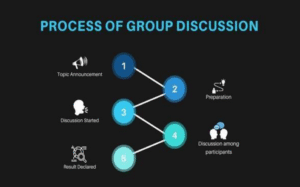
The main goal of a GD is to reach a reasonable conclusion or solution through collaboration and discussions.
Why Group Discussions are important?
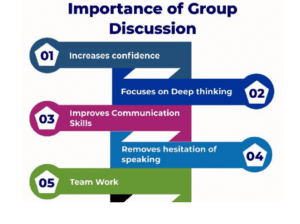
Group discussions are an essential tool for personal growth, intellectual development and professional skill enhancement.
-
Enhances Critical Thinking: GDs encourage participants to think analytically, evaluate arguments, identify logical flaws and make decisions based on evidence rather than assumptions.
-
Improves Communication Skills: Participants learn to express thoughts clearly and confidently, listen actively and articulate viewpoints persuasively a skill valuable in personal and professional settings.
-
Fosters Collaboration and Teamwork: Individuals learn to respect diverse opinions, compromise and build upon each other’s ideas to achieve common goals.
-
Problem Solving and Decision Making: By brainstorming solutions and considering various perspectives, a group can arrive at more well rounded and innovative outcomes than a single person.
-
Confidence Building: Regular participation helps individuals overcome the fear of public speaking and boosts self-confidence and assertiveness.
-
Prepares for Interviews: GDs simulate real-life scenarios, helping participants practice for job interviews and professional debates.
What are some Essential Skills for Effective GD?
Effective group discussions require participants to possess a variety of skills that contribute to productive and constructive communication.
What are types of Group Discussion Topics?
-
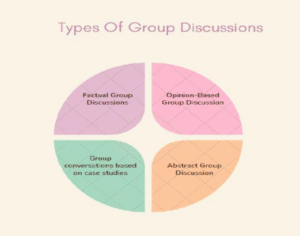
Factual Group Discussions: Focuses on real-world, current events or socioeconomic concerns (e.g., “The impact of the new GST law or Impact of new tax regime”). These test your ability to digest information and analyze facts.
-
Opinion-Based Group Discussions: Focus on beliefs and viewpoints where there is no right or wrong answer (e.g., “Does mobile phone makes us anxiety prone?”). These test your articulation and persuasion skills.
-
Group Conversations based on Case Studies: Mimic real world business circumstances. The group is given a fictitious scenario and must work together to identify the problem and propose a solution.
-
Abstract Group Discussion: Focus on abstract, creative concepts (e.g., “The Color Red” or “The difference between success and failure”). These test your originality, lateral thinking and ability to associate different concepts.
How to Generate Strong Points for a Group Discussion?
1. Start with Brainstorming
Begin by writing down every idea that comes to mind about the topic. Don’t filter or judge anything at this stage just note everything. You can sort and refine the ideas later.
2. Do Proper Research
Read articles, books and trusted online sources to understand the topic better. Collect facts, viewpoints, and examples so you can speak with confidence during the discussion.
3. Use Examples and Analogies
To make your points more relatable support them with real life examples, case studies or comparisons. This helps others understand your perspective clearly.
4. Prioritize Your Best Points
After gathering ideas, choose the most relevant and strongest points. Focus on what adds real value to the discussion rather than trying to cover everything.
5. Practice Your Points
Before the actual GD, rehearse how you will present your points. Rearrange them if needed so they flow logically. If possible, get feedback from friends or classmates.
6. Create a Mind Map
Make a simple diagram starting with the main topic and branching into subtopics. This gives you a clear visual structure and may even help you discover new points.
7. Use the 5W + 1H Method
Ask questions like Who, What, When, Where, Why and How to explore the topic from multiple angles. For example, if the topic is climate change, ask:
-
Why is it happening?
-
How can we reduce it?
-
Who is most affected?
8. Problem Solution Breakdown
If the topic involves an issue, identify the core problems and suggest practical solutions. This shows critical thinking and a constructive approach.
9. Consider Environmental Impact
For topics related to nature or sustainability, think about how the issue affects ecosystems, resources, and climate. Highlight the need for eco friendly and sustainable actions.
10. Consider Social Impact
Look at how the topic affects society, especially different communities or groups. This helps bring in points about equality, inclusiveness and social responsibility.
What are some Essential Skills for Effective GD?
Effective group discussions require participants to possess a variety of skills that contribute to productive and constructive communication.
| Skill Required | How It Helps in a GD |
| Active Listening | Focus on what others are saying without interrupting in between. It shows respect and allows you to build logically on the ideas presented by others and then answer accordingly. |
| Critical Thinking | Analyze information and evaluate arguments carefully. This helps you identify the strengths and weaknesses of different perspectives. |
| Clarity of Thought | Organize your thoughts before speaking. Present your ideas in a structured, coherent and concise manner which will make others attentive to your words. |
| Flexibility | Be open minded and willing to adapt your viewpoint based on new evidence or logical reasoning presented by others don’t be rigid. |
| Empathy and Respect | Value different viewpoints, even if they differ from your own. Avoid personal attacks and maintain an inclusive environment. |
| Time Management | Stay mindful of time constraints. Prioritize your arguments and ensure the discussion stays focused on the main topic. |
| Body Language Awareness | Use non-verbal cues (eye contact, nodding, open gestures) to convey engagement and professionalism. |
What are some Rules of Conduct for GDs? (Do’s and Don’ts)
A respectful and open atmosphere is essential for a productive and good GD.
✅ The DOs (What to Practice)
-
Prepare: Familiarize yourself with the topic and gather relevant information beforehand so that you are prepared.
-
Listen Actively: Pay attention to others’ viewpoints. Use summarizing or paraphrasing to ensure you understand and to show respect for their input.
-
Speak Respectfully: Express your thoughts politely and tactfully dont argue.
-
Stay on Topic: Keep the discussion focused on the main subject and prioritize your arguments.
-
Seek Consensus: Look for areas of agreement or common ground to move the discussion towards a solution.
-
Use Effective Phrases: Use phrases to manage the flow and promote inclusion:
-
To Summarize: “Let’s quickly summarize…”
-
To Promote Inclusion: “Does anyone have a different viewpoint?”
-
To Guide Focus: “Let’s focus on the main topic…”
-
❌ The DON’Ts (What to Avoid)
-
Don’t Interrupt or Dominate: Allow everyone to express their thoughts. Dominating the conversation discourages others from participating and others will also be reluctant while listening you.
-
Don’t Rush to Judgment: Take time to hear different viewpoints before forming conclusions. Be open to changing your perspective.
-
Don’t Be Dismissive: Avoid belittling others’ ideas or opinions, even if you disagree. Respectful disagreement is encouraged.
-
Don’t Use Offensive Language: Refrain from using inflammatory language that may create tension within the group.
-
Don’t Engage in Side Conversations: Avoid having unrelated conversations with a subset of participants, as this is distracting and exclusive.
-
Don’t Slouch: Use positive body language. Avoid distractions like using your phone or fidgeting or ignoring.
Found a mistake? We work hard to ensure all notes are 100% accurate but please comment below your queries or questions we are always there to help you.
Enjoyed reading the above article make sure to check out Top 5 CV Writing Skills for Perfect Resumes & Cover Letters
By lunotes.in – crafted with love. ❤️