
5 Proven Job Interview Strategies for Cracking your Dream Job
Job Interview: Preparation, Conduct, and Feedback and follow up
The job interview is a very important process when it comes to cracking or landing a job. Your primary goals are to convince the employer you are the best candidate among the other pool of candidates and to determine if the organization is the right fit for your career goals. in this article we will discuss everything related to interview and how to crack any type of interview for landing your dream job.
Strategy 1: How to do Research & Planning for an job interview?
First and foremost for which ever companies interview which you are preparing for its important to know about the companie ”culture” ”what company is for” ”what are companies goals” and ”what that company do” You should aim to talk like an insider that you already well aware with the company and you are genuinely interested for the job role.
1. Know the Company Fully
Research is non-negotiable. Use the company website about page , if they dont have one research about them on internet, annual reports (if available) or press releases and network with other candidates of that particular company.
| Information to Research | Why It Matters |
| Products & Services | Be familiar with what they sell and their core business. |
| Mission & Goals | Shows you align with the companies corporate vision. |
| Key Executives | Know the names and roles of the leadership team specially the founders they will not ask that but its better to know if the company is big. |
| Recent News | Check for acquisitions, new product launches, or recent challenges (example : applying in APPLE its better to know what are the recent releases of i phones and what are the upgrades they have made from previous one). |
| Corporate Structure | Understand the organization’s size, facilities and the type of clients they serve into. |
| Financial Health | Research the last five years of performance (stock, sales volume) to demonstrate you are well-grounded. (specially if you are finance guy but if you are applying to some other field example: Marketing- so its better to know about recent marketing campaigns ) |
2. Know Yourself fully (Goals and thorough with your Resume)
-
Career Goals: Be prepared to discuss your short-term and long-term goals. Relate them directly to the company “I see myself increasing my skills and becoming productive in a firm ( like why this company type….)“
-
Resume Alignment: Ensure your resume objective precisely matches the job role you are interviewing for. If you have new information, update and align your resume before the interview make sure its updates and latest and also there is no point of adding information which has no relevant to the job role cause it can cause hurdles during your interview .
Strategy 2: How to Make a Winning First Impression during an interview?
We all have heard that First impressions are the last impression —research indicates that an interviewer often decides whether to hire a candidate in just 5½ minutes.
1. Punctuality and Attire
-
Be Punctual: Arrive 10 minutes early. This gives you time to catch your breath, observe the work environment, and calm yourself down. Allowing yourself time to settle makes you look prepared, not rushed if its a online interview make sure you have a blanked pen and paper.
-
Dress Professionally: Your attire should be neat, clean, well-groomed, and conservative (especially if you are unsure of the office culture you can prefer basic white shirt or black pant).
-
Wear a solid color pant with light color shirt or coordinate professionaly wear with a sublet blazer if you have one not necessary.
-
Shirts and Pants must be ironed with collars lying flat.
-
Wear polished, closed-toe formal shoes.
-
Minimize jewelry, accessories, and strong scents. (try to avoid them)
-
2. Conduct and Body Language very important
-
The Handshake: Greet each person with a firm but quick handshake while maintaining eye contact and smiling. Confidence is the key.
-
Seating: Wait to sit down until the interviewer invites you to do so and always carry a smile.
-
Engagement: Show you are truly engaged. Do not play on your phone or see here and there—this is a sign of disrespect. Be an attentive listener and first listen to what interviewer is asking and then politely answer it .
Strategy 3: How to answer Interview Questions (Using STAR Method)
These methods are mainly applicable to Behavior-based and situational questions and plus they are increasing in popularity because past behavior is considered a valid predictor of future performance.
1. Behavioral-Based Questions (BBQs)
These questions usually begin with: “Tell me about a time when….” or “Describe a situation and how you handled it….”
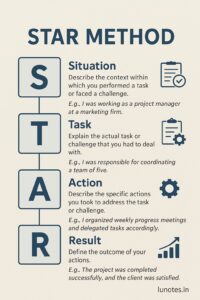
The best way to answer BBQs is by using a structured approach like the STAR Method (Situation, task, Action, Result) or the similar W5 Model (What, Who, When, Where, Why and How).
STAR Method |
Explanation |
|---|---|
| S: Situation | Set the background what was the problem or situation you were in. Describe where you were, what was happening, and why the situation mattered to you |
| T: Task | Explain your specific responsibilities or work need to be done What goal, duty or challenge were you expected to handle? |
| A: Action | Describe the exact steps you took, Focus on your contribution — what you did, how you did it and why. Use verbs like organized, coordinated, implemented etc |
| R: Result | what final outcome you got. Highlight achievements, improvements, numbers or benefits. Use data when possible (e.g., “increased efficiency by 20%”). |
2. What Types of Questions to Prepare For an interview?
-
Personal Questions: Aimed at interests and future plans regarding you. (Ex: “What you want to do in next 5 years?”)
-
Research Questions: Aimed at assessing your interest and knowledge of the job/company which you are going to do . (Ex: “What do you want to join our company (lunotes)?”)
-
Tip: List three or four attractive factors and only mention a single, minor, non-critical unattractive item.
-
-
Situational Questions: Hypothetical questions asking how you would handle a real-life situation on the job (e.g., handling a rude co-worker or a customer problem beyond your responsibility pr how you will handle stressful situations with the employee).
Strategy 4: Conducting Mock Interviews and Feedback
Preparation builds confidence and teaches you how to present and what to present during an real interview. Mock interviews are very important part of this preparation process.
1. What is The Role of Mock Interviews?
Mock interviews allow you to practice responding to Behavioral based and situational questions in a low-stakes environment. You can utilize recorded video mock interviews or practice sessions with career center staff who already have a experience of taking a lot of interviews. ex: Dhristi ias conduct mock interviews and post them on their youtube channel you can go visit and see those PLAYLIST LINK FOR MOCK INTERVIEWS.
2. What is the Value of Feedback?
Feedback is the main purpose of the mock interview this is how you learn and improve. You can get suggestions on:
-
Your clarity and succinctness (avoiding rambling).
-
Your use of the STAR method.
-
Your non-verbal cues (body language, eye contact) how to sit how much to eye contact what are the manners.
3. How to Handle Different Interview Settings?
| Setting | important Strategy |
| Panel/Two or More People | Maintain good eye contact with the person asking the question, but look at the other interviewers frequently to include them in the discussion. |
| Telephone Interview | Keep your resume and research notes in front of you. Choose your words carefully and vary your voice tone. If unready, politely request a callback time. |
| Video Conferencing | Make eye contact directly with the camera (this appears as direct eye contact to the employer). Check the monitor frequently to observe interviewers body language. |
| Competitive Group Interview (group discussions) | Contribute thoughtfully and intelligently, do not monopolize the conversation just for the sake of dominating the convo. The interviewers are watching who emerges as a leader but also being polite and respectful to others. |
Strategy 5: Post-Interview Follow-up
The job search doesn’t end when you leave the room. Post-interview follow-up demonstrates that you are genuinely interested, want to work and ready to improve.
1. how to Send a Thank You Note?
Send a professional thank you note (email is often acceptable) within 48 hours of the interview. Reiterate your continued genuine interest in the position.
2. How to Follow-up and then Research?
-
Ask the Next Step: Always ask the interviewer, “What is the next step in the hiring process?” This gives you permission to follow up later.
-
Salary Negotiation: After the interview (especially if you think you have done well and you ae expecting an offer), research potential salary offerings for the particular position. Knowing the corporate culture (expected overtime, work at home policies, companies employee satisfaction) is is important before taking the final decision and getting a salary you truly deserve
-
Never Assume: Do not assume that a second interview will lead to a job offer; keep collecting information actively.
Found a mistake? We work hard to ensure all notes are 100% accurate but please comment below your queries or questions we are always there to help you.
Enjoyed reading the above article make sure to check out Top 5 CV Writing Skills for Perfect Resumes & Cover Letters
By lunotes.in – crafted with love. ❤️