What are Marketing Basics their Needs, Scope & Benefits?
What Exactly is a “Market”?
Before diving into marketing, let’s clarify the word “market.”
In everyday language, a market is a physical or digital space (like Aminabad market or Amazon market) where people buy and sell things—a collection of sellers.
However, for a marketing professional, the definition is flipped. A market is a group of potential customers who share a similar need or want. It’s all about the buyers.
So, What is Marketing?
Simply put, marketing is the activity you do for a market. It’s a process that starts with understanding the customer and ends with their satisfaction.
The famous marketing guru Philip Kotler defines it as:
“A societal process by which individuals and groups obtain what they need and want through creating, offering, and freely exchanging products and services of value with others.”
The Nature of Marketing
Marketing can be understood from a few different perspectives:
-
It’s a Human Activity: It’s driven by the fundamental human need to satisfy needs and wants.
-
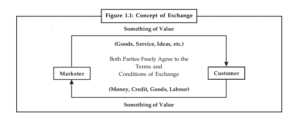
It Involves Exchange: The core of marketing is a value-for-value exchange process.
-
It’s an Economic Function: It connects producers with consumers, facilitating economic activity and the flow of goods and money.
-
It’s a Business & Social Function: As a business function, it drives revenue. As a social function, it helps deliver a higher standard of living to society.
Understanding Needs, Wants, and Demand
To succeed in marketing, you must understand this crucial distinction.
1. Needs
A need is a basic human requirement. These are fundamental and not created by marketers. Think of needs for food, water, air, shelter, and clothing.
2. Wants
Needs become wants when they are directed toward a specific object that can satisfy the need. Wants are shaped by our culture and individual personality.
Example: An Indian person and an American person both feel hungry—that’s the need.
-
The Indian person’s want might be for chapattis, rice, and curry (protein deficient loog ).
-
The American person’s want might be a hamburger and fries. (mote loog) The underlying need is the same, but the want is specific.
3. Demand
Demand is the final step. It’s a want for a specific product that is backed by an ability and willingness to pay. You might want a Mercedes, but you only become part of the demand for it when you have the money to buy one. (ish liye mehnat kar ladle)
The Scope of Marketing: What Does it Cover?
Marketing is a vast field. Its scope includes understanding what to market, who to market to, and what strategies to use.
1. What Can Be Marketed?
Marketing isn’t just for physical products. Marketers are involved in promoting 10 different types of entities: Goods, Services, Events, Experiences, Persons, Places, Properties, Organizations, Information, and Ideas.
2. The People Involved: Marketers and Prospects
-
A Marketer is someone who is seeking a response from another party. This response could be a purchase, a vote, attention, or a donation. (response seek karne wala)
-
The Prospect is the other party (the potential customer) from whom the marketer wants a response. (jis se response seek hoga)
3. Core Marketing Concepts
The scope of marketing involves focusing on several key areas:
-
Value and Satisfaction: Creating products and services that deliver perceived value and lead to customer satisfaction.
-
Consumer Behavior: Studying how individuals and groups select, buy, use, and dispose of goods to satisfy their needs.
-
Competition: Analyzing competing offerings to create a stronger, more attractive product.
-
STP (Segmentation, Targeting, and Positioning): This is a foundational marketing strategy.
-
Segmentation: Dividing the broad market into smaller groups of consumers with similar needs.
-
Targeting: Selecting one or more of these segments to enter.
-
Positioning: Creating a clear, distinct, and desirable image of the product in the target consumer’s mind.
-
4. The Marketing Mix (The 4Ps & 7Ps)
This is the set of tactical marketing tools that a firm blends to produce the response it wants in the target market. (Internal Link Idea: Link to a detailed post on the 7Ps of Marketing)
The Original 4Ps (For Goods):
-
Product: The offering and its features.
-
Price: The amount the customer pays.
-
Place: Where and how the product is distributed to the customer.
-
Promotion: The communication activities, like advertising.
The Extended 7Ps (For Services):
-
-
People: The staff and salespeople who interact with the customer.
-
Process: The systems and processes used to deliver the service.
-
Physical Evidence: The environment where the service is delivered (e.g., a clean restaurant).
-
Why is Marketing So Important? (Benefits) 🏆
Marketing offers huge benefits to both businesses and society as a whole.
Benefits for a Business
-
Satisfies Customer Needs: Helps businesses identify and fulfill the needs and wants of their customers.
-
Drives Profit: By creating demand, marketing is the primary revenue-generating function of a business.
-
Provides Consumer Insights: Helps the company understand consumer behavior and trends.
-
Builds Awareness: Informs customers about new products and services.
-
Manages Expectations: Creates and manages consumer expectations about the brand and its offerings.
Benefits for Society and the Economy
-
Improves Standard of Living: By creating new and better products, marketing gives people more choices and improves their quality of life.
-
Creates Jobs: The marketing, advertising, sales, and distribution industries create millions of employment opportunities.
-
Educates Consumers: Informs people, allowing them to make better purchasing decisions.
-
Boosts National Income: Successful marketing leads to business growth, which contributes to the nation’s overall economic health (GDP).
-
Protects Against Recession: By stimulating demand for goods and services, marketing helps keep the economy moving, even during slow periods.