Motivation & Perception in Consumer Behavior
Introduction to Psychological Factors
Why do you buy a specific brand of toothpaste? Why do you prefer an iPhone over Android? The answer lies in Psychological Factors.
Two of the most powerful psychological drivers are Motivation (The Why) and Perception (The How we see it).
1. Motivation: The Driving Force
Definition:
Motivation is the internal driving force that impels an individual to action. It is the energy that pushes a consumer to satisfy an unfulfilled need.
Need: A state of felt deprivation.
Drive: The tension caused by the need.
Goal-Object: The product that satisfies the need.
Example: You feel hungry (Need) $\rightarrow$ You feel restless (Drive) $\rightarrow$ You buy a Burger (Goal-Object).
Needs, Wants, and Demands
Before understanding motivation theories, we must distinguish between these three core marketing concepts:
Need: The basic human requirements for survival and well-being. These exist naturally (e.g., Food, Water, Clothing, Safety).
Want: When a need is directed towards a specific object shaped by culture and personality.
Example: An American needs food but wants a Hamburger. An Indian needs food but wants Rice and Dal.
Demand: Wants backed by the ability to pay (Purchasing Power).
Example: Many people want a Mercedes, but only those who have the money create the demand.
Maslow’s Hierarchy of Needs Theory
Proposed by Abraham Maslow (1943), this is the most famous theory of motivation. It suggests that human needs are arranged in a pyramid (hierarchy). A person tries to satisfy the lower-level needs first before moving to higher-level needs.
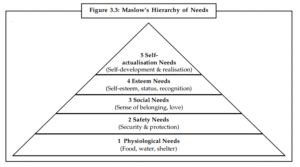
The 5 Stages:
Physiological Needs (Basic Survival):
Food, water, sleep, shelter.
Marketing Application: Maggi (Hunger), Bisleri (Thirst), Real Estate (Shelter).
Safety Needs (Security):
Protection from physical and emotional harm, job security, financial stability.
Marketing Application: LIC (Life Insurance), Voltas Locks, Helmets, Fixed Deposits.
Social Needs (Belongingness/Love):
Affection, friendship, acceptance, sense of belonging.
Marketing Application: Facebook (Connecting people), Cadbury Silk (Love), Greeting Cards.
Esteem Needs (Ego/Status):
Self-respect, status, recognition, prestige.
Marketing Application: Luxury cars (BMW), Premium Credit Cards, Raymond Suits (“The Complete Man”).
Self-Actualization Needs (Full Potential):
Becoming the best version of oneself, creativity, personal growth.
Marketing Application: Nike (“Just Do It”), Education Services, Hobby Classes.
Note: Maslow later expanded this to 8 stages (adding Cognitive, Aesthetic, and Transcendence needs), but for BBA exams, the 5-stage model is primary.
2. Perception: Creating Reality
Definition:
Perception is the process by which an individual selects, organizes, and interprets information to create a meaningful picture of the world.
“Perception is Reality.”
If a consumer perceives a product as high quality (even if it isn’t), they will treat it as high quality.
The Role of Perception in Marketing
Two people can see the same advertisement but interpret it differently.
Selective Attention: Consumers notice only a few ads out of the thousands they see daily. Marketers must use bold colors and catchy slogans to grab attention.
Selective Distortion: Consumers twist information to fit their existing beliefs. If you love Apple, you might ignore news about iPhone bugs.
Selective Retention: Consumers remember only the good points of brands they like and forget the good points of competitors.
Practical Example:
Tata Sky: Positioned itself as “Isko Laga Dala To Life Jingalala.” The perception created is that it solves all entertainment boredom.
Pricing: A price of ₹999 is perceived as “significantly cheaper” than ₹1000 due to psychological pricing perception.
3. Motivational Research
Consumers often don’t know why they buy what they buy, or they won’t admit it. Motivational Research helps uncover these hidden, subconscious reasons.
Definition:
Motivational Research is a type of qualitative research designed to uncover the consumer’s subconscious or hidden motivations. It is based largely on the psychoanalytic theories of Sigmund Freud.
Nature and Scope
Qualitative: It deals with “Why” (feelings/emotions), not “How many” (statistics).
Subconscious: It probes below the surface level of “I bought it because it’s cheap” to find the real reason (“I bought it to look cool”).
Small Sample Size: It involves in-depth study of a few people rather than surveying thousands.
Techniques of Motivational Research
In-Depth Interviews: A one-on-one long interview (1-2 hours) where a psychologist encourages the consumer to talk freely about their feelings regarding a product.
Focus Groups: A group of 6-10 people discussing a product under the guidance of a moderator. It reveals social motivations.
Projective Techniques: Used when consumers are shy to tell the truth. They are asked to project their feelings onto someone else.
Word Association: “What is the first word that comes to mind when I say ‘Coffee’?”
Sentence Completion: “People who buy sports cars are ________.”
Thematic Apperception Test (TAT): Showing a picture and asking the consumer to tell a story about it.
Summary: Role in Consumer Behavior
| Concept | Role in Marketing | Example |
| Motivation | Tells us WHY they buy. It identifies the unfulfilled need. | Selling a gym membership by triggering the motive of Social Appeal or Health. |
| Perception | Tells us HOW they see the product. It shapes the brand image. | Packaging chips in a matte packet to make them be perceived as Premium. |
| Motivational Research | Helps uncover HIDDEN reasons for buying. | Finding out that men buy convertibles not for wind-in-hair, but as a substitute for a mistress (Classic 1950s research finding!). |