What is Working Capital Management? (Concept & Meaning)
Working Capital Management is the functional area of finance that deals with a firm’s current assets and current liabilities. It ensures the company has sufficient liquidity to run day-to-day operations while maximizing profitability.
Working Capital refers to funds invested in current assets like raw materials, work-in-progress, finished goods, debtors, and cash.
Two Concepts of Working Capital:
Gross Working Capital: The total investment in all current assets.
Net Working Capital: The excess of total current assets over total current liabilities.
Formula:Net Working Capital = Current Assets - Current Liabilities
Types based on Time:
Permanent (Hard Core) Working Capital: The minimum level of current assets required at all times to carry out business. It should ideally be financed by long-term sources.
Temporary (Variable) Working Capital: The additional capital required over and above the permanent level to meet fluctuating demands (e.g., seasonal spikes).
The Working Capital Cycle (Operating Cycle)
The Operating Cycle refers to the length of time from the purchase of raw materials to the realization of cash from sales. It represents the time funds are tied up in the business process.
Formula:Operating Cycle = R + W + F + D - C
R = Raw Material Storage Period
W = Work-in-Progress Holding Period
F = Finished Goods Storage Period
D = Debtors Collection Period
C = Credit Period from Suppliers
Getty Images
Note: A shorter operating cycle means the firm needs less working capital because cash is recovered quickly. A longer cycle requires more working capital.
Approaches to Financing Working Capital
How should a firm fund its working capital needs? There are three main approaches based on the risk-return trade-off.
1. Matching (Hedging) Approach
The firm matches the maturity of the source of funds with the life of the asset.
Long-term sources finance Fixed Assets + Permanent Working Capital.
Short-term sources finance Temporary Working Capital.
Risk/Return: Moderate.
2. Conservative Approach
The firm relies more on long-term funds to be safe.
Long-term sources finance Fixed Assets + Permanent Working Capital + Part of Temporary Working Capital.
Short-term sources finance only the remaining peak temporary needs.
Risk/Return: Low Risk (high liquidity), but Lower Return (since long-term funds are costlier).
3. Aggressive Approach
The firm relies heavily on short-term funds to save costs.
Short-term sources finance Temporary Working Capital + Part of Permanent Working Capital.
Risk/Return: High Risk (danger of insolvency if loans aren’t renewed), but Higher Return (since short-term funds are cheaper).
Shutterstock
Regulation of Bank Finance (Tandon Committee)
Banks are the primary source of working capital finance in India. To regulate this, the RBI set up the Tandon Committee (1974) to introduce financial discipline.
The 3 Methods of Lending (Maximum Permissible Bank Finance – MPBF):
Method 1: Bank lends 75% of the Working Capital Gap (Current Assets – Current Liabilities). The borrower provides 25% from long-term sources.
Formula:MPBF = 0.75 (CA - CL)
Method 2: Bank lends 75% of Total Current Assets minus Current Liabilities. The borrower provides 25% of Total Current Assets.
Formula:MPBF = (0.75 * CA) - CL
Method 3: Bank lends against “Core Current Assets.” (Rarely used).
Impact: These norms ensured that companies maintain a minimum current ratio and do not rely entirely on bank funds for their operations.
Factors Affecting Working Capital Needs
Nature of Business: Manufacturing firms need more WC than trading or service firms due to production cycles.
Production Policy: Seasonal vs. steady production affects inventory levels.
Credit Policy: Liberal credit to customers increases debtors, increasing WC needs.
Business Cycle: Booms increase demand and WC needs; recessions decrease them.
Growth & Expansion: Growing firms need more WC for larger operations.
The Time Value of Money (TVM) is one of the most important concepts in finance. It states that money available today is worth more than the same amount in the future because it has the potential to earn interest.
Why is money today more valuable?
Because you can invest money now and earn a return and everything else in future is uncertain. Interest is the reward for waiting or the cost of borrowing money.
Important Terms
Principal (P): The original amount of money invested or lent.
Interest Rate (i): The percentage charged or earned per time period (e.g., 6% per year).
Time (n): Number of periods the money is invested.
Future Value (FV): Amount an investment grows to in the future.
Present Value (PV): Current value of a future amount.
Future Value (Compounding)
Future Value tells us how much an investment made today will be worth in the future.
1. Simple Interest
Interest is earned only on the original principal.
SimpleInterest= Principal × Rate × Time
2. Compound Interest
Interest is earned on principal + previous interest (the power of compounding).
Formula: Future Value of a Single Amount
FV = PV (1 + i)^n
Where:
FV = Future Value
PV = Present Value
i = Interest Rate per period
n = Number of periods
Note: More frequent compounding (monthly/quarterly) results in a higher future value.
Present Value (Discounting)
Present Value is the current worth of a future sum of money.
It answers:
How much should I invest today to receive ₹X in the future?
Formula
PV = FV / (1 + i)^n
Example on Present value of Money
Alpha Company can invest at 16% interest compounded annually, while Beta Company can invest at 16% interest compounded semi-annually. Both companies need ₹2,00,000 after 4 years. We will calculate how much each must invest today (Present Value).
Beta Company needs to invest less today because its investment grows faster due to more frequent compounding.
Annuities (Series of Equal Payments)
An annuity is a series of equal payments made at regular intervals of time (e.g., rent, insurance, pension).
1. Future Value of an Ordinary Annuity
The value of all future payments plus interest earned.
FV_annuity = R × [((1 + i)^n – 1) / i]
Where R = periodic payment (rent)
2. Present Value of an Ordinary Annuity
The lump sum needed today to provide equal future payments.
PV_annuity = R × [(1 – (1 + i)^(-n)) / i]
Example: Future Value of an Ordinary Annuity
In the beginning of 2006, the directors of Molloy Corporation decided that the plant facilities must be expanded in a few years. The company plans to invest ₹50,000 every year, starting on June 30, 2006, into a trust fund that earns 11% interest compounded annually.
Question
How much money will be in the fund on June 30, 2010, after the last deposit has been made?
Solution
The first deposit is made at the end of the first year, so it is an ordinary annuity
Number of periods (n) = 5 years
Interest rate (i) = 11%
The last deposit (2010) earns no interest because it is deposited on the final day
From the Future Value of Ordinary Annuity Table, Future Value Factor (at n = 5, i = 11%) = 6.22780
Formula
FV = Rent × Future Value Annuity Factor
Calculation
FV = 50,000 × 6.22780

FV = ₹3,11,390
Conclusion
Molloy Corporation will have ₹3,11,390 in the fund on June 30, 2010.
Finding the Required Annual Deposit
If the company needs exactly ₹3,00,000 on June 30, 2010, how much must it deposit every year?
Formula
Rent = FV / Future Value Annuity Factor
Calculation
Rent = 3,00,000 / 6.22780
Rent = ₹48,171.10
Final Answer
The company must deposit ₹48,171 every year to accumulate ₹3,00,000 by June 30, 2010.
Perpetuities
A Perpetuity is an annuity that pays forever (infinite life). Examples: perpetual bonds, preferred stock dividends.
Formula
PV = C / i
Where C = constant annual payment
Growth Calculations & Doubling Money
1. Compound Annual Growth Rate (CAGR)
gr = (Vn / V0)^(1/n) – 1
2. Rule of 72
A shortcut to estimate how long it takes to double money.
Finance is the art and science of managing money. Virtually all individuals and organizations earn, raise, spend, or invest money. Financial Management is broadly concerned with the acquisition and use of funds by a business firm.
In earlier years, it was synonymous with just raising funds. Today, its scope has broadened to include the efficient use of resources.
Scope of Financial Management
Financial management focuses on managing money in a smart and planned way. Its main aim is to make sure the business has enough funds and uses them correctly to increase profit and value. The scope of financial management includes the following areas:
1. Financial Analysis, Planning & Control
It means understanding the company’s financial position by analyzing financial statements like Balance Sheet & Profit-Loss account.
Planning helps decide how much money is required and where it will be spent.
Control ensures that money is used properly and not wasted.
Example: Checking budgets, comparing actual performance with planned performance.
2. Profit Planning
Profit planning means deciding the expected level of profit and making strategies to achieve it.
It includes controlling costs, increasing sales, and improving efficiency.
Example: Setting profit targets for the year and preparing plans to reach them.
3. Financial Forecasting
It means predicting the future financial needs of the business.
Helps in estimating cash needs, investment requirements, and financial risks.
Example: Forecasting future sales, future expenses, and capital needs.
4. Acquisition and Use of Funds
It means arranging funds from different sources (like shares, loans, debentures).
Also includes deciding where and how to invest this money to earn the best return.
Example: Raising money from the bank and investing it to buy new machinery.
Objectives: Profit Maximization vs. Wealth Maximization
Every Finance Manager has to ask one question: “What is our ultimate goal?”
There are two schools of thought: the Traditional approach (Make Profit) and the Modern approach (Create Wealth).
1. Profit Maximization (The Old School)
The Idea:
Business exists to make money. Therefore, any decision that increases profit is “Good,” and any decision that reduces profit is “Bad.”
Why it sounds right: It’s simple. Profit measures efficiency. If we are profitable, we survive.
Why it is actually WRONG (The Flaws):
It is Vague: What is “Profit”? Is it short-term profit? Long-term? Before tax? After tax? It is not clear.
Ignores Risk:
Example: Project A gives a guaranteed profit of ₹50,000. Project B gives a profit of ₹1 Lakh but has a 50% chance of failing completely.
A “Profit Maximizer” would choose Project B because the profit is higher, ignoring the huge risk of losing everything.
Ignores Time Value of Money:
Example: Option A gives you ₹1 Lakh today. Option B gives you ₹1 Lakh after 5 years.
Profit Maximization says both are equal (₹1 Lakh = ₹1 Lakh). But common sense tells us money today is more valuable than money 5 years later.
2. Wealth Maximization (The Modern School)
The Idea:
The goal is not just to earn profit, but to increase the Market Value of the company. This is also called Shareholder Value Maximization. The focus is on increasing the share price in the stock market.
The Formula:
Wealth = Number of Shares Owned × Current Market Price per Share
Why it is BETTER:
Considers Risk: It avoids risky projects because high risk makes share prices fall.
Considers Time: It recognizes that cash now is better than cash later. It uses Discounted Cash Flow (DCF) techniques.
Long-Term Focus: It doesn’t cut corners to make a quick buck. It invests in quality, brand, and research, which increases the company’s value over 10-20 years.
Considers Everyone: To keep the share price high, a company must treat customers, employees, and society well. If they cheat customers to make a quick profit, the share price will eventually crash.
Comparison: Which one wins?
Basis
Profit Maximization
Wealth Maximization
Concept
Traditional / Narrow
Modern / Broad
Goal
Earn large profits
Increase market value of shares
Time Horizon
Short-term focus
Long-term focus
Risk
Ignores risk factor
Considers risk factor
Time Value
Ignores timing of returns
Recognizes money has time value
Best For
Survival stage companies
Established, growing companies
While Profit is necessary for survival (like oxygen), Wealth Maximization is the ultimate goal (like a healthy life). A good Financial Manager always chooses Wealth Maximization because it accounts for risk, time, and future growth.
The Three Key Finance Functions (Decisions)
Financial management revolves around three major decisions that must be optimal to maximize firm value.
1. Investment Decision
Where should the firm invest its funds?
Capital Budgeting: Selecting long-term assets (projects) that yield returns in the future.
Working Capital Management: Managing current assets (cash, receivables, inventory) for day-to-day operations.
2. Financing Decision
How should the firm raise funds?
Capital Structure: Determining the right mix of Debt and Equity.
Source of Funds: Choosing between loans, shares, or retained earnings based on cost and risk.
3. Dividend Decision
How much profit should be distributed among stakeholders?
Dividends: Distributing profits to shareholders.
Retained Earnings: Keeping profits for reinvestment in the company.
The manager must decide the optimal dividend payout ratio that maximizes shareholder wealth.
Shutterstock
Interface of financial management with Other Functions
Finance is the lifeblood of an organization and connects with all other departments:
Marketing: Finance allocates budget for ads and sales campaigns.
Production: Finance approves funds for machinery and raw materials.
HR: Finance manages payroll and benefits costs.
Economics: Financial managers use economic theories (supply-demand, marginal analysis) for efficient operations.
Accounting: While accountants focus on accrual-based reporting, financial managers focus on cash flows for decision-making.
Understanding Capitalization
Before we jump into “Over” or “Under,” let’s understand Capitalization.
In simple terms, Capitalization is the total amount of money invested in the business (Shares + Debentures + Long-term Loans).
Think of capitalization like a shirt.
Fair Capitalization: The shirt fits perfectly. The capital invested generates just the right amount of profit.
Overcapitalization: The shirt is too loose (Too much capital, too little profit).
Undercapitalization: The shirt is too tight (Too little capital recorded, but massive profit).
1. Overcapitalization
A company is Overcapitalized when it has raised more money than it can profitably use. It sounds like having “too much money,” but in finance, it is a bad situation.
Simple Definition:
When a company’s earnings are very low compared to the huge capital it has invested. It is like buying a Ferrari just to deliver pizzas—the investment is huge, but the return is tiny.
Example:
Imagine Company A invests ₹10 Lakhs. The normal industry return is 10% (so it should earn ₹1 Lakh). However, Company A only earns ₹50,000.
The shareholders invested a lot but are getting very little return.
Verdict: Company A is Overcapitalized.
Symptoms (How to spot it):
Low Dividend: The company cannot pay good dividends because profits are low.
Low Share Price: Since dividends are low, people sell the shares, and the market price falls below the face value (e.g., a ₹10 share trades at ₹8).
Difficulty Raising Loans: Banks won’t lend money because the company isn’t profitable enough.
Causes (Why it happens):
Buying assets at high prices: Buying machinery when it was very expensive.
High Promotion Costs: Spending too much money on ads that didn’t bring sales.
Liberal Dividends: In the past, the company distributed all profits to shareholders and didn’t save anything for the future.
Remedies (How to fix it):
Reduction of Capital: Cancel old shares and issue new ones at a lower value.
Buyback: The company buys back its own shares to reduce the number of claimants on profit.
2. Undercapitalization
A company is Undercapitalized when it has very little recorded capital but is making huge profits. This sounds good, but it has dangerous side effects.
Simple Definition:
When a company’s earnings are exceptionally high compared to the capital invested. It is like a small roadside stall making crores in profit.
Example:
Imagine Company B invests only ₹1 Lakh. The normal industry return is 10% (expected profit ₹10,000). But Company B earns ₹50,000 (a 50% return!).
The return is massive compared to the small investment.
Verdict: Company B is Undercapitalized.
Symptoms (How to spot it):
High Dividend: The company pays huge dividends.
High Share Price: Everyone wants to buy these shares, so the market price shoots up above book value (e.g., a ₹10 share trades at ₹50).
High Secret Reserves: The company has a lot of hidden profit saved up.
Causes (Why it happens):
Buying assets cheaply: Buying a factory during a recession (low price) which is now producing great value.
Conservative Policy: For years, the company saved its profits instead of distributing them, making the company internally very rich.
High Efficiency: The management is super efficient and generates profit out of nothing.
Consequences (The hidden dangers):
Competition: Seeing huge profits, rivals will enter the market to copy you.
Labor Trouble: Workers will demand higher wages seeing the high profits.
Consumer Anger: Customers might feel the company is overcharging them to make such high profits.
Remedies (How to fix it):
Stock Split: Divide 1 share of ₹100 into 10 shares of ₹10. This reduces the earnings per share to look normal.
Bonus Shares: Issue free shares to existing shareholders to convert savings into capital.
Feature
Overcapitalization (Bad)
Undercapitalization (Risky but Good)
Earnings
Very Low
Very High
Share Price
Lower than Face Value
Higher than Face Value
Real Value
Assets are worth less than recorded.
Assets are worth more than recorded.
Remedy
Reduce Capital / Buyback
Issue Bonus Shares / Stock Split
Conclusion:
Financial management is more than just procurement of funds. It is about the optimal combination of investment, financing, and dividend decisions to maximize the wealth of shareholders while maintaining ethical standards and stakeholder relationships.
Time Management is the process of planning and exercising conscious control over the time spent on specific activities. For BBA and MBA students juggling lectures, assignments, and personal lives, it is the key to increasing effectiveness, efficiency, and productivity.
Time is a unique resource—it cannot be saved, retrieved, or bought. Everyone gets the same amount. The difference lies in how you use it.
The Purpose & Benefits
Why manage time? It isn’t just about getting work done; it’s about improving the quality of your life.
Stress Relief: A schedule reduces anxiety. You know exactly what needs to be done.
More Opportunities: Employers look for graduates who can prioritize.
Goal Realization: You achieve objectives faster.
Eliminate Wastage: Stop spending hours on things that don’t add value to your degree or career.
The Time Management Matrix (Prioritization)
To manage time effectively, you must distinguish between what is Urgent and what is Important. This matrix helps you categorize your tasks.
Sector 1: Urgent & Important
Sector 3: Urgent & Not Important
DO IT NOW
These are crises or deadline-driven projects.
• Submitting an assignment due today.
• Medical emergencies.
• Exam preparation the night before.
DELEGATE IT
These are interruptions.
• Some phone calls/emails.
• Meetings with no clear agenda.
• Pressing matters that don’t advance your goals.
Sector 2: Not Urgent & Important
Sector 4: Not Urgent & Not Important
SCHEDULE IT (The Focus Zone)
This is where growth happens.
• Semester planning.
• Relationship building.
• Exercise and personal growth.
• Prevention activities.
DELETE IT
These are time wasters.
• Excessive social media scrolling.
• Trivia and busy work.
• Watching TV aimlessly.
Pro Tip: Successful students spend most of their time in Sector 2. They plan ahead so tasks don’t become urgent crises (Sector 1).
To manage time effectively, tasks should be categorized based on Importance and Urgency. This helps distinguish between being “busy” and being “productive.”
Core Strategies for Success
1. Set SMART Goals
Don’t just say “I will study.” Be specific.
Specific
Measurable
Attainable
Relevant
Timely
2. The Art of Delegation
Delegation is a management skill you must learn for your MBA. It is not running away from work; it is assigning tasks to others based on their skills to avoid burnout. Note: Always set a specific end date for delegated tasks.
3. Learn to Say “No”
Over-committing is a major cause of stress. If a request does not align with your priorities (Sector 3 or 4), politely refuse.
4. The “15-Minute” Rule
Take a break between tasks. Working continuously lowers focus. A 10-15 minute break refreshes your mind and boosts productivity for the next task.
Time Wasters vs. Time Savers
Common Time Wasters (Avoid These):
Procrastination: Putting off tasks leads to indecision and stress.
Inability to say No: Taking on too much.
Crisis Management: Constantly fighting fires because of poor planning.
Micro-managing: Failing to let others perform.
Perfectionism: Spending too much time on tasks that don’t require perfection.
Proven Time Savers (Do These):
Handle correspondence once: Reply to emails/messages immediately if it takes less than 2 minutes.
Use Checklists: Keep a “To-Do” list to organize your day.
Carry a Notebook: Capture brilliant ideas immediately so you don’t forget.
Start Early: Successful leaders often start their day early to plan before the chaos begins.
Busting Time Management Myths
Myth: “I work better under pressure.”
Reality: Rushing usually compromises quality and increases errors.
Myth: “Planning takes too much time.”
Reality: Research shows that 1 hour of planning can save hours of execution time.
Myth: “All stress is bad.”
Reality: There is good stress (excitement) and bad stress (anxiety). Time management helps manage the bad stress.
Myth: “I’m busy, so I’m productive.”
Reality: You might be busy doing “urgent but not important” tasks (Sector 3). Activity does not equal productivity.
Conclusion
Poor time management leads to poor workflow, wasted opportunities, and a reputation for being unreliable. By applying these skills—prioritizing, planning, and delegating—you improve not just your grades, but your future career prospects.
Employee Remuneration refers to the total compensation provided to employees in exchange for their services or labor. It is one of the most critical functions of Human Resource Management because it directly impacts employee motivation, satisfaction, and productivity.
Remuneration is not just “cash.” It encompasses all forms of financial and non-financial rewards.
Wage vs. Salary: What is the Difference?
While often used interchangeably, there is a distinct difference between wages and salaries in business contexts:
Basis
Wage
Salary
Definition
Payment made to workers usually on an hourly, daily, or piece-rate basis.
A fixed regular payment made to employees, usually monthly or annually.
Target Group
Usually associated with Blue-collar workers (labourers, factory workers).
Usually associated with White-collar employees (managers, admin staff).
Stability
Variable (depends on hours worked or output produced).
Fixed (does not fluctuate based on hours worked in the short term).
Payment Cycle
Daily or Weekly.
Monthly.
Extra Pay
Eligible for overtime pay if they work extra hours.
Usually not eligible for overtime (expected to complete tasks regardless of time).
Components of Remuneration
A well-structured remuneration system consists of two main parts:
1. Financial Compensation (Monetary)
Base Pay: The basic wage or salary.
Incentives: Performance-based rewards (e.g., sales commissions, production bonuses).
Allowances: Payments for specific needs (e.g., House Rent Allowance, Travel Allowance).
Benefits: Insurance, retirement plans (PF/Gratuity), and paid time off.
2. Non-Financial Compensation
Recognition: Praise, awards, and job titles.
Work Environment: Flexible schedules, remote work options, and supportive leadership.
Growth: Opportunities for training, upskilling, and career advancement.
Factors Influencing Employee Remuneration
When a company decides how much to pay, they consider several factors:
Nature of the Job: The complexity, risk, and responsibilities involved.
Industry Standards: What are competitors paying? (Benchmark rates).
Employee Profile: Qualifications, experience, and skill set.
Company’s Financial Health: The organization’s ability to pay.
Performance: Individual productivity and contribution to goals.
Case Study Analysis: T.R. Venkatachalam Chetty Cashews
To understand remuneration in the real world, let’s look at a study conducted at T.R. Venkatachalam Chetty (TRV) Cashews, a leading manufacturer and exporter.
Objective of the Study:
To analyze if employees are satisfied with their wages, benefits, and incentives, and how this affects their motivation.
Key Findings:
Satisfaction Levels: About 52% of employees expressed high overall satisfaction. Leadership was viewed positively.
Incentives: While 80% of employees receive performance-based incentives, many felt the process lacked transparency and fairness.
Disparities: Significant compensation gaps were found across different departments.
Non-Monetary Benefits: Employees valued paid time off but felt other benefits (like flexible hours) were inconsistent.
Suggestions for Improvement (Managerial Takeaways):
Standardize Pay: Align salaries with current industry benchmarks to remain competitive.
Skill-Based Pay: Introduce incentives for employees who learn new skills or get certified.
Transparency: Be clear about how bonuses are calculated so employees trust the system.
Expand Perks: Offer non-monetary benefits like childcare support and educational opportunities.
Importance of a Good Remuneration System
Why should a company care about paying well?
Attracts Talent: Competitive pay brings in the best candidates.
Retains Employees: Reduces labor turnover (people leaving for better pay).
Boosts Morale: Fair pay makes employees feel valued and respected.
Increases Productivity: Financial incentives motivate employees to work harder.
Ensures Compliance: Adhering to minimum wage laws avoids legal trouble.
Conclusion:
An effective remuneration system is a balance. It must be fair (internal equity), competitive (external equity), and transparent. As seen in the TRV Cashews case, even if employees are generally satisfied, issues like transparency and fairness in incentives must be addressed to maintain a highly motivated workforce.
Reward Management is the process of formulating and implementing strategies and policies to reward employees fairly, equitably, and consistently in accordance with their value to the organization.
It is much more than just “payroll.” It is a strategic approach to managing people. It deals with the design, implementation, and maintenance of reward systems (pay, benefits, and non-financial rewards) that meet the needs of both the organization and its employees.
In simple terms: It is about deciding how much to pay, why to pay it, and what else to offer besides money to keep employees happy and productive.
The Aims & Philosophy of Reward Management
Why do companies have a reward system? It’s not just because they have to. A good system achieves specific goals:
Reward Value: To pay people according to the value they create. If an employee brings in high revenue, they should be rewarded accordingly.
Motivation & Commitment: To encourage employees to work harder (engagement) and stay loyal to the company (commitment).
Attraction & Retention: To offer a package good enough to hire the best talent and stop them from leaving for a competitor.
Alignment: To ensure that what the company pays for (e.g., sales targets) aligns with the company’s business goals.
Performance Culture: To create an environment where high performance is recognized and celebrated.
The Philosophy (Guiding Principles): A reward system is built on certain beliefs:
Fairness (The “Felt-Fair” Principle): Employees must feel that they are treated justly.
Equity:
Internal Equity: Is my pay fair compared to my colleague’s?
External Equity: Is my pay fair compared to the market rate?
Transparency: Employees should understand how their pay is calculated. Nothing should be hidden.
Consistency: Decisions on pay shouldn’t vary arbitrarily between different managers.
Economic Theories: How are Pay Levels Determined?
Have you ever wondered why a software engineer earns more than a clerk? Or why salaries go up in some years and down in others? Economists have different theories to explain this.
Theory
Explanation
Real-World Example
1. Law of Supply & Demand
Ideally: Pay is a price. If labor is scarce (low supply) and companies need it (high demand), pay goes up. If there are too many workers (high supply), pay goes down.
IT Boom: When there was a shortage of coders, their salaries skyrocketed because demand exceeded supply.
2. Efficiency Wage Theory
Ideally: Some firms intentionally pay more than the market rate. Why? They believe high pay motivates superior performance and attracts the best talent.
Google/Microsoft: They pay top-tier salaries to ensure they get the smartest people and keep them highly productive.
3. Human Capital Theory
Ideally: Skills, education, and experience are “capital.” The employee invests time and money to get them. Pay is the “return on investment” for these skills.
MBA vs. High School: An MBA graduate gets paid more because they have invested more in their “human capital” (education).
4. Agency Theory
Ideally: Owners (Principals) and Employees (Agents) have different interests. Owners want profit; employees want less work. Pay incentives align their interests.
Stock Options: Giving a CEO shares in the company ensures they work hard to increase profit, benefiting both them and the owners.
5. The Effort Bargain
Ideally: Employment is a deal. The worker says, “I will give this much effort if you give me this much reward.”
Performance Bonus: “If you hit 100 sales, you get a bonus.” The worker agrees to the extra effort for the extra reward.
The Elements of a Reward System
A complete reward system is made up of several interconnected parts. It acts like a machine where every gear serves a purpose.
Reward Strategy: The “Big Picture” plan. It defines the long-term direction of how the company will pay and reward staff.
Reward Policies: The rules of the game.
Market Stance: Do we want to pay above the market (market leaders) or just the average (market matchers)?
Base Pay: The fixed salary or wage (hourly/monthly) for doing the job. This is guaranteed pay.
Job Evaluation: A systematic process to determine the “size” or “worth” of a job compared to others in the company. This ensures Internal Equity.
Market Rate Analysis: Checking what competitors are paying for similar jobs. This ensures External Competitiveness.
Contingent Pay: “Pay at Risk” or variable pay. This is extra money paid for performance, skill, or competence (e.g., Sales Commission, Annual Bonus).
Employee Benefits: Indirect rewards like pensions, sick pay, health insurance, and company cars. These provide security.
Non-Financial Rewards: Rewards that don’t involve money but provide satisfaction, such as recognition, praise, better job titles, or career growth.
Total Reward: The Holistic Approach
Modern HR doesn’t just focus on salary. It focuses on Total Reward. Total Reward combines financial (tangible) and non-financial (intangible) rewards to create a complete package for the employee.
Definition: “Total reward includes all types of rewards – indirect as well as direct, and intrinsic as well as extrinsic.” — Manus & Graham
Shutterstock
Explore
(Note: While this tag was in context history, a specific “Total Reward Model” diagram would be better here if available, but we will describe it conceptually below).
The Two Main Components of Total Reward
1. Transactional Rewards (Tangible / Financial)
These are rewards you can touch or see in your bank account. They arise from the financial transaction between employer and employee.
Base Pay: Salary.
Contingent Pay: Bonuses, incentives, shares.
Benefits: Pensions, holidays, insurance.
Nature: Essential to recruit and retain people, but competitors can easily copy them. (If you pay ₹50k, a competitor can offer ₹55k).
These are psychological rewards related to the work environment and learning. They touch the heart and mind.
Learning & Development: Training, mentoring, career progression.
Work Environment: Leadership style, company culture, recognition, work-life balance.
Nature: Essential for motivation and engagement. These are very hard for competitors to copy. You cannot easily “copy” a great company culture.
Why is Total Reward Important?
Greater Impact: Money motivates to an extent, but recognition and growth sustain that motivation.
Talent Magnet: It helps the company become an “Employer of Choice.”
Cost-Effective: You can motivate employees through recognition (free) rather than just increasing salaries (expensive).
Developing a Reward Strategy
How does a company decide its reward system? It creates a Reward Strategy. This is a declaration of intent—a roadmap showing where the company wants to go with its rewards.
The 3 Components of an Effective Strategy (Brown, 2001)
Clear Goals: The strategy must support the business. (e.g., If the business goal is “Innovation,” the reward strategy should be “Bonus for new ideas”).
Well-Designed Programs: The pay structure must fit the company’s specific needs.
Supportive Processes: HR must have good systems to manage payroll and performance.
The Development Process (4 Phases)
Diagnosis Phase: Look at the current situation. Are employees happy with pay? Are we losing staff? What is the business goal?
Detailed Design Phase: Create the new plan. Test it. (e.g., Designing a new bonus scheme).
Final Testing: Run a pilot program to see if it works.
Implementation: Launch the new system and train managers on how to use it.
The Role of Line Managers: In modern companies, HR designs the system, but Line Managers (Team Leaders) implement it. They are the ones who decide the performance ratings and communicate pay raises. Therefore, HR must train managers to be fair and consistent.
Industrial relations (IR) are complex and influenced by social, economic, and psychological factors. Different schools of thought offer different approaches to explain and manage these relationships.
1. Psychological Approach
This approach attributes IR problems to differences in perception. Labour and Management see things differently.
Workers: Dissatisfaction with pay or conditions makes them aggressive (strikes).
Employers: Feel restricted by regulations and demanding workers, leading to lockouts.
Key Insight: Conflict arises from motives like power, status, and recognition, not just money.
2. Sociological Approach
This looks at societal changes affecting workers.
Factors: Urbanization, housing shortages, pollution, and the breakdown of the joint family system cause stress and “culture pollution.”
Key Insight: External social misery impacts workplace behavior, requiring continuous analysis of social factors.
3. Human Relations Approach
This approach argues that people are motivated by social and psychological factors, not just money.
Core Belief: Employees are not machines. Their behavior is shaped by feelings, sentiments, and informal groups.
Solution: Managers need social skills. They must explain the importance of jobs, encourage participation, and integrate individual goals with organizational goals to reduce conflict.
4. Giri Approach (V.V. Giri)
Proposed by V.V. Giri (former President of India), this approach emphasizes collective bargaining and internal settlement.
Key Belief: Outside interference (like courts) should be avoided.
Solution: Disputes should be settled through voluntary negotiations and bipartite machinery within the industry.
5. Gandhian Approach
Based on truth and non-violence (Satyagraha).
Right to Strike: Accepted, but only for a just cause and in a peaceful manner.
Trusteeship Theory: Wealth belongs to society, not the owner. The employer is a “trustee” who should serve society’s interests. Workers are co-partners.
Solution: If employers fail, workers should appeal to their conscience or use non-violent non-cooperation.
6. HRD (Human Resource Development) Approach
This modern approach views employees as the organization’s greatest asset.
Core Belief: People have unlimited potential that can be developed with the right climate.
Manager’s Role: Shifts from “policeman” to “developer, coach, and mentor.”
Tools: Team building, training, open communication, and empowering employees to take decisions.
Trade Unions: Voice of the Workforce
Trade Union Definition:
British Ministry of Labour: “All organizations of employees… known to include among their functions that of negotiating with their employees with the object of regulating conditions of employment.”
Dale Yoder: “A continuing long-term association of employees… formed for the purpose of protecting their mutual interests.”
Objectives & Role of Trade Unions
Improve Conditions: Secure fair wages and better working/living conditions.
Cooperation: Offer cooperation to improve production and discipline.
Growth: Enlarge opportunities for training and promotion.
Identity: Promote an identity of interests between workers and the industry.
Welfare: Provide educational, cultural, and recreational facilities.
Security: Safeguard tenure (job security).
Advantages of Trade Unions
For Labour: Prevents exploitation, unites the workforce, provides education, and increases bargaining power.
For Employers: Helps avoid/pacify conflicts through collective talks, provides a stable workforce, and promotes unity.
For Society: Represents the manpower of the country, helping the government frame better labor laws.
Weaknesses of Trade Unions in India
Despite having over 43,000 registered unions, the movement in India suffers from significant weaknesses:
Fragmentation: Too many small unions with small memberships prevent them from hiring experts or having strong bargaining power.
Political Influence: Unions are often controlled by political parties/leaders rather than workers, turning them into political tools.
Outside Leadership: Dependence on outsiders (social workers, politicians) retards the growth of internal leadership.
Intra-Union Rivalry: Conflicts between rival unions weaken the movement.
Financial Crunch: Low membership fees lead to weak financial positions.
Concentration: Activity is concentrated mostly in metropolitan areas and large industries, leaving other sectors unrepresented.
Causes of Slow Progress
The National Commission on Labour identified key reasons for slow progress and recommended:
Settling rivalries (“One Union, One Industry”).
Reducing political influence by building internal leadership.
Canceling registration of dormant unions.
Raising membership fees to improve finances.
History: Growth of Trade Unions in India
The movement evolved through six key phases:
1875-1918 (Origin): Started with agitations against poor conditions. First registered union: Amalgamated Society of Railway Workmen of India (1897).
1918-1924 (Early Growth): Post-WWI economic distress spurred growth. AITUC formed in 1920. Trade Union Act passed in 1926.
1924-1935 (Split): Ideological differences led to splits (communists vs. non-communists).
1935-1939 (Unity): New constitution led to unity among unions.
1939-1946 (WWII Era):INTUC established in 1946.
1947-Present (Modern Era): Rapid increase in the number of unions after independence, driven by new spirit and economic distress
Grievance is any discontent or dissatisfaction arising out of anything connected with the company that an employee thinks, believes, or feels is unfair, unjust, or inequitable.
It is a feeling of injustice related to one’s employment situation. If not addressed, a grievance turns into a complaint, which can lead to indiscipline and low productivity.
According to the National Commission on Labour:
“Complaints affecting one or more individual workers in respect of their wage payments, overtime, leave, transfer, promotion, seniority, work assignment, and discharges constitute Grievances.”
Causes of Grievance
Grievances usually stem from three main areas:
Working Conditions: Improper job matching, poor conditions, unavailable tools, bad relationships.
Management Policy: Issues with wage payment, leave, overtime, promotion, or transfer.
Personal Reasons: Over-ambition or excessive self-esteem.
Grievance Handling Procedure
An effective procedure is essential for maintaining industrial peace.
Principles of a Good Procedure:
Should be dealt with at the lowest level first (immediate superior).
Clear line of appeal must be available.
Must be resolved speedily.
Must be set up with the participation of employees.
The Model Grievance Procedure (India)
Adopted by the Indian Labour Conference (1957), this provides a 5-step time-bound framework:
Step 1: Employee presents grievance verbally to the designated officer. Response required within 48 hours.
Step 2: If unsatisfied, the employee goes to the Department Head. Response required within 3 days.
Step 3: If still unsatisfied, the grievance goes to the Grievance Committee. Recommendation required within 7 days.
Step 4: If the committee is not unanimous, the matter goes to the Manager. Decision required within 3 days.
Step 5: The employee can appeal to the manager for revision (with a union official). Decision within 7 days.
Final Resort: If still unresolved, it may go to Voluntary Arbitration.
What is Discipline? (Meaning & Concept)
Discipline is an approach aimed at instilling orderly behavior and respect for willing obedience to a recognized authority. It is the “employee’s self-control” which motivates them to comply with the organization’s goals and objectives.
In an industrial setting, discipline is crucial for a healthy environment, escalating production, and ensuring smooth functioning.
Key Definitions:
Webster’s Dictionary: “Training that corrects, moulds, strengthens or perfects individual behavior.”
Dr. Spriegel: “The force that prompts an individual or a group to observe the rules, regulations and procedures which are deemed to be necessary to the attainment of an objective.”
Aspects of Discipline
Negative Aspect: Uses “fear” as a force. If an employee defies rules, strict punishment is levied. This is the traditional concept.
Positive Aspect: Focuses on “self-discipline.” It asserts cooperative efforts and willing approval from employees to abide by the rules. This is the modern, progressive outlook.
Indiscipline and Misconduct
Indiscipline is the non-compliance with formal and informal rules and regulations. It has detrimental effects on morale and the organization.
Misconduct is a specific action or behavior that is prejudicial to the employer’s interests, inconsistent with duties, or unsafe.
Categories of Misconduct:
Minor Contravention: Negligence, minor disobedience (few serious consequences).
Major Contravention: Lying, cheating, stealing (partially hinders work).
Intolerable Offences: Threat to use weapons, drug use, smoking near inflammables (endangers the relationship).
Examples of Misconduct (Model Standing Orders Act, 1946):
Willful insubordination or disobedience.
Theft, fraud, or dishonesty.
Habitual late coming or absence without leave.
Taking or giving bribes.
Engaging in strikes or inciting others to strike illegally.
McGregor’s Hot Stove Rule
Douglas McGregor gave a model for enforcement of discipline called the “Hot Stove Rule.” It compares disciplinary action to touching a red-hot stove. It has four key characteristics:
Advance Warning: A red-hot stove warns you (“don’t touch me, you will burn”). Similarly, employees must know the rules and the consequences of breaking them beforehand.
Immediate Effect: Touching the stove burns you instantly. Discipline should also be immediate; the penalty must be imposed soon after the violation.
Consistency: Every time you touch the stove, you get burned. Similarly, every time a rule is broken, the penalty must be consistent.
Impersonal Approach: The stove burns everyone who touches it, regardless of who they are. Management should punish the act, not the person, without discrimination or favoritism.
The Disciplinary Action Procedure
Administering discipline requires a fair and systematic process.
Ascertaining the Problem: Look into the violation. Who was involved? What was the gravity of the offence?
Searching for Facts: Thoroughly examine the case and gather evidence. Give the employee a chance to explain (Principles of Natural Justice).
Deciding the Penalty: The punishment should fit the offence and discourage future occurrences.
Application of Penalty: Impose the penalty on the wrongdoer.
Follow-up: Vigilant supervision of the employee to ensure behavior correction.
Code of Discipline in Indian Industry
Adopted by the Indian Labour Conference in 1957, this code lays down principles for maintaining discipline:
Voluntary Agreement: It is a state-induced voluntary agreement between unions and management.
No Unilateral Action: Both parties must avoid taking action without exploring all avenues of settlement.
Existing Machinery: Utilize existing machinery for dispute settlement.
No Coercion: Avoid violence, intimidation, or victimization.
Recognition: Employers must recognize the majority union.
Fairness: Awards and agreements should be implemented promptly.
Objectives of Discipline
To obtain willing approval of employees.
To ensure uniformity and assurance.
To improve quality of production and morale.
To generate respect for human relations.
Employee Exit & Exit Interviews
Employee Exit is the separation of an employee from the organization. It can be voluntary or involuntary.
Types of Exit
Resignation: Voluntary termination by the employee.
Retirement: Leaving upon reaching the age of superannuation.
Dismissal: Termination as a punishment for major offences.
Discharge: Permanent separation due to incompetence, health, or redundancy.
Downsizing: Reducing the workforce to cut costs or restructure.
The Exit Interview
This is a meeting between HR and a departing employee.
Purpose: To collect honest feedback about the organization’s culture, policies, and reasons for leaving.
Benefit: Since there is no pressure, employees reveal true feelings, helping the company improve and reduce future turnover.
Performance Appraisal (PA) is the systematic evaluation of an individual with respect to his or her performance on the job and their potential for development.
It is a formal, structured system of measuring and evaluating an employee’s job-related behaviors and outcomes. The goal is to discover how and why the employee is performing the way they are and how they can improve in the future to benefit the employee, the organization, and society.
Key Focus: It measures both past performance and future potential.
Key Requirement: Successful appraisal requires a consistent approach, clear standards, and bias-free ratings.
Objectives of Performance Appraisal
Why do organizations conduct appraisals? Here are the 5 main objectives:
Compensation Decisions: It serves as a basis for pay raises and bonuses. It supports the idea of “pay for performance” rather than just seniority.
Promotion Decisions: It acts as a guide for job changes, transfers, or promotions based on competence.
Training & Development: It identifies skill gaps. It tells employees what skills they need to develop to move up the ladder.
Feedback: It provides constructive feedback to employees about where they stand and how they can improve.
Personal Development: It helps reveal the root causes of good or poor performance, aiding in self-improvement.
Motivation: Recognition of good work motivates employees to perform even better.
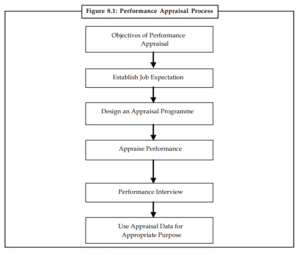
The Performance Appraisal Process
The appraisal process is a systematic cycle:
1. Objectives of Performance Appraisal
The first step is to clearly define why the appraisal is being done.
Objectives may include improving employee performance, deciding promotions or salary increments, identifying training needs, and evaluating strengths & weaknesses.
Clear objectives make the appraisal system meaningful and useful.
2. Establish Job Expectations
Employees must know what is expected from them.
HR and managers set performance standards, job responsibilities, and key result areas (KRAs).
When expectations are clear, employees can perform better and meet targets.
3. Design an Appraisal Program
HR decides the method of appraisal to be used (e.g., ranking method, rating scale, 360-degree feedback, MBO, etc.).
The program includes who will evaluate (manager, peers, customers, or self-appraisal), when evaluation will take place, and how the process will be recorded.
A good design ensures fairness and transparency.
4. Appraise the Performance
Actual evaluation of the employee takes place.
Performance is measured by comparing actual performance with standards set earlier.
Data is collected through observation, reports, tests, checklists, feedback, etc.
The goal is to get a realistic and unbiased assessment.
5. Performance Interview / Feedback
The manager discusses results with the employee.
Strengths and areas for improvement are communicated.
It helps in motivation, understanding problems, and setting future goals.
This should be a two-way discussion, not just criticism.
6. Use Appraisal Data for Appropriate Purpose
The final step is using the appraisal results for HR decisions.
Used for:
Promotions, transfers, rewards, salary hikes
Training and development
Career planning
Corrective actions (if necessary)
Ensures that the appraisal process leads to action and improvement.
Techniques & Methods of Performance Appraisal
Appraisal methods are broadly classified into Past-Oriented and Future-Oriented methods.
A. Past-Oriented Methods (Traditional)
1. Rating Scales
The most common method. It consists of numerical scales representing job-related criteria (e.g., dependability, output, attitude). The rater marks the employee on a scale from “Poor” to “Excellent.”
Pros: Easy to use for large numbers of employees.
Cons: Prone to rater bias and the “illusion of precision.”
2. Checklists
A list of statements about employee traits (e.g., “Is regular?”, “Works hard?”). The rater simply ticks ‘YES’ or ‘NO’. HR assigns weights/scores to these answers later.
Pros: Economical and standardized.
Cons: Biased if weights are improper.
3. Forced Choice Method
The rater must choose from a block of statements (e.g., “Learns fast” vs. “Works hard”) to describe the employee. This reduces personal bias as the rater doesn’t know the scoring value of each statement.
4. Critical Incident Method
The superior records specific “critical” incidents of behavior that led to success or failure (e.g., “Handled a difficult client perfectly” or “Missed a key deadline”). In this manager records specific good or bad incidents of employee behavior.
Pros: Based on actual behavior and events, not vague traits.
Cons: Negative incidents are often noticed more than positive ones.
5. Behaviorally Anchored Rating Scales (BARS)
A modern technique that combines rating scales with critical incidents. It uses descriptive statements of behavior (anchors) to define points on the scale (e.g., a “5” rating is defined by specific, excellent behavior).
Pros: Very accurate and job-specific.
Cons: Time-consuming to develop.
6. Field Review Method
An outsider (from HR or corporate) conducts the appraisal by interviewing the supervisor. This reduces supervisor bias but is time-consuming.
B. Future-Oriented Methods (Modern)
1. Management by Objectives (MBO)
Proposed by Peter F. Drucker (1954).
Process: The superior and subordinate jointly set specific goals for a time period. At the end, performance is measured against these agreed goals or achievement of the goals.
Pros: Increases motivation and clarity.
Cons: Not suitable for rigid jobs (like assembly lines).
2. 360-Degree Feedback
A multi-source appraisal where data is collected from everyone around the employee: Supervisors, Peers, Subordinates, Customers, and Self evaluation.
Pros: Provides a holistic view; excellent for soft skills and leadership development.
Cons: Can be intimidating; analysis is complex.
3. Assessment Centers
Employees are evaluated by a team of experts using various exercises like role-playing, case studies, and business games over 2-3 days. Ideally used for identifying potential managers.
Judges managerial and leadership skills.
4. Psychological Appraisal
Conducted by psychologists using in-depth interviews and tests to assess personality, intellectual, emotional, and motivational characteristics. It focuses on future potential.
Advantages
Merit-Based Rewards: Ensures that salary hikes and promotions are fair and based on data, not favoritism.
Identifies Training Needs: Pinpoints exactly what skills are missing.
Improves Communication: Forces the boss and subordinate to talk about work expectations.
Documentation: Creates a legal record of performance which helps in case of firing or disputes.
Problems & Errors in Appraisal
Even the best systems fail if raters are biased. Common errors include:
Halo Effect: Rating an employee high on everything just because they are good at one thing (e.g., Communication).
Horn Effect: Rating an employee low on everything because of one negative trait.
Central Tendency: Playing it safe by rating everyone as “Average.”
Leniency/Strictness: Being too nice or too harsh to everyone.
Recency Effect: Judging based only on the last few weeks rather than the whole year.
Stereotyping: Judging based on gender, race, or background rather than performance.
Uses of Performance Appraisal
Where is this data used?
Salary Administration: Deciding increments and pay structures.
Promotion/Transfer: Moving people to the right jobs.
Confirmation: Deciding if a probationer (new hire) should be made permanent.
Layoffs/Termination: Deciding whom to fire during cost-cutting (usually the low performers).
HR Planning: Validating if the selection process was correct. (If all new hires are performing poorly, the selection process might be flawed).
Performance Management System (PMS)
Performance Management is broader than just “Appraisal.” It is a continuous process of:
Identifying performance parameters.
Setting standards.
Planning performance in participation with employees.
Identifying competency gaps.
Planning development activities.
And improve employee performance.
While Appraisal is a one-time event (evaluation), Management is an ongoing cycle of goal-setting, monitoring, and feedback to ensure organizational goals are met.
Job Evaluation is the output provided by Job Analysis. While Job Analysis describes the duties, authority relationships, and skills required for a job, Job Evaluation uses that information to evaluate the worth of each job.
It is a formal and systematic process of comparing jobs to determine the value of one job relative to another. The primary goal is to establish a logical job hierarchy to fix fair wages and salaries.
Key Distinction: It evaluates the JOB, not the PERSON. (Performance Appraisal evaluates the person). It assesses the demands the job makes on a normal worker, ignoring individual abilities.
Key Definitions
ILO (International Labour Organization): “An attempt to determine and compare demands which the normal performance of a particular job makes on normal workers without taking into account the individual abilities or performance of the workers concerned.”
Kimball and Kimball: “An effort to determine the relative value of every job in a plant to determine what the fair basic wage for such a job should be.”
“Job evaluation is the process of analyzing and assessing various jobs systematically to ascertain their relative worth in an organization.” — Dale Yoder
Principles of Job Evaluation (The Kress Model)
According to Kress, a successful job evaluation programme must follow these six principles:
Rate the Job, Not the Person: The focus must remain strictly on the requirements of the role, not the person currently holding it.
Use Definable Elements: The factors used for rating (e.g., skill, effort) should be explainable, limited in number, and cover all job requisites without overlapping.
Clear Definitions: The elements selected must be clearly defined and properly selected to avoid ambiguity.
Foreman Participation: Supervisors and foremen should participate in rating the jobs within their own departments to ensure accuracy.
Employee Cooperation: Employees should be given an opportunity to discuss job ratings; this secures their cooperation and trust.
Avoid Too Many Wage Rates: It is unwise to create a unique wage rate for every single point total. Instead, jobs should be grouped into occupational wages.
The 7 Key Objectives
Why do organizations perform Job Evaluation?
Standardization: To provide a standard procedure for determining the relative worth of each job.
Accurate Descriptions: To secure and maintain complete and impersonal descriptions of every distinct job in the plant.
Equal Pay for Equal Work: To ensure that like wages are paid to all qualified employees for similar work.
Fair Promotion: To promote fair and accurate consideration of employees for advancement and transfer.
Benchmarking: To provide a factual basis for comparing wage rates with similar jobs in the community or industry.
HR Decisions: To provide information for selection, placement, training, and work organization.
Equitable Pay Structure: To determine a rate of pay that is fair relative to other jobs in the plant.
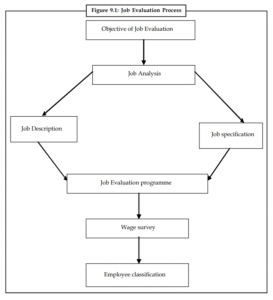
The Job Evaluation Process
The process is a logical flow that transforms job data into a wage structure.
Job Analysis: Collecting data via questionnaires, interviews, or observation.
Job Description: A written statement of what the job holder does.
Job Specification: A statement of the human qualities required to do the job.
Job Evaluation Programme: Choosing the method (Ranking, Point, etc.) to assess the jobs.
Employee Classification: Grouping similar jobs into grades or categories.
Wage Survey: Checking market rates for “Key Jobs” to ensure external competitiveness.
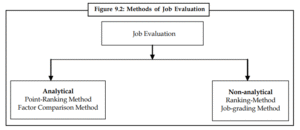
Methods of Job Evaluation
Methods are broadly classified into Non-Analytical (Qualitative) and Analytical (Quantitative).
A. Non-Analytical Methods (Qualitative)
These methods treat the job as a whole and do not break it down into detailed factors.
1. Ranking Method
This is the simplest form. The committee assesses the worth of each job based on its title or content and arranges them in order of importance.
Example: CEO > Manager > Clerk > Peon.
Pros: Easy and cheap for small companies.
Cons: Very subjective; doesn’t say how much more valuable one job is than another.
The 5-Step Mechanism:
Preparation of Job Description: Essential to resolve disagreements among raters.
Selection of Raters: Usually a committee. Jobs are often ranked by department (clusters) to avoid comparing dissimilar jobs (e.g., factory vs. clerical).
Selection of Key Jobs (Benchmark Jobs): 10 to 20 representative jobs are selected first to establish a rough rating scale.
Ranking of All Jobs: All other jobs are compared to the Key Jobs and ranked from “lowest to highest.”
Job Classification: The ranked list is divided into groups (usually 8 to 12), and wage ranges are assigned to each group.
Factors used for Ranking:
Supervision of subordinates.
Cooperation with associates.
Probability/Consequences of errors.
Minimum experience requirement.
Minimum education required.
Pros & Cons:
Merit: Simple, inexpensive, less time-consuming.
Demerit: Subjective (based on personal bias), does not tell how much more valuable one job is than another.
2. Job Classification (Grading) Method
In this method, the number of grades is decided first, and then jobs are fitted into these grades. This is common in Government jobs.
The 5-Step Mechanism:
Job Description: Gather basic job info.
Grade Description: Define specific levels or grades (e.g., Grade 1 = Routine work, Grade 2 = Skilled work). Each grade must be distinct.
Selection of Key Jobs: Select 10-20 jobs covering all departments.
Grading Key Jobs: Assign key jobs to appropriate grade levels.
Classification: All remaining jobs are matched against the grade definitions and classified.
Pros & Cons:
Merit: Administratively easy for pay determination. Widely used in government services.
Demerit: Rigid system. It is difficult to write grade descriptions that fit a large, diverse organization.
B. Analytical Methods (Quantitative)
These methods break jobs down into components (factors) and assign scores.
3. Point Ranking Method
This is the most widely used and systematic method.
The 5-Step Mechanism:
Select Job Factors: Choose compensable factors like Skill, Responsibility, Effort, and Working Conditions.
Construct a Scale: Assign point values to each factor (e.g., Skill = 50% weight). Divide factors into degrees (Degree 1, Degree 2) and assign points to degrees.
Evaluate Jobs: Analyze every job and award points for each factor based on the scale.
Design Wage Structure: Sum the points to find the total job worth.
Adjust Wages: Convert points into monetary values.
Pros & Cons:
Merit: The worth is determined by distinct factors, not just “overall feel.” It is systematic and easy to explain to employees.
Demerit: Developing the point scale is complex and time-consuming.
4. Factor Comparison Method
This method ranks jobs by comparing them factor-by-factor against “Key Jobs.”
The 5 Universal Factors Used:
Mental Requirements
Skill Requirements
Physical Exertion
Responsibility
Job Conditions
Mechanism: Instead of points, this method often assigns a monetary value to each factor. Each job is ranked against others for each of the five factors individually.
Pros & Cons:
Merit: Can evaluate unlike jobs (manual vs. clerical) using the same set of factors.
Demerit: Highly complicated and expensive to install.