Selling vs. Marketing Key Differences & The Modern Marketing Concepts (BBA/MBA)
Selling vs. Marketing: Aren’t They the Same Thing?
In everyday conversation, people often use the terms “selling” and “marketing” interchangeably.
However, in the world of business, they are fundamentally different.
At its simplest:
-
Selling is the action of converting a product into cash.
-
Marketing is a much broader process of identifying and satisfying customer needs.
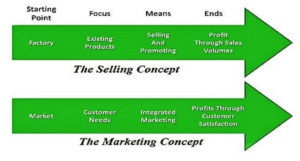
This can be visualized as two different paths to profitability:
Key Differences at a Glance
Here is a detailed breakdown of the core differences between the two philosophies:
What is a Marketing Concept? 🤔
A company’s marketing concept, also known as its marketing orientation, is its core philosophy for achieving business success. It’s the mindset that drives all strategic decisions, from product development to sales. This philosophy has evolved significantly since the late 19th century, moving from a focus on the factory to a focus on the customer.
these are 5 main stages of modern marketing concept:
1. The Production Concept 🏭
This is one of the oldest philosophies in business.
-
The Core Idea: Customers will prefer products that are widely available and inexpensive.
-
The Company’s Focus: The main goal is to achieve high production efficiency, cut costs, and enable mass distribution. The management often comes from an engineering or manufacturing background.
-
When It Works Best: This concept is effective when demand in the market is much higher than the supply, or when customers are very price-sensitive and care more about getting the product than its features. It’s still relevant in many developing economies.
Example: In India, The National Textile Corporation (NTC) operates on this philosophy, aiming to provide affordable clothing for the nation’s large population. Globally, Intel for many years focused on mass-producing its processors to make each new version cheaper and more accessible.
2. The Product Concept 💡
This concept represents a shift from quantity to quality.
-
The Core Idea: Customers will favor products that offer the highest quality, best performance, and most innovative features.
-
The Company’s Focus: Managers concentrate on making superior products and continuously improving them. This is often driven by technological advancements in the lab, a model known as the “Technology Push Model”.
-
The Big Risk: The company can become so focused on its product that it forgets to check if customers actually want or understand the new features. A great invention might fail if the market isn’t ready for it.
Example: Onida introduced its “Golden Eye Technology” in televisions to the Indian market, but customers couldn’t perceive the benefit at the time. Later, when customers were more tech-savvy, LG successfully launched similar technology and won the market.
3. The Selling Concept 📢
This approach is based on the fear that if left alone, customers won’t buy enough.
-
The Core Idea: The key to success is to undertake aggressive selling and promotion efforts. The goal is to sell what the company makes, rather than making what the market wants.
-
The Company’s Focus: The most important activities are personal selling and advertising, often using a “hard sell” approach. This is common for “unsought goods”—products people don’t actively think about buying, like insurance.
-
The Big Risk: A hard sell might lead to a sale today, but if the product doesn’t live up to the hype, it can create dissatisfied customers who may “bad-mouth” the company, harming long-term relationships.
Example: The aggressive tactics sometimes used to sell credit cards or insurance policies are a classic example of the selling concept in action.
4. The Marketing Concept 🎯
This is the foundation of modern marketing and represents a major shift in business thinking.
-
The Core Idea: A company can only achieve its goals by identifying the needs and wants of a target market and then delivering the desired satisfaction more effectively and efficiently than competitors.
-
The Company’s Focus: Instead of trying to find customers for an existing product, the focus is on making the right product for the customer. The key questions become:
-
What do our customers really want?
-
Can we develop it for them?
-
How do we keep them satisfied?
-
Example: The Indian auto industry is a perfect case study. For decades, companies like Hindustan Motors and Premier Automobiles operated on a production concept, selling outdated models because demand was high and choice was low. A customer might have to wait five to ten years for a Bajaj scooter. The entry of customer-focused Maruti changed everything. The old companies couldn’t compete, and now almost every auto manufacturer is desperately trying to understand and please the Indian customer.
5. The Societal Marketing Concept 🌍
This is the most advanced and modern marketing philosophy. It extends the marketing concept by adding a crucial third dimension: society’s well-being.
-
The Core Idea: The organization should deliver value to customers in a way that maintains or improves both the customer’s and society’s long-term well-being.
-
The Company’s Focus: It’s about balancing three key pillars: Company Profits, Customer Satisfaction, and Public Interest (Society). This concept asks if a product that is good for the customer is also good for society in the long run.
-
When It Works Best: This is ideal for modern companies that want to build a sustainable and ethical brand reputation.
Example: A company that sells organic vegetables in biodegradable packaging is practicing societal marketing. It satisfies the customer’s need for healthy food (Customer Satisfaction), it makes money from sales (Company Profits), and it promotes environmental sustainability (Societal Well-being).
The Three Principles of the Marketing Concept
-
Customer-Oriented Planning: All company activities, in every department, should be focused on satisfying customer needs.
-
Coordinated Efforts: All marketing functions (product, price, distribution, promotion) must be integrated and work together consistently.
-
Achieving Company Goals: The reward for satisfying customers is achieving the company’s goals of sales and profits, which are necessary for survival and growth.
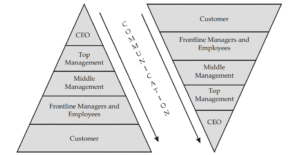
Putting the Customer on Top: The Inverted Pyramid
To truly adopt the marketing concept, a company must flip its traditional organizational structure. In this model, the customers are at the top, followed by the frontline employees who serve them. Top management is at the bottom, supporting the rest of the organization in its mission to create satisfied customers