What is Consumer Behavior? Buying Motives, Process & its Influencing Factors
Understanding Consumer Markets & Buying Behaviour
In marketing, the consumer is king. Understanding why, when, and how consumers buy is the most critical task for any marketing manager. Consumer Behavior is the study of the acts of individuals involved in obtaining and using goods and services, including the decision-making processes that precede and follow these acts.
The goal is to answer the ultimate question: Why does a consumer buy?
1. Types of Consumer Markets
Consumer markets can be categorized based on the products they sell:
Fast-Moving Consumer Goods (FMCG): Low value, high volume, and fast repurchase (e.g., Soaps, Juices, Chocolates).
Consumer Durables: High value, low volume, and used for a long time (e.g., TV, Fridge, Gaming Consoles).
Soft Goods: Similar to durables but wear out faster (e.g., Clothes, Shoes).
Services Market: Intangible products (e.g., Teaching, Parlors, Childcare).
Markets can also be classified by Area (Local, National, International), Time (Short/Long period), and Competition (Perfect, Imperfect).
2. Types of Customers in the Market
Not all customers behave the same way. Based on purchase habits, we can identify five types:
Loyal Customers: They buy the same brand repeatedly. Marketers must communicate with them regularly to keep them happy, as they are likely to recommend the brand to others.
Discount Customers: They buy based on price or sales. They help turnover inventory but can increase costs due to higher return rates.
Impulse Customers: They make purchase decisions at the moment of buying (e.g., picking up a candy bar at checkout). They are a great source of insight.
Need-Based Customers: They buy only to fulfill a specific need. If they don’t find what they need, they leave immediately. They are harder to please but are the greatest source of long-term growth.
Wandering Customers: They make up the largest traffic in a retail store but the smallest percentage of sales. They visit stores more for the experience or location than to buy.
The Consumer Buying Decision Process (5 Stages)
A consumer goes through a specific journey before making a purchase.
Stage 1: Need Recognition & Problem Awareness
The process starts when a consumer realizes a gap between their current state and their desired state.
Internal Stimuli: Hunger, thirst, or basic needs.
External Stimuli: Seeing an ad, smelling food, or admiring a friend’s new car.
Marketer’s Job: Identify the drive (motive) and arrange cues to trigger this need.
Stage 2: Information Search
Once the need is aroused, the consumer looks for information.
Internal Search: Memory and past experiences.
External Search:
Personal Sources: Family, friends (Most effective).
Commercial Sources: Ads, salespeople (Most informative).
Public Sources: Mass media, consumer ratings.
Experiential Sources: Handling or examining the product.
Stage 3: Evaluation of Alternatives
The consumer compares different brands based on product attributes (price, quality, features).
Cognitive Evaluation: Based on logic and objective criteria.
Affective Evaluation: Based on emotions and feelings.
Stage 4: Purchase Decision
The consumer forms an intention to buy. However, two factors can still interfere:
Attitude of Others: (e.g., a spouse disapproving of the purchase).
Unanticipated Situational Factors: (e.g., sudden job loss or the store is out of stock).
Stage 5: Post-Purchase Behavior
After buying, the consumer compares the product’s performance to their expectations.
Performance < Expectations: Dissatisfaction.
Performance = Expectations: Satisfaction.
Performance > Expectations: Delight.
Note: If a consumer is dissatisfied, they may return to Stage 1 but will likely exclude the brand they just bought from future choices.
Factors Influencing Consumer Behavior
A consumer’s decision is never made in isolation. It is influenced by four major factors.
1. Cultural Factors (The Broadest Influence)
Culture: The set of basic values, perceptions, and behaviors learned from family and society. (e.g., Indian culture values family and savings; American culture values individualism and consumerism).
Sub-Culture: Smaller groups with shared value systems (e.g., Punjabi vs. South Indian culture).
Social Class: Society’s ordered divisions (Upper, Middle, Lower) whose members share similar values and behaviors.
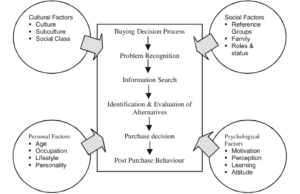
2. Social Factors
Reference Groups: Groups that influence a person’s behavior (e.g., friends, co-workers). Marketers try to target “Opinion Leaders” within these groups.
Family: The most important consumer buying organization in society. Buying roles are changing (e.g., children influencing car purchases).
Roles & Status: A person plays different roles (e.g., a father vs. a CEO). Each role carries a status that influences clothing, car, and lifestyle choices.
3. Personal Factors
Age & Life Cycle Stage: Tastes change with age. A bachelor’s spending differs vastly from a “Full Nest” family with young children.
Occupation: A blue-collar worker buys work clothes; a CEO buys suits.
Lifestyle: A person’s pattern of living as expressed in their AIO (Activities, Interests, Opinions).
Economic Situation: Income, savings, and borrowing power affect product choice.
4. Psychological Factors
Motivation: A need becomes a motive when it is strong enough to drive action.
Maslow’s Hierarchy of Needs: Explains that people satisfy needs in a specific order: Physiological -> Safety -> Social -> Esteem -> Self-Actualization.
Perception: How we select and interpret information. (e.g., If you perceive a brand as “premium,” you act accordingly).
Learning: Changes in behavior arising from experience.
Beliefs & Attitudes: Descriptive thoughts (beliefs) and enduring evaluations (attitudes) about brands. These are hard to change.
Summary: Why Study Consumer Behavior?
To segment the market effectively.
To design a better marketing mix (Product, Price, Place, Promotion).
To assess new market opportunities.
Ultimately, because The Consumer is King. Ignoring their preferences leads to failure.