E-Retailing: Components, Advantages, Challenges & Traditional vs Online Retail Notes | Revision Notes
E-retailing (or online retailing) is the sale of goods and services through the internet. It has revolutionized traditional business operations by allowing customers to shop from the comfort of their homes.
So, e-tailing is basically just the online selling of goods to consumers, kind of like electronic retail. E-commerce, on the other hand, is much broader. It includes any commercial activity done online, whether it’s selling things wholesale, financial services, or even marketing. So you could say e-tailing is a part of e-commerce.
1. Key Components of E-Retailing
For an e-retail business to be successful, several essential ingredients (components) must be integrated:
-
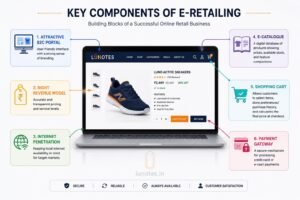
Attractive B2C Portal: User-friendly interface with a strong sense of branding.
-
Right Revenue Model: Accurate and transparent pricing and service levels.
-
Internet Penetration: Keeping local internet availability in mind for target markets.
-
E-Catalogue: A digital database of products showing prices, available stock, and feature comparisons.
-
Shopping Cart: Allows customers to select items, store preferences/purchase history, and calculates the final price at checkout.
-
Payment Gateway: A secure mechanism for processing credit card or e-cash payments.
-
Support Services (Crucial for online/offline processing):
-
Communication backbone
-
Payment mechanism
-
Order fulfillment
-
Logistics
-
2. Advantages of E-Retailing
E-tailing provides massive opportunities compared to traditional brick-and-mortar stores.
-
Price and Selection: Easy online price comparisons and quick deals.
-
New Markets: Overcomes physical boundaries to reach a global audience.
-
Home Shopping Experience: Unmatched convenience and comfort.
-
Business Leverage: Allows existing retailers to grow revenues without building new physical infrastructure.
-
Valuable Insights: E-commerce software tracks consumer behavior to understand shopping patterns.
-
24/7 Shopping: Removes the barriers of time and space. Open all day, every day.
-
Reasonable Cost: Highly cost-effective; eliminates the need to pay heavy rent for mall or storefront spaces.
3. Shortcomings (Disadvantages) of E-Retailing
Despite its growth, online retail faces several consumer-level drawbacks:
-
Lack of Emotional/Family Experience: Misses the weekend or festive joy of physically shopping with family.
-
Intangible Merchandise: No sensory support. Customers cannot touch, feel, or smell the product before buying.
-
Security Fears: Reluctance to share credit/debit card details due to fear of misuse.
-
Impersonal Service: Lacks the tangible, personalized service of a traditional store.
-
Fear of Fraud: Inability to physically inspect goods creates a lingering sense of doubt regarding quality.
4. Major Challenges in E-Retailing
Running an e-retail business is complex. E-tailers face several systemic and operational challenges:
A. Conflict Management
-
Channel Conflict: Levi’s has physical stores and also sells its clothes in other department stores. Now, if Levi’s starts selling directly online, it might undercut those other stores, because they might have to compete with Levi’s directly. Those stores might get upset and feel like Levi’s is their competitor instead of a partner, and that’s what creates a “channel conflict.
-
Internal Conflicts: Friction within a click-and-mortar (It’s basically a business model that combines physical stores with online sales. So, you could browse products online and then go pick them up in person, or order them on the website and have them delivered.) organization regarding pricing, advertising budgets, and logistics (e.g., offline stores handling returns for online purchases).
B. Operational & Financial Challenges
-
Order Fulfillment & Logistics: The difficulty of shipping small quantities to a massive number of buyers, alongside managing returned items.
-
Viability & Risk: “Pure-play” online retailers often struggle with customer acquisition, intense competition (especially in books/CDs), and financing losses before becoming profitable.
-
Revenue Models: The failure of early dot-coms that sold goods below cost while relying purely on advertising revenue.
C. Systemic & Legal Challenges
-
Changing Business Processes: E-retailing requires bypassing traditional rules (like warehouse inspections) and relying heavily on localized suppliers for direct delivery.
-
Legal Issues & Taxation: Complexities regarding the validity of digital signatures, copyright laws, and varying Value Added Tax (VAT) rules, since the place of billing, dispatch, and delivery often fall in different tax jurisdictions.
-
Security & Privacy: The constant threat of website hacking, data pilferage, and cyber criminals stealing passwords and banking info. Payment gateways must have multiple layers of security.
Quick “Traditional vs. E-Retailing” Concept check
Traditional: Tangible goods, sensory experience, high rent, limited store hours, restricted physical reach. E-Retailing: Intangible virtual display, data-driven insights, 24/7 operations, global reach, high logistics complexity.
Found a mistake? We work hard to ensure all notes are 100% accurate but still If you spot an error or have a suggestion, please [click here to report it].
By LuNotes – crafted with love. ❤️