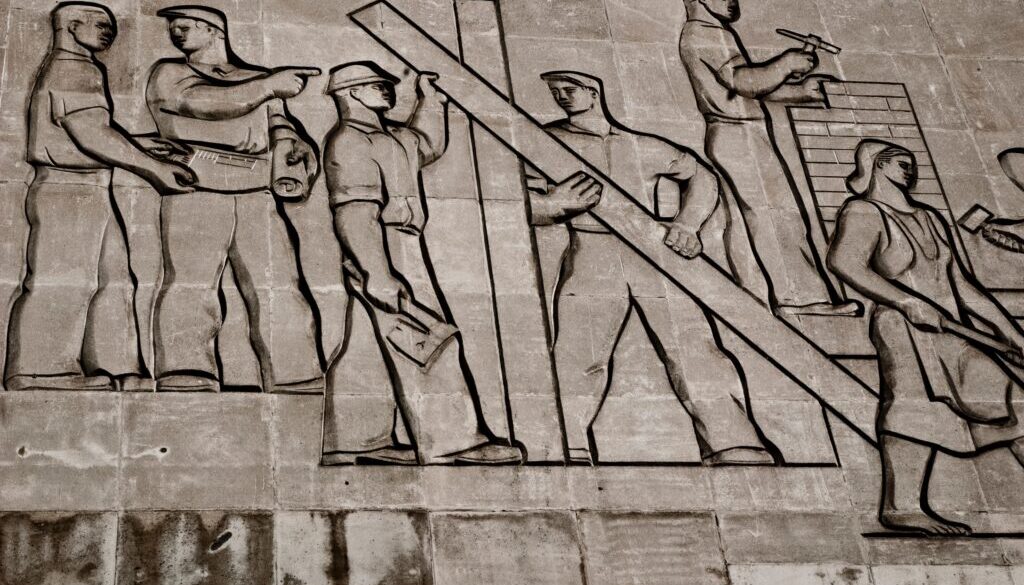
Trade Unions, Industrial Disputes, and the Trade Unions Act 1926 | Complete BBA Semester Revision Notes
1. Meaning, Features & Functions of Trade Unions
A Trade Union is a continuous association of wage earners formed primarily to maintain and improve their working conditions. It operates on the core labor philosophy: “United we stand, divided we fall.”
Key Definition (High MCQ Importance)
Section 2(h) of the Trade Unions Act, 1926: Defines a Trade Union as any combination, whether temporary or permanent, formed primarily for regulating relations between:
Workmen and employers
Workmen and workmen
Employers and employers
OR for imposing restrictive conditions on the conduct of any trade or business (includes federations of two or more trade unions)
A Trade Union has the legal power to set strict limits on how a boss runs their business to protect workers.
It stops companies from doing whatever they want—like forcing 14-hour days or replacing staff with cheap contract labor overnight.
This same legal power applies to Federations, which are massive networks of smaller unions joined together to set rules for an entire industry.
Dual Classification of Functions & Core Principles
The Two Types of Union Functions
-
Militant / Protection Functions (The Sword): Aggressive actions used when peaceful talks fail. This includes going on strikes or staging gheraos (surrounding the boss) to force management to give better pay or working conditions.
-
Fraternal / Positive Functions (The Shield): Friendly support system funded by worker fees. It helps workers by providing money when they are sick, injured, or temporarily unemployed, and organizes fun activities or classes.
The 4 Core Principles
-
Doctrine of Vested Interest: What’s already ours stays ours. Bosses cannot change existing benefits or working conditions for the worse.
-
Doctrine of Supply and Demand: Power in numbers. By grouping together, workers control the labor supply, forcing the boss to negotiate instead of hiring cheap replacement labor.
-
Doctrine of Living Wage: Workers have a moral right to earn enough money to live a normal, decent life with their families—not just survive.
-
Doctrine of Partnership: Workers are equal partners in the business. They have an equal right to work, enjoy leisure time, get retirement pay, and receive equal pay for equal work.
2. Theoretical Foundations of Trade Unions (The 7 Approaches)
1. Social-Psychological Approach (Robert F. Hoxie)
-
Core Idea: Unions don’t just form because of money. They form because groups of people who think alike face the same bad environment and bond together emotionally.
-
Hoxie’s 4 Types of Unions:
-
Business Unionism: Pure “Bread-and-Butter.” Only cares about immediate goals like higher pay and fewer hours. No interest in politics.
-
Friendly or Uplift Unionism: Idealistic. Wants to improve the worker’s intellectual and moral life through education, insurance, and profit-sharing.
-
Revolutionary Unionism: Class warfare. Rejects the boss-worker system entirely and wants to destroy private property using general strikes and violence.
-
Predatory Unionism: Ruthless and lawless. Cares only about quick results and will use any method (peaceful or violent, honest or crooked) to get them.
-
2. Sociological Approach (Frank Tannenbaum)
-
Core Idea: A worker’s fight against the machine. Industrial machines make workers feel like a replaceable cog, creating deep insecurity.
-
The Fix: The union gives the worker back their dignity, friendship, and control over the machine. The factory floor itself is what creates the union, not outside troublemakers.
3. Scarcity Consciousness Approach (Selig Perlman)
-
Core Idea: Workers are driven by a fear of missing out (Job Consciousness).
-
The Fix: Workers naturally believe that good job opportunities are limited (scarce). Therefore, they form a union to collectively guard, ration, and protect those few available jobs for themselves.
4. Industrial Democracy Approach (Sidney & Beatrice Webb)
-
Core Idea: Bringing democracy into the workplace. Just like citizens use votes to clear out political dictators, workers use a trade union to clear out managerial dictators. It uses collective bargaining to make workers and bosses equals.
5. Classless Society Approach (Karl Marx)
-
Core Idea: Weapons of revolution. Capitalism naturally forces bosses to exploit workers, creating a class struggle. Marx warned that unions shouldn’t get distracted by small goals like a 5% raise; their true ultimate goal must be to completely abolish the boss-and-wage system.
6. Gandhian Approach
-
Core Idea: Truth and Non-Violence (Sarvodaya). Bosses and workers are family partners, not enemies. Workers have a right to see company financial books. Strikes are allowed only as a final resort and must follow a strict three-step chain:
3. Structure and Membership Typologies in India
Structural Hierarchy (The Chain of Command)
Unions flow from top-level political policy down to the actual workplace level:
-
National Central Federations: The top apex body. Handled by big politicians; decides political ideology.
-
Provincial/State Bodies: Mid-level teams managing state-specific rules.
-
Local/HQ Unions: The actual on-the-ground agents that sit down with factory bosses to negotiate contracts.
The 4 Membership Categories
-
Craft Union (Horizontal): Joins workers who do the exact same job, even if they work in different industries (e.g., Indian Pilots Guild). They care about their specific trade, not class struggle.
-
Industrial Union (Vertical): Joins everyone inside the same industry, no matter what their specific job is (e.g., Kanpur Suti Mill Mazdoor Sabha where cleaners, weavers, and clerks are in the same union). This builds powerful unity.
-
Staff Union: Exclusively for white-collar, professional, and office employees.
-
General Union: Opens the doors to any worker from any industry or skill level. Its power comes from pure numerical strength.
4. Historical Milestones & Chronological Revision Periods(Not very important for the exam want to read you can read it)
Major Historical Milestones
-
1877: First Strike in India hits Empress Mills in Nagpur after bosses cut wages.
-
1881: First Factories Act passed. It mostly protected British businesses, failing to stop child labor or help women.
-
1890: First Workers’ Group formed. Narayan Lokhande (Father of India’s Trade Union Movement) founded the Bombay Mill Hands’ Association and started the labor journal Dinbandhu.
-
1906: First permanent union attempt started by Post Office workers in Bombay and Calcutta.
-
1918: B.P. Wadia sets up the Madras Labor Union, forming the first proper modern union.
-
1920: Anusuyaben Sarabhai and Mahatma Gandhi found the Textile Labor Association (TLA) in Ahmedabad as a test lab for peaceful labor relations.
-
1920: AITUC (All India Trade Union Congress) is formed to send Indian leaders to global meetings. Lala Lajpat Rai is its first President.
-
1929: The Great Split. Moderate leaders left AITUC because communists were taking over. They rejoined in 1940 after agreeing to keep international politics out of it.
-
Post-1947 (Political Splits): Political parties created their own loyal unions—INTUC (by Congress for peaceful means) and HMS (by Socialists for a socialist society).
The 6 Historical Eras (MCQ Cheat Sheet)
-
Pre-1918 (Social Reform Phase): Rich philanthropists try to help workers. 1911 law limits factory work to 12 hours a day.
-
1918–1924 (The Birth Era): Prices skyrocketed after WWI, forcing workers to build proper unions. AITUC born in 1920.
-
1925–1934 (The Split Era): Political fights between Leftists and Rightists. Important laws passed: Trade Unions Act (1926) and Trade Disputes Act (1929) which banned general public strikes.
-
1935–1938 (The Unity Era): Fragmented unions join back together. The 1938 Bombay Act sets up the first permanent labor court.
-
1939–1946 (WWII Chaos): The government uses emergency Rule 81A to ban strikes and force legal settlements so war production doesn’t stop.
-
Post-1947 (The Modern Multiplicity): Unions break into multiple groups based on political party lines (INTUC, HMS, BMS, CITU).
-
Indian Labour Conference (ILC): The biggest top-level advisory team formed in 1942. They created the formulas for setting minimum wages.
7. Trade Union Rivalry and Compulsory Recognition
Inter-Union vs. Intra-Union Rivalry
-
Inter-Union Rivalry (Between Two Unions): Two separate, competing unions fight inside the same company to win over the workers. This is usually backed by rival political parties.
-
Intra-Union Rivalry (Internal Infighting): Two internal factions inside the same exact union fight over who gets to be the president or handle the money (like the Paradip Port case, where two leaders filed separate financial returns claiming they were the real boss).
-
The Damage: This infighting destroys collective bargaining power, confuses management, and causes worker chaos.
The Truth About Union Recognition
-
CRITICAL EXAM FACT: Forcing an employer to recognize your union is NOT a Fundamental Right under Article 19(1)(c) of the Indian Constitution. The Constitution only guarantees your right to form a group, not your right to force a boss to sit down and talk to it (Kalindi v. Tata Locomotive).
-
State-Level Rules: Since there is no central national law for compulsory recognition, states made their own rules:
-
Maharashtra (1971 Act): Gives exclusive bargaining rights to the majority union and bars unrecognized unions from general talks.
-
Madhya Pradesh (1960 Act): A union must prove it has at least $25\% of the local workforce as members to get recognized.
-
C.P. and Berar Act (1947): Requires a steady membership of $15\% to $20\% for the past 6 months.
-
How to Qualify as the Majority Union (National Code)
-
Must be registered for at least 1 year.
-
Must have at least $15\% of the company’s workers signed up as members.
-
Must have zero recorded violations of the Code of Discipline in the past year.
-
Once recognized, no one can challenge that union’s status for at least 2 years.
Minority Unions (“Members-Only” Rights)
-
What it is: A smaller union that represents only the specific workers who join it, not the whole factory.
-
Their Rights: They cannot negotiate big company-wide contracts. However, by law, they do have a strict right to meet management to solve individual worker complaints or help their specific members during disciplinary inquiries (Bharat Forge case, 2010).
8. Size and Finance of Indian Trade Unions
Why are Indian Unions Small and Divided?
-
The 7-Worker Loophole: Section 4 of the Trade Unions Act says any 7 workers can form a union. This low number encourages anyone to start a mini-union, creating thousands of tiny, weak groups.
-
Declining Membership: Modern factories outsource work to non-union contractors, move plants to distant villages, or talk to employees directly, making traditional political unions less popular.
The Two Legal Money Funds (Trade Unions Act, 1926)
                       ┌──────────────────────────┐
                       │  TRADE UNION LEGAL FUNDS │
                       └────────────┬─────────────┘
                                    │
            ┌───────────────────────┴───────────────────────┐
            ▼                                               ▼
┌───────────────────────┐                       ┌───────────────────────┐
│     GENERAL FUND      │                       │    POLITICAL FUND     │
│     (Section 15)      │                       │     (Section 16)      │
├───────────────────────┤                       ├───────────────────────┤
│ • Mandatory Fee       │                       │ • 100% Voluntary      │
│ • Salaries, Audits    │                       │ • Election Campaigns  │
│ • Legal Court Costs   │                       │ • Political Pamphlets │
│ • Strike Compensation │                       │ • Public Meetings     │
└───────────────────────┘                       └───────────────────────┘
-
A. General Fund (Section 15): Mandatory. Collected from regular monthly member fees.
-
Can only be spent on: Staff salaries, audit fees, court costs, strike compensation, and worker welfare (pensions, sickness allowances, union newsletters).
-
-
B. Political Fund (Section 16): 100% Voluntary. Under the 2019 amendment, no worker can be forced to pay this. Choosing not to pay cannot be used to deny a worker their regular union benefits.
-
Can only be spent on: Financing election campaigns, buying political booklets, holding political rallies, or maintaining elected political members.
-
Methods to Improve Union Money
-
Follow the National Commission on Labour (NCL) advice to raise the minimum legal membership fee rate.
-
Use the Check-off System: An agreement where the employer directly deducts the union fee from the worker’s salary check and electronically transfers it to the union’s bank account.
9. Structural Sections of the Trade Unions Act, 1926 (NOT MUST TO READ 1 DAY BEFORE EXAM, IF YOU HAVE TIME MAKE SURE TO READ IT)
-
Section 3 (Appointing Registrars): The government appoints a official called the Registrar of Trade Unions for the state.
-
Section 4 (Mode of Registration): Any 7 or more members can apply. The application remains valid even if up to half ($50\%$) of the signers quit or walk away before the final registration date.
-
Section 5 (Application Details): You must send the application with the union rulebook, names of office-bearers, and a statement of your financial assets/liabilities if the union has been active for more than 1 year.
-
Section 6 (Minimum Fee): A union cannot register unless its rulebook states that the minimum subscription fee is at least 25 paise per month per member.
-
Section 7 (Name Changes): The Registrar can reject your registration if your union name matches or looks deceptively similar to an existing union.
-
Section 9 (The Certificate): The Registrar issues a registration certificate, which stands as absolute proof that the union is legally registered.
-
Section 10 (Canceling Registration): The Registrar can cancel a union’s license if the union asks for it, if they used fraud to register, or if they broke rules. A mandatory 2-month written notice must be given to the union first.
-
Section 11 (Appeals): If the Registrar rejects or cancels your union, you can appeal the decision in the High Court or a Principal Civil Court.
-
Section 13 (Body Corporate Status): Once registered, the union becomes a legal entity (Body Corporate). It gets a common seal, can own property, sign contracts, and can sue or be sued in its own name.
-
Section 14 (Exclusion of Other Acts): The Societies Registration Act, Co-operative Societies Act, and Companies Act do not apply to registered trade unions. Registering under them is legally blank and void.
The 3 Core Legal Immunities (The Shields against Lawsuits)
-
Section 17 (Protection from Criminal Conspiracy): Union leaders cannot be arrested for criminal conspiracy (Section 120B IPC) just for making plans or agreements to push a lawful labor strike, as long as they don’t break criminal laws or use violence.
-
Section 18 (Protection from Civil Suits): Employers cannot sue the union in civil courts for causing business/financial losses during a strike. Crucial Agent Clause: The union cannot be blamed or sued for a rogue member’s illegal actions if it’s proven the agent acted completely without the union’s knowledge or against explicit orders.
-
Section 19 (Enforceable Agreements): Union agreements are perfectly legal even if they technically put a “restraint on trade” (like limiting work hours).
Changing Union Formats
-
Section 21 (Minors): Anyone who turns 15 years old can legally become a union member and sign papers.
-
Section 23 (Name Change): Needs a vote of at least two-thirds ($2/3\text{rds}$) of the total union membership.
-
Section 24 (Amalgamation/Merging): To merge two unions, at least $50\%$ of all members must cast a vote, and at least $60\%$ of those votes must say “Yes.”
-
Section 25 (Notice): Written notices for name changes or merges must be signed by the Secretary and 7 members, then sent to the Registrar.
-
Section 27 (Dissolution/Closing down): A closing notice signed by 7 members and the Secretary must reach the Registrar within 14 days. If the union rules don’t explain how to distribute remaining cash, the Registrar is statutorily required to divide the remaining funds equally among all existing members.
Found a mistake? We work hard to ensure all notes are 100% accurate but still If you spot an error or have a suggestion, please [click here to report it].
By LuNotes – crafted with love. ❤️